[Orgs] 2 Organization management UI + role-aware permission gating (stacked on #267) - #268
[Orgs] 2 Organization management UI + role-aware permission gating (stacked on #267)#268amal66 wants to merge 35 commits into
Conversation


|
Went through the full diff — the core feature here is solid, but the PR bundles several independent changes worth calling out. Breakdown: 1. Backend pagination/search/sort (the stated scope)
2. Frontend lazy-load integration
3. Perf/schema work inside the migration that goes beyond pagination
4. State-management removal in
5. Shared
6. Drive-by logic fix in delete-selected (both pages)
Requested changes:
Happy to re-review quickly once that's done — #1 + #2 + the tests look good and I don't expect issues with the core approach. |

27208bc to
8cc1bf7
Compare

5157e02 to
3bc199e
Compare
3bc199e to
384c923
Compare
Rebase round, 2026-08-16Rebased onto the updated #267 (itself on current
Two commits added on top:
Verification
|
ebddef7 to
35ab80c
Compare

|
|
Live smoke evidence — 2026-08-18 rebaseRecorded end-to-end runs of the highest-risk RBAC behaviours against a full local stack (Next dev + backend + Supabase CLI stack, fresh browser contexts, two org users: an owner and a member). All five checks passed, and no request in any flow returned a 5xx. Each section below has an inline recording (GIF), key frames, and a link to the original video. Full asset set lives on
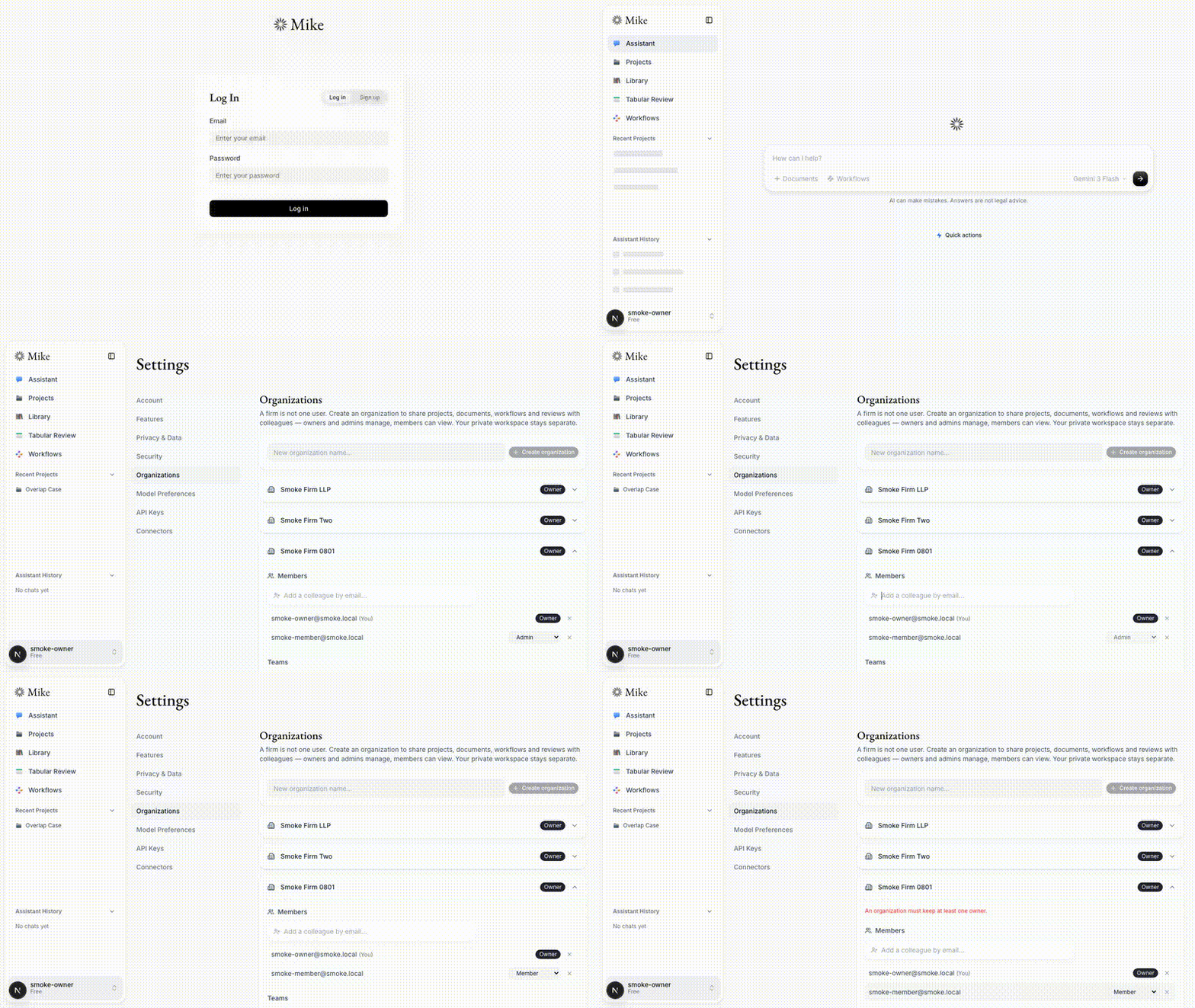
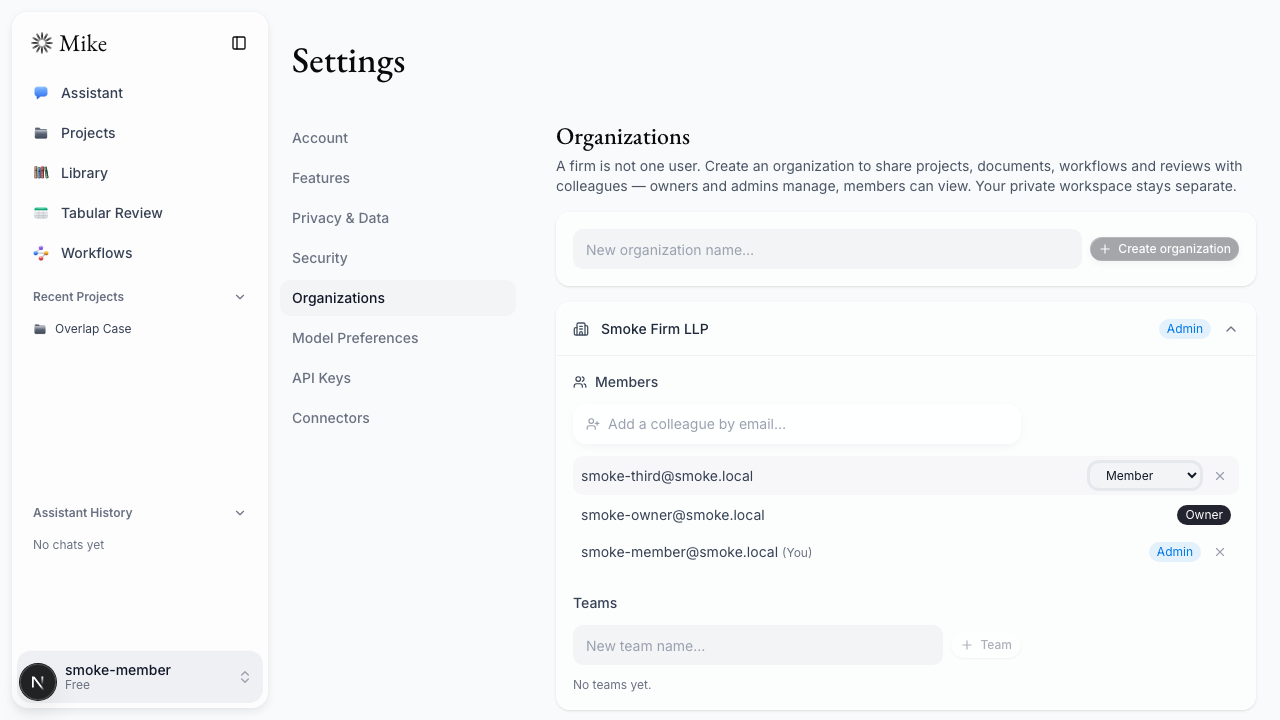
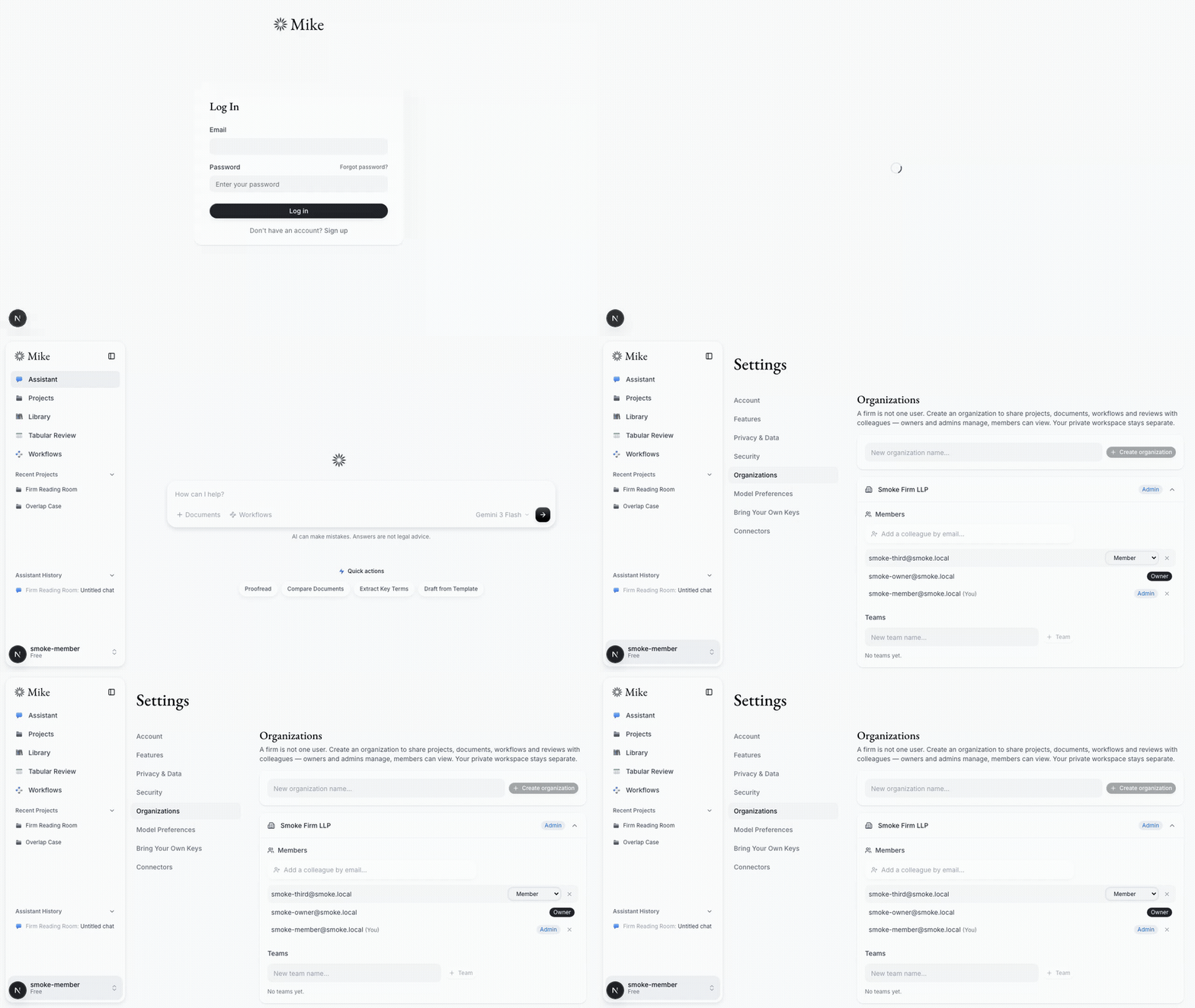
1 — Org lifecycle + last-owner denial (create org → add member by email → role Member↔Admin → leave as sole owner)
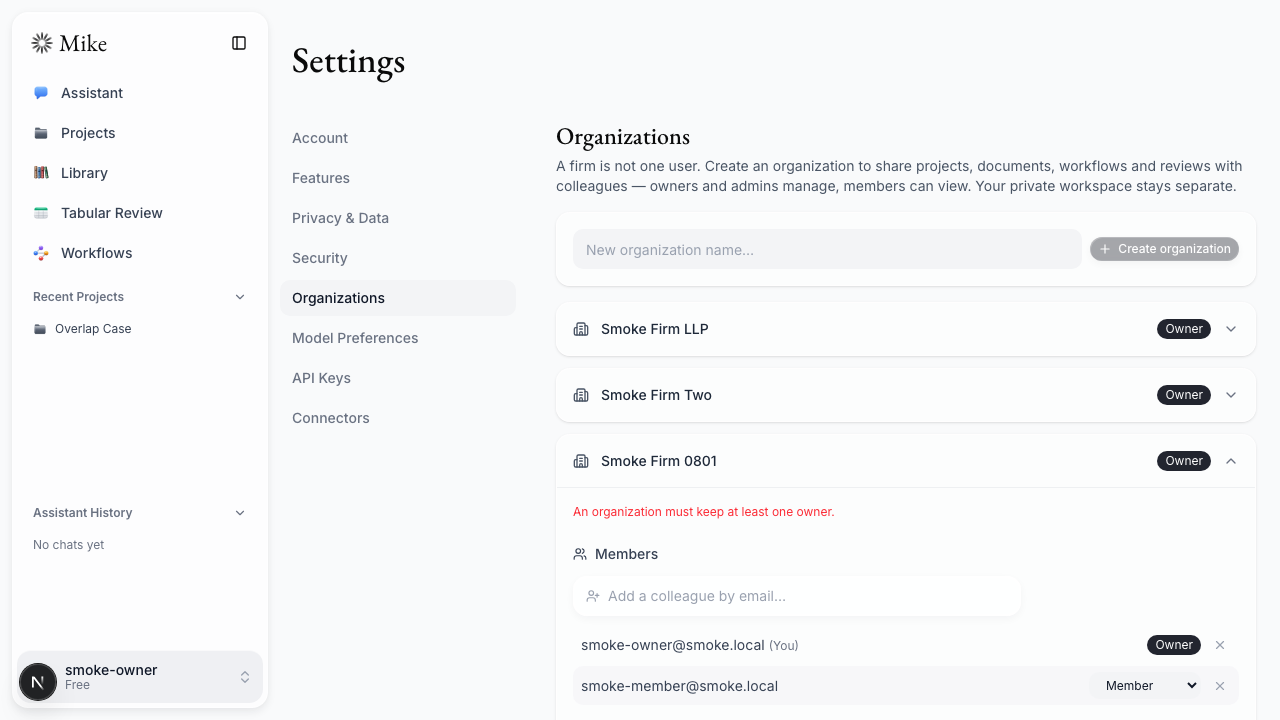
The leave attempt returns HTTP 409 (asserted on the DELETE response), the confirm popup closes, and the error renders inline in the org card:
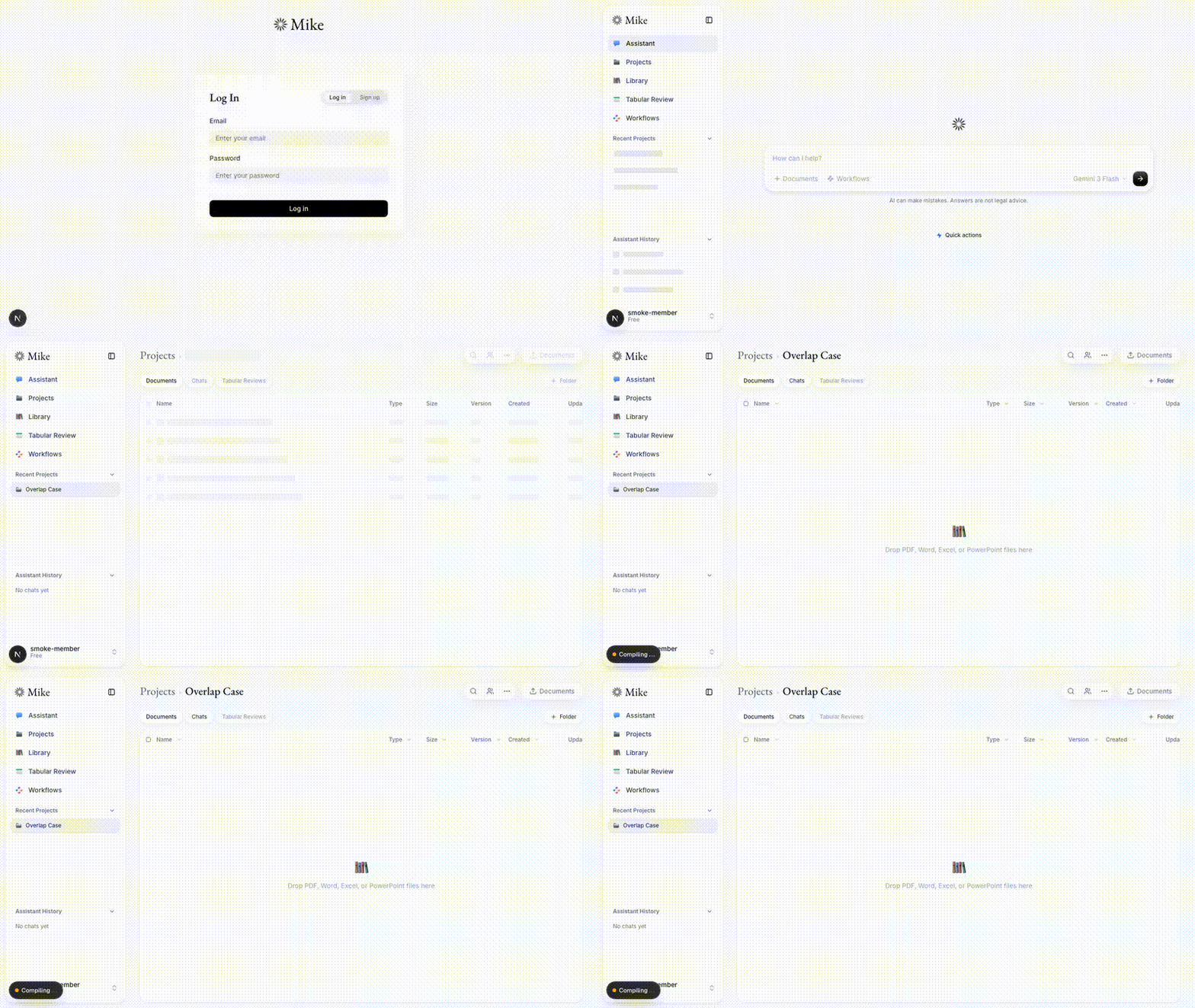
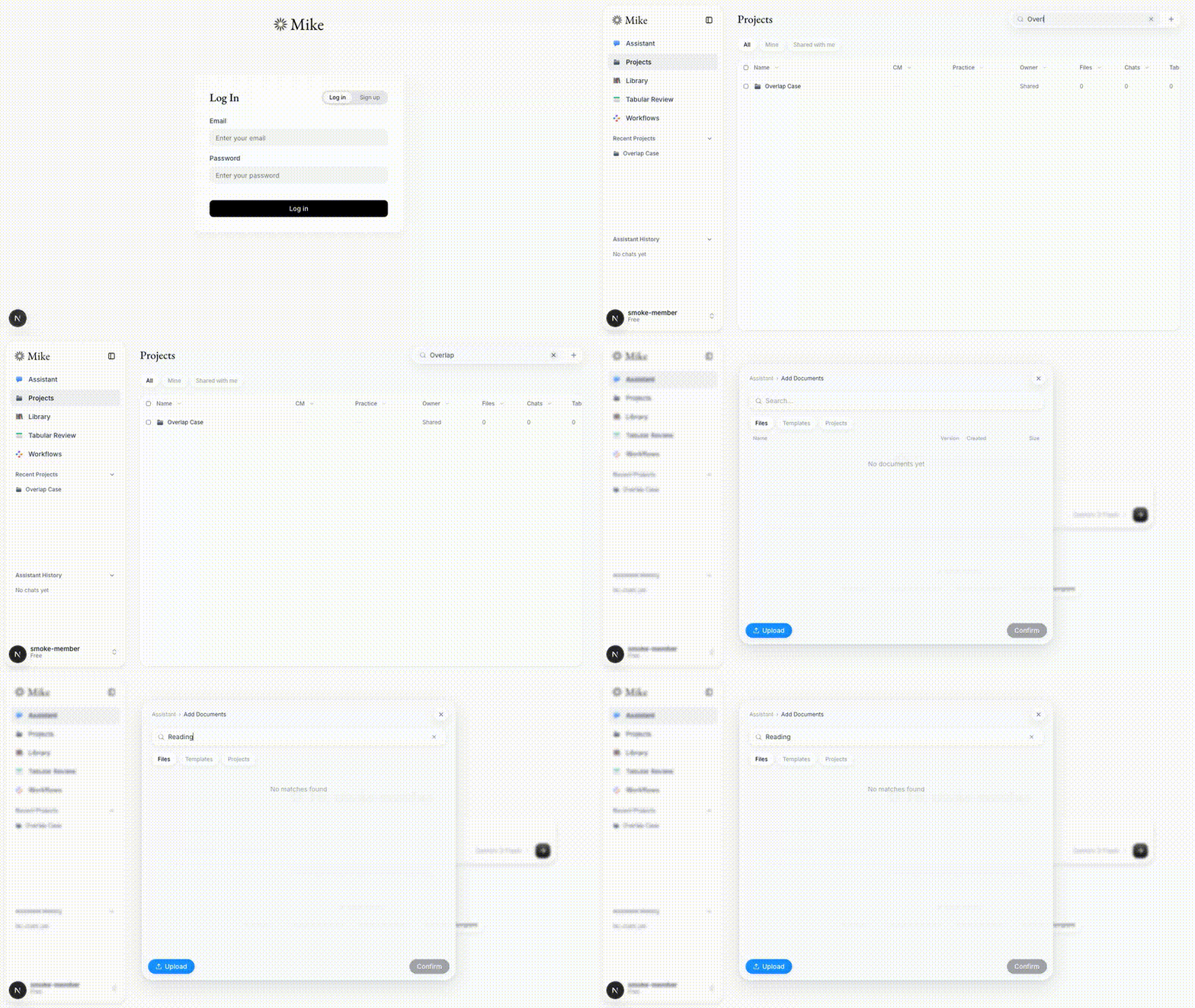
2 — Overlap keeps editor (member is org viewer AND direct-shared on “Overlap Case”)Precondition verified in the DB row:
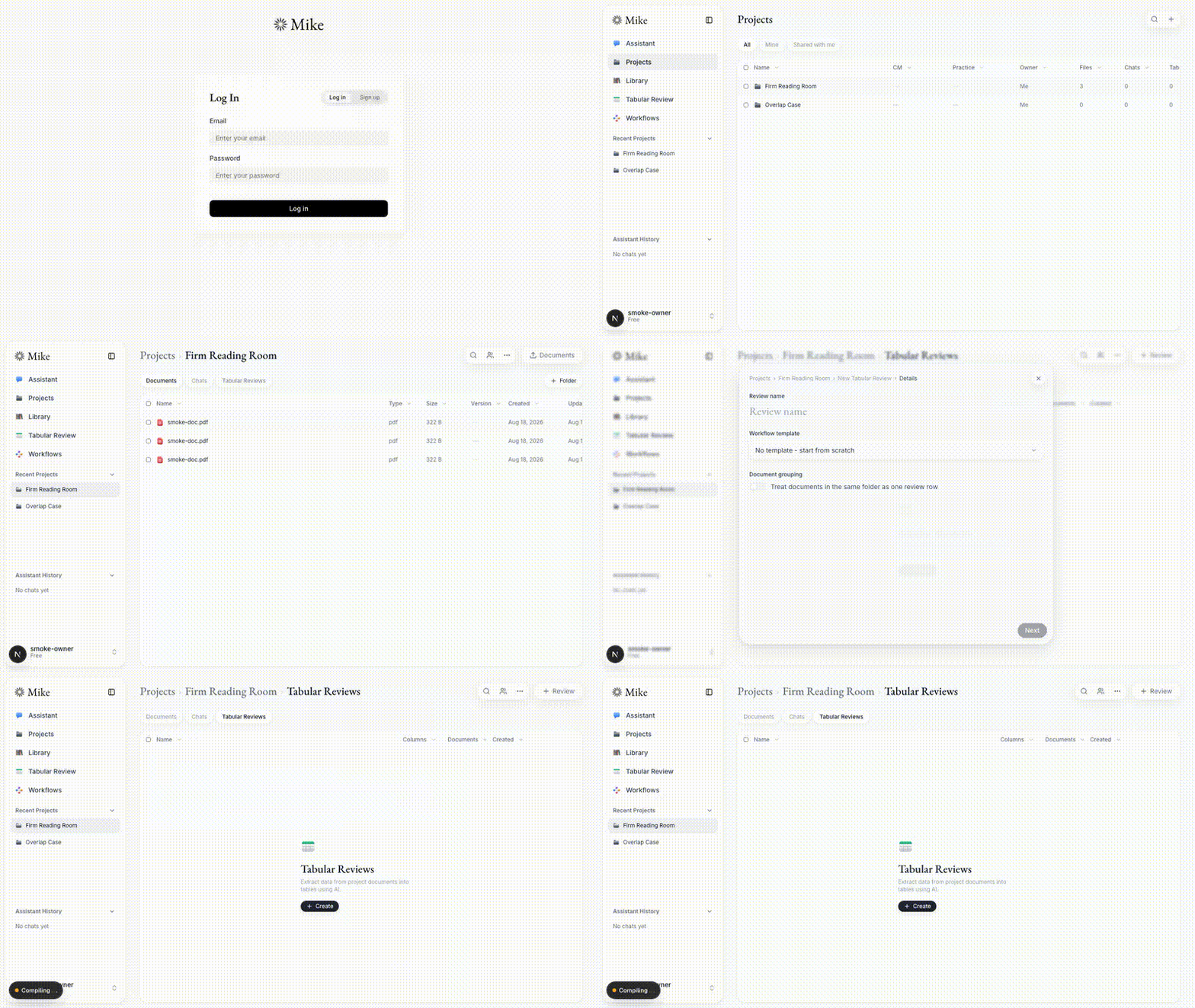
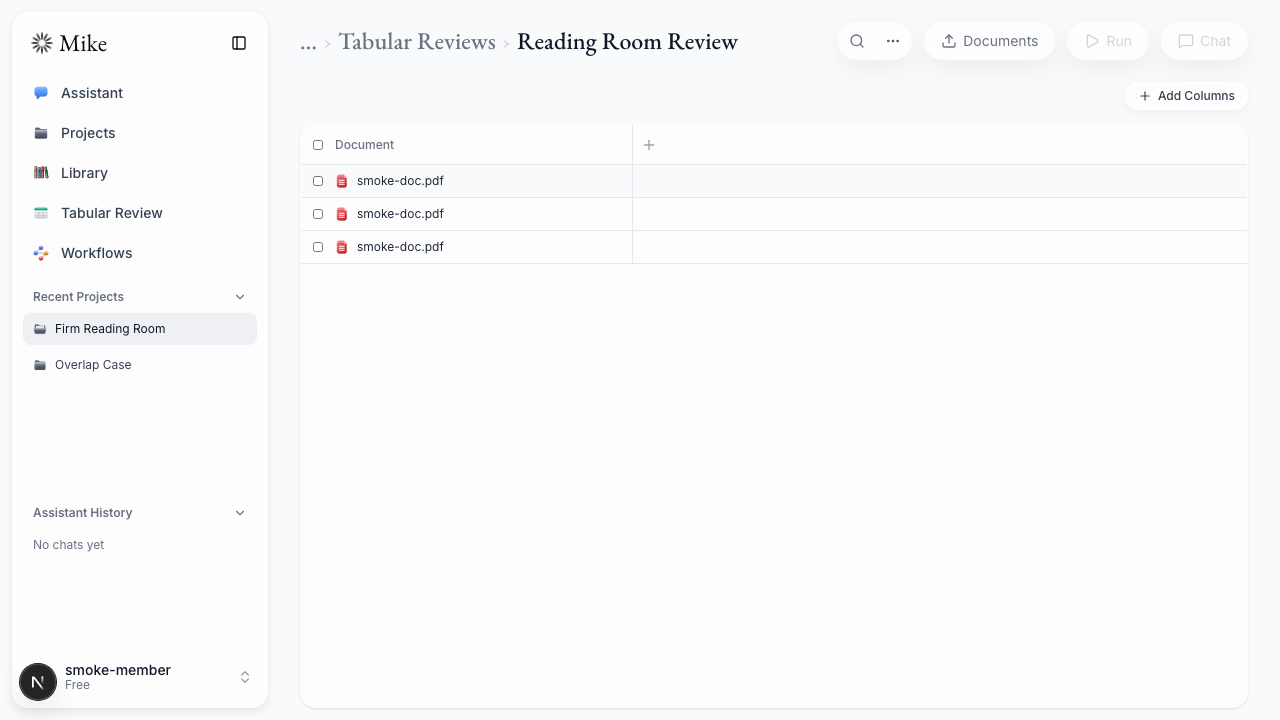
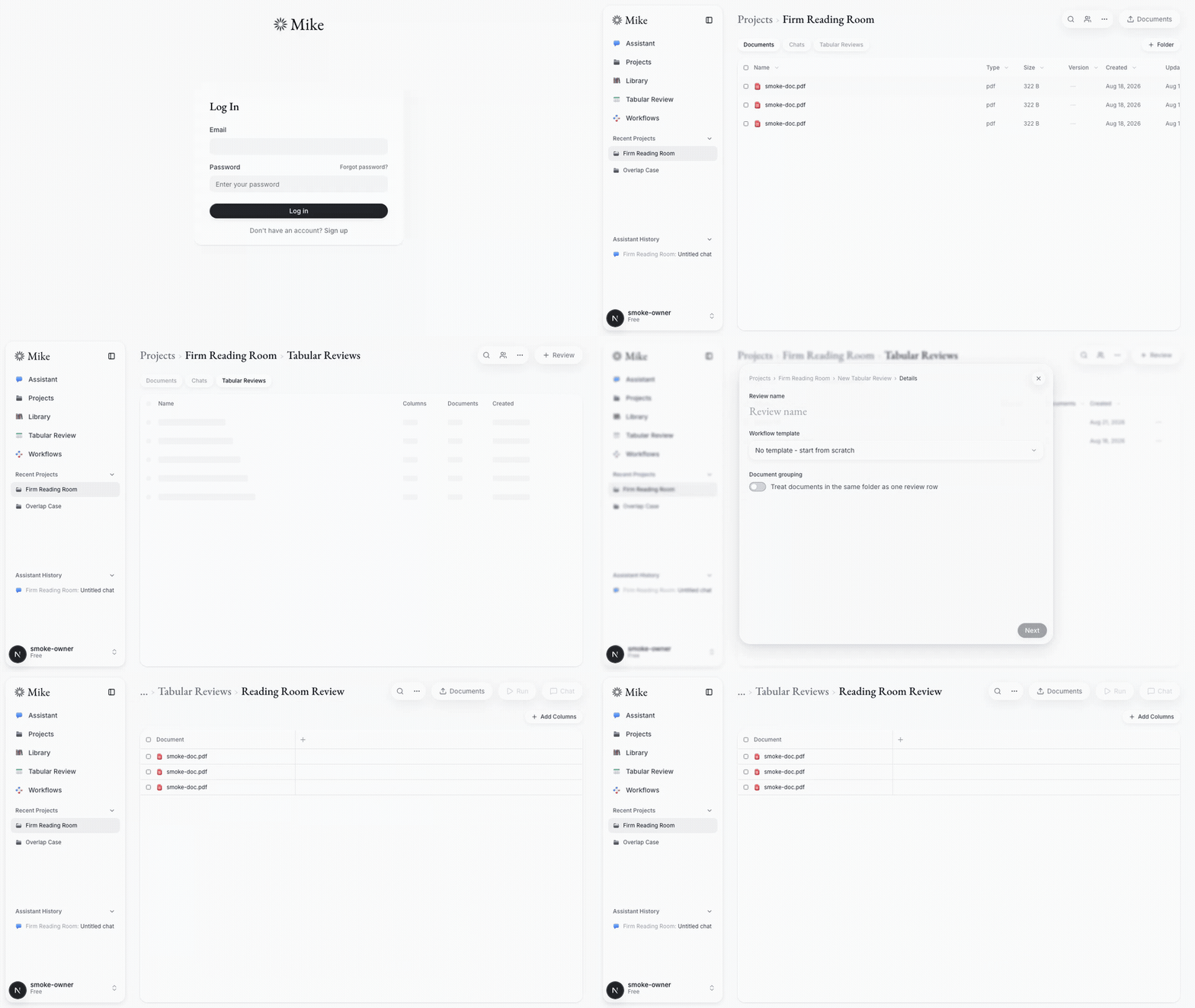
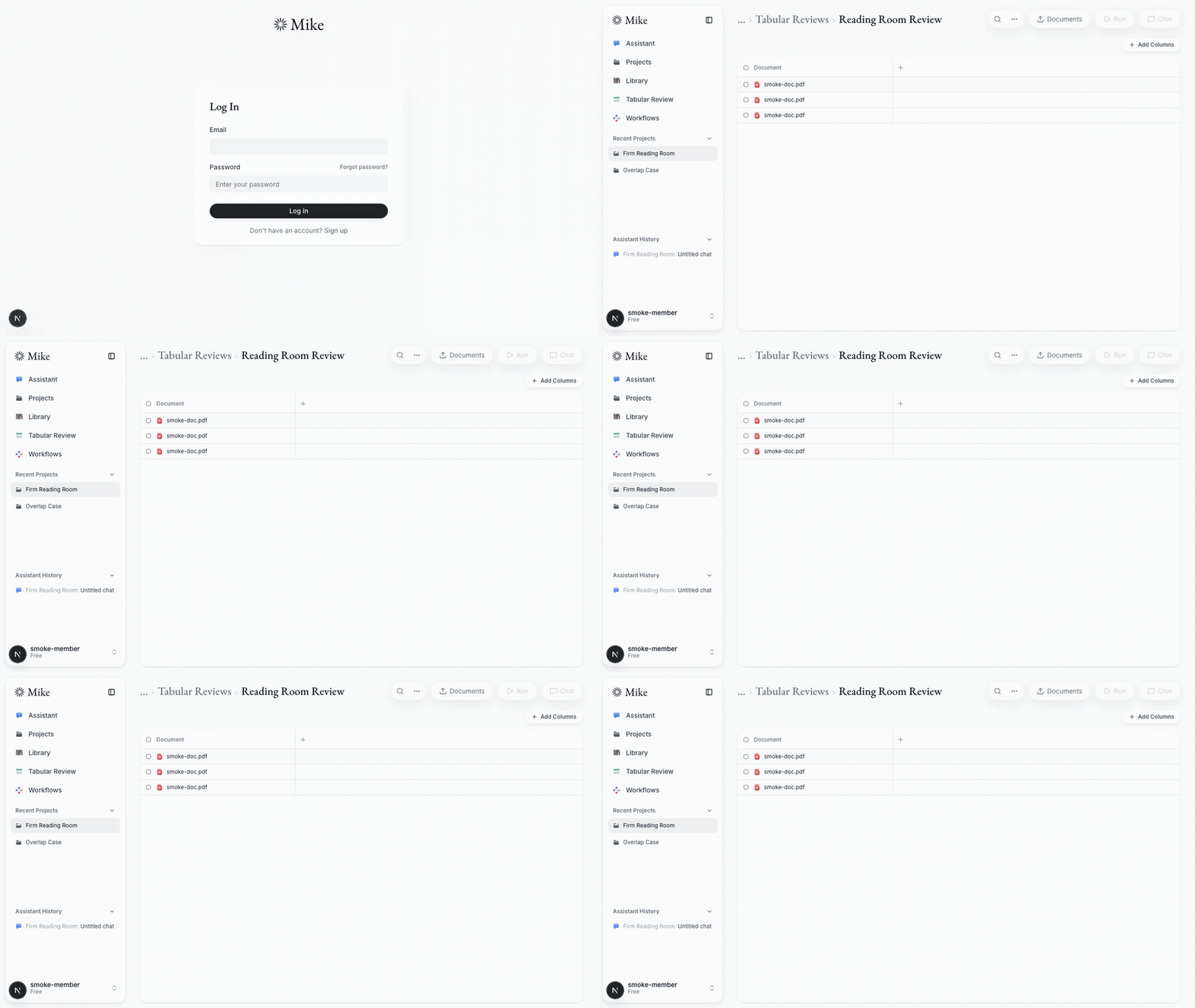
3 — Pure org viewer gating (org-only project + review, no direct share)Setup as owner (upload PDF → create “Reading Room Review”):
As the member (view-tier via org only): the project and review are visible, but Run, Documents (add-to-review) and Chat are all disabled, and the project’s upload control is greyed:
4 — Admin roster limits (owner row untouchable, no Owner grant)As an org admin: the owner’s row renders as a static pill with no role control, and the role menu for another member was asserted to contain no “Owner” option:
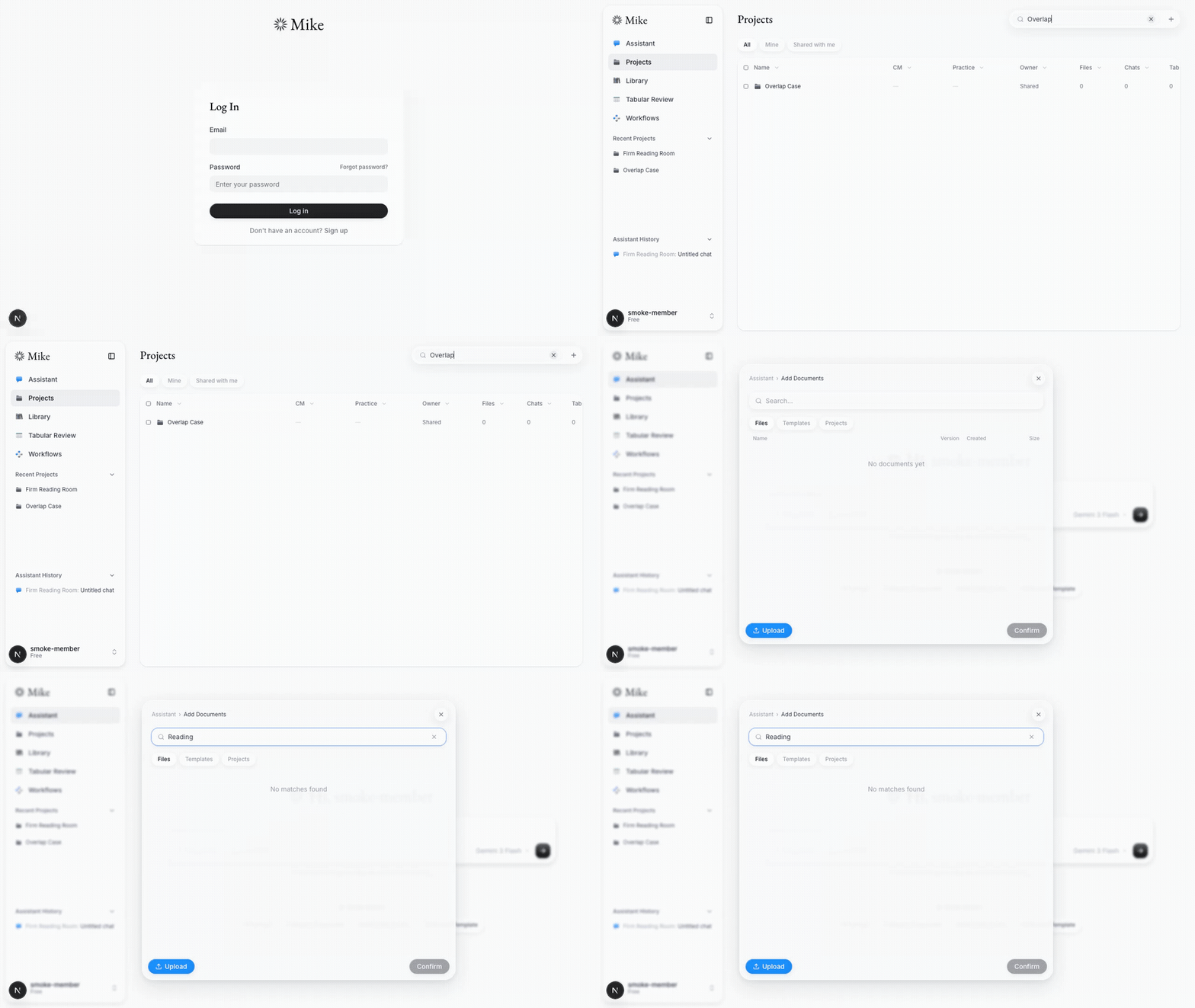
5 — Directory search with org rowsAs the member, project search and the assistant document-picker both return the org-shared rows; the run recorded zero 5xx responses:
Observations (not blockers, flagging for awareness)
Also re-verified on the rebased tips: backend 709/709 (incl. the 27 supabase-gated stack tests against a live stack), frontend suite green with coverage 99.82/97.19/100/100 vs floors 97/96/98/98. |

 amal66
changed the title
amal66
changed the title


Introduce an organizations tenant layer on top of the existing per-user
model: every account gets an auto-provisioned personal org, orgs carry
owner/admin/member RBAC via org_members, and teams group members inside
an org. projects/documents/workflows/tabular_reviews gain a nullable
org_id (ON DELETE SET NULL) so org membership becomes a third access
branch alongside row ownership and shared_with emails — in the access
helpers, the overview RPCs, and the org-aware /orgs REST module.

Mechanical port of the organizations/RBAC feature from amal66/mike@main
(b3166dd) onto the upstream layout.

Co-Authored-By: Claude Fable 5 <noreply@anthropic.com>
Claude-Session: https://claude.ai/code/session_01CEguyEgXa9JjCciXCcVemC
…nches

Give the three access branches a Drive-style role ladder instead of raw
ok/isOwner flags: row owner → owner, shared_with email → editor, org
owner/admin → manager, plain org member → viewer. A single capability
matrix (lib/permissions.ts) maps roles to what routes may do — view,
content.edit, docs.organize, structure.manage, members.manage,
container.delete — and every project/document/review write route now
declares the capability it needs instead of hand-rolling an owner check.

This makes the ADR's 'org membership grants visibility, not ownership'
promise real: plain org members are read-only (previously the org branch
returned ok:true and most write routes gated on nothing beyond ok), and
org owner/admins can curate content (manage folders, sharing, review
structure) without being able to delete containers they don't own.

Notable tightenings, all fail-closed:
- folder rename/move/delete, doc-set/column edits on reviews, and
  clear-cells are manager+ (generalising the owner-only folder-delete
  gate that landed upstream in open-legal-products#193)
- version pushes, edit resolution, chat, and review generation are
  editor+ (org viewers excluded)
- project PATCH (metadata + sharing) is manager+, so org admins can
  manage without owning; project/review DELETE stays owner-only
- GET /projects/:id and /people now go through checkProjectAccess (the
  roster previously 404'd for org members who could read the project)

Detail responses expose access_role alongside is_owner so the client
can render per-role affordances. can() is exhaustively unit-tested
(role × capability), and route suites cover the new gates.

Co-Authored-By: Claude Fable 5 <noreply@anthropic.com>
Org viewers could append messages to a colleague's chat — and burn LLM
credits doing it — because the existing-chat path only asked "can you
see this chat?", never "can you write to it?".

WHY THIS MATTERS

The organizations feature gives every plain org member visibility into
their org's projects: they map to the "viewer" project role
(backend/src/lib/access.ts, orgRoleToProjectRole). Visibility is the
point — but the capability matrix (backend/src/lib/permissions.ts) is
explicit that chatting is a WRITE:

    capability    | min role | covers
    content.edit  | editor   | upload documents, push versions, CHAT, ...

Creating a chat already honored that: validateAccessibleProjectId gates
new project chats on can(projectRole, "content.edit"). But POST /chat
with an existing chat_id, and POST /chat/:chatId/generate-title, gated
only on getAccessibleChat — which returned the chat whenever
checkProjectAccess(...).ok was true. That is true for org viewers. So a
viewer could:

  - append user messages into a colleague's project chat,
  - trigger LLM generation (spending the owner's configured API keys),
  - overwrite the chat's title via generate-title (an UPDATE on chats).

WHAT IS THE ACCESS-VS-CAPABILITY DISTINCTION

"Can you see this resource?" and "can you write to this resource?" are
different questions and must be answered by different checks:

  - an ACCESS check resolves whether the caller has any standing at all
    (owner / shared editor / org member) — it yields a role;
  - a CAPABILITY check asks whether that role clears the bar for the
    specific operation: can(role, "content.edit").

A route that stops after the access check silently grants its weakest
role the powers of its strongest. That is exactly the bug class here:
read-only endpoints (GET /chat/:chatId) and write endpoints (POST
/chat) shared one gate, so the gate had to be as permissive as the
reads — and the writes inherited that permissiveness.

HOW THE FIX WORKS

getAccessibleChat now returns the caller's ProjectRole along with the
chat, instead of flattening everything to "found / not found":

    type ChatAccess =
        | { ok: true; chat: AccessibleChat; projectRole: ProjectRole }
        | { ok: false };

The chat owner maps to "owner"; for project chats everyone else
inherits their project role from checkProjectAccess. Chats without a
project_id remain reachable only by their owner (unchanged).

Each caller then declares the capability it needs:

  - GET /chat/:chatId — read: any resolved role (project.view
    semantics), so org viewers keep read access. Unchanged behavior.
  - POST /chat with chat_id — write: rejects with 403 unless
    can(projectRole, "content.edit"), mirroring the new-chat path.
  - POST /chat/:chatId/generate-title — write (UPDATEs chats.title):
    same 403 gate.

403 (not 404) is correct for viewers: they are allowed to know the chat
exists — they can read it — they just cannot modify it.

Note: routes/projectChat.ts does NOT have this hole — it already gates
the entire POST on content.edit before touching any chat row.

Tests (chat.routes.test.ts) add a table-aware supabase stub so the
caller's org role can be varied, and prove: viewer POST to an existing
chat → 403 with no LLM call; viewer generate-title → 403; chat owner
and org admin (manager) still stream successfully; admin generate-title
still works; viewer GET of the same chat still returns 200.

Co-Authored-By: Claude Fable 5 <noreply@anthropic.com>
With two or more owners in an org, an admin could demote an owner to
member (or remove them outright), because the membership mutations
checked the ACTOR's rank but never compared it to the TARGET's.

WHY THIS MATTERS

The role ladder is owner > admin > member. updateMember and
removeMember guarded three things:

  - the actor can manage members at all (roleCanManage → owner/admin),
  - "only an owner may GRANT the owner role" (no self-escalation),
  - last-owner protection (never demote/remove the sole owner).

None of those look at who the target IS. So in an org with owners A and
B plus admin C, C could call updateMember(target=A, role="member"):
C passes roleCanManage, "member" is not "owner" so the grant check does
not fire, and B still counts as an owner so last-owner passes. Result:
an admin deposes an owner — and with both owners demoted one at a time,
an admin becomes the effective top of the org without ever holding the
owner role. That inverts the hierarchy the ladder is supposed to
encode.

WHAT IS AN ACTOR/TARGET RANK CHECK

Role-ladder authorization has two halves, and they are easy to conflate:

  1. Does the ACTOR's role permit this KIND of operation?
     ("admins may manage members")
  2. Does the ACTOR outrank-or-equal the TARGET of the operation?
     ("...but not members who outrank them")

Check (1) alone is enough for rank-neutral operations (creating a
team). Any operation aimed at another member also needs check (2),
otherwise every manager-tier role can act on the tier above it. The
existing "only an owner may grant owner" rule is the escalation half of
this idea; what was missing is the demotion half: only an owner may act
AGAINST an owner.

HOW THE FIX WORKS

Both mutations now fetch the target's role (they already did, for
last-owner counting) and add a rank guard before it:

    if (targetRole === "owner" && actorRole !== "owner")
        return { ok: false, kind: "forbidden" };

  - updateMember: an admin demoting an owner → forbidden, regardless of
    how many owners exist. Owner-on-owner changes still work.
  - removeMember: an admin removing an owner → forbidden. An owner
    leaving on their own is unaffected: self-leave implies
    actorRole === targetRole === "owner", so the guard passes and the
    existing last-owner protection still has the final say.

Since owner/admin/member is a three-rung ladder, this single condition
IS the full outrank-or-equal rule: owners outrank everyone, admins may
act on admins/members, and plain members cannot reach these functions
at all (roleCanManage already rejects them).

Tests (orgs.test.ts) seed a two-owner org so last-owner protection is
provably not what stops the attack: admin-demotes-owner → forbidden,
admin-removes-owner → forbidden, owner-demotes-owner still ok,
owner-self-leave with a second owner still ok, and the existing
last-owner cases stay green.

Co-Authored-By: Claude Fable 5 <noreply@anthropic.com>
Adding an org or team member by email used the Supabase admin API's
listUsers({ perPage: 1000 }) and scanned the page in JavaScript. Any
user beyond the first 1000 accounts silently resolved to null, so the
route answered "No user with that email" for a user who exists.

WHY THIS MATTERS

List-and-scan lookups against an admin API are a scalability trap that
looks fine in every dev and demo environment:

  - CORRECTNESS decays with growth. listUsers is paginated; a single
    perPage: 1000 call is only "everyone" while the instance has fewer
    than 1000 accounts. The day it crosses that line, membership adds
    start failing for exactly the newest users — with a misleading 404
    and no error anywhere in the logs.
  - COST grows linearly. Even while it still works, resolving ONE email
    means transferring up to 1000 user records and comparing each in
    process, on every add-member call — O(n) network and CPU for what
    an indexed table answers in O(log n).
  - The admin auth API is a management surface, not a query engine. It
    has no "find by email" filter here, which is the hint that
    lookup-by-attribute belongs on a queryable table with an index.

The comment above the helper claimed it "mirrors the lookup pattern in
routes/projects.ts /people" — but that route actually uses the
user_profiles-based helpers in lib/userLookup.ts, not the admin API.
The codebase already had the right tool; this route just didn't use it.

WHAT THE INDEXED LOOKUP IS

lib/userLookup.ts maintains lookups over the user_profiles table, which
stores each user's normalized (lowercased, trimmed) email and is kept
in sync on auth events (syncProfileEmail). findProfileUserByEmail is a
single indexed query:

    const { data } = await db
        .from("user_profiles")
        .select("user_id, email, display_name")
        .eq("email", normalized)
        .maybeSingle();

One row travels over the wire regardless of whether the instance has
100 users or 10 million, and "not found" is an honest answer instead of
an artifact of pagination.

HOW THE FIX WORKS

routes/orgs.ts's resolveUserIdByEmail now delegates to that helper:

    const user = await findProfileUserByEmail(db, email);
    return user?.id ?? null;

The contract is unchanged — null when no such user — so both callers
(POST /orgs/:orgId/members and POST /orgs/:orgId/teams/:teamId/members)
keep their existing 404 behavior for genuinely unknown emails, and the
stale comment is corrected. This was also the last listUsers scan in
the backend. Email normalization (trim + lowercase) lives inside the
helper, matching the semantics the old loop implemented by hand.

findProfileUserByEmail is covered by unit tests
(lib/__tests__/userLookup.test.ts: found via normalization, not-found,
and blank-input cases); the org routes have no route-level test file,
so the two-line delegation rides on that existing coverage.

Co-Authored-By: Claude Fable 5 <noreply@anthropic.com>
…API actually calls

WHY THIS MATTERS

PR migration 20260717_03 added the new org-membership visibility branch
("you can see rows tagged with an org you belong to") to
get_tabular_reviews_overview — but only to its legacy 3-argument
overload. The API never calls that overload. GET /tabular-review builds
nine named arguments (p_user_id, p_user_email, p_project_id, p_scope,
p_limit, p_offset, p_search_term, p_sort_key, p_sort_direction) in
lib/tabularReviewsOverview.ts, so PostgREST resolves the 9-argument
overload from 20260726_01 — which never got the org branch. Result: on
any install upgraded via migrations, org-shared reviews were readable
through the detail endpoints (access.ts allows them) yet invisible in
every list view. Fresh installs, which bootstrap from schema.sql, were
unaffected because schema.sql's 9-argument version already carries the
org branch — so fresh and migrated databases silently diverged, the
worst kind of bug: nothing errors, some deployments just show less data.

WHAT IS FUNCTION OVERLOADING IN POSTGRES

Postgres identifies a function by name AND argument types.
get_tabular_reviews_overview(text, text, text) and
get_tabular_reviews_overview(text, text, text, text, integer, integer,
text, text, text) are two completely independent functions that happen
to share a name. CREATE OR REPLACE matches on the full signature, so
replacing one overload never touches the other:

  create or replace function f(a text) ...           -- replaces f(text)
  create or replace function f(a text, b int) ...    -- separate function!

PostgREST resolves an RPC call to the overload whose named parameters
match the JSON body it received. A call with nine named keys can only
ever hit the 9-argument overload. That is why patching the 3-argument
overload in 20260717_03 was a no-op for the API.

HOW THE FIX WORKS

This migration re-declares both overloads exactly as backend/schema.sql
already defines them (the bodies are copied verbatim, not rewritten):

1. The 9-argument overload gains the two org-membership arms:
   - accessible_projects: projects whose org_id is in an org the caller
     belongs to (EXISTS against org_members) — so in-project reviews of
     org colleagues become visible;
   - visible_reviews: org-tagged reviews owned by someone else become
     visible in the global list (p_project_id is null).
2. The 3-argument overload becomes the thin wrapper schema.sql uses —
   it simply delegates to the 9-argument version with scope 'all' and an
   effectively unlimited page — replacing 20260717_03's divergent
   full-body copy. From now on there is a single source of truth for the
   visibility predicate, and this file sorts after every earlier
   overview migration, so replaying migrations from scratch also ends in
   the correct state (previously 20260726_01 sorted after 20260717_03
   and wiped the org branch on replay).

Signatures do not change, so CREATE OR REPLACE suffices — no DROP
FUNCTION, and the migration is safe to re-run. schema.sql needs no
change: it was already correct; this converges migrated installs onto
it.

Co-Authored-By: Claude Fable 5 <noreply@anthropic.com>
WHY THIS MATTERS

get_tabular_review_ids_overview backs GET /tabular-review/ids, the bulk
"select all matching" action: it returns id + owner for every review the
caller can see, so the client can select the whole filtered set without
fetching full payloads. For performance it does NOT delegate to
get_tabular_reviews_overview — it carries its own copy of the visibility
predicate, and its own migration (20260727_01) warns in its header:

  "If the access/visibility rules in get_tabular_reviews_overview's
   visible_reviews CTE ever change, mirror the change here too."

The organizations work changed exactly those rules — it added a third
visibility branch, "rows tagged with an org the caller belongs to",
alongside "row owner" and "shared_with email" — but this RPC was never
mirrored, neither in a migration nor in schema.sql. The user-visible
symptom is nasty because it is partial: an org member SEES a colleague's
org-shared reviews in the list, but "select all matching" silently
skips them, so bulk actions run over fewer rows than the visible
selection implies. Nothing errors; rows just go missing.

HOW THE FIX WORKS

Add the same two org-membership arms the paginated overview uses
(compare its 9-argument definition in schema.sql):

1. accessible_projects gains an EXISTS against org_members on
   p.org_id — reviews living in an org colleague's project become
   visible, exactly like email-shared projects already were:

     or (
       p.org_id is not null
       and p.user_id <> p_user_id
       and exists (
         select 1 from public.org_members m
         where m.org_id = p.org_id and m.user_id::text = p_user_id
       )
     )

2. The row filter gains the matching arm for org-tagged reviews in the
   global list (p_project_id is null), keyed on tr.org_id.

The change is made in BOTH places that define this function — edited
in place in backend/schema.sql (fresh installs bootstrap from it) and
as new migration 20260805_02 (upgrades existing installs) — with
byte-identical function bodies, so the two install paths cannot
diverge. org_members.user_id is a uuid FK to auth.users while content
tables store user_id as text, hence the ::text casts. Org membership
grants visibility only; user_id still identifies the owner.

The signature is unchanged, so the migration is CREATE OR REPLACE only
and safe to re-run.

TESTS

The org-visibility integration suite (tabularPagination.supabase.test.ts)
now seeds two real auth users in one org — the FK to auth.users means
random UUIDs won't do — makes one a plain "member", and asserts the
member sees the colleague's in-project and standalone org reviews via
the ids RPC, plus a lockstep assertion that the ids RPC returns exactly
the set the paginated overview shows, which is the drift this bug class
is about.

Co-Authored-By: Claude Fable 5 <noreply@anthropic.com>
…actor

WHY THIS MATTERS
The manager-gate test for POST /tabular-review/:reviewId/clear-cells was
written when the endpoint keyed cell resets on document_ids. After
rebasing onto main it hit the 400 validation branch ("row_ids is
required") before ever reaching the 403 role check it exists to prove,
so the RBAC gate went untested.

WHAT IS THE LOGICAL-ROWS REFACTOR
Main's folder-grouped tabular review work (open-legal-products#274) reshaped reviews around
logical review rows: a row can represent a folder of documents, not just
one document, so cell-level operations now address rows. clear-cells
accordingly takes row_ids instead of document_ids.

HOW THE FIX WORKS
The test now sends { row_ids: ["row-1"] }, a valid payload under the
current API, so the request passes validation and exercises the intended
assertion: an org editor without structure.manage receives 403 "Only a
review manager can clear cells". No production code changes.

Co-Authored-By: Claude Fable 5 <noreply@anthropic.com>
…dels

Rebasing onto current main surfaced a new instance of the overload trap
this branch already fixed once for tabular reviews (20260816_04/05):
since the org feature was written, main grew paginated overloads for the
projects and workflows overviews (20260807_01), bulk select-all ids RPCs
and a sidebar summaries RPC (20260812_01), and a TS-side directory
search. Every one of them re-implements the visibility predicate, and
every one of them predates the org concept — so an org member would see
org content in the detail endpoints and legacy lists but not in the
paginated lists, the sidebar, select-all, or the document picker.

SQL (migration 20260816_06 + schema.sql in lockstep, byte-identical
bodies): get_projects_overview (10-arg), get_project_ids_overview,
get_project_summaries gain the same org-membership EXISTS arm the legacy
overloads got in 20260816_03; get_workflows_overview (12-arg) and
get_workflow_ids_overview gain the org_shared CTE from the 3-arg
version, with scope 'shared' including org-shared rows.

TS: handleProjectDirectorySearch (GET /projects?view=directory-search)
adds the org branch to its inline access derivation via listUserOrgIds,
mirroring listAccessibleProjectIds. GET /projects/:id/directory and
/export already route through checkProjectAccess and inherit the org
branch for free.

Co-Authored-By: Claude Fable 5 <noreply@anthropic.com>
…e on docs and reviews

ensureDocAccess and ensureReviewAccess checked the row's own org
membership before falling through to the project check — but the project
check is what carries the shared_with editor branch. A colleague who is
BOTH a plain member of your org AND explicitly shared on your project
(the normal in-firm sharing case) matched the org branch first and came
out a viewer: every content.edit route (upload versions, rename, chat,
accept/reject edits, generate) suddenly 403'd for someone main happily
allowed. checkProjectAccess and the file's own precedence note already
had it right: owner, then shared_with, then org.

Reorder both helpers to match — project fall-through (share-aware)
first, the row's own org branch after — while keeping the org branch's
upgrade power: an org owner/admin is a manager even where the project
branch only found viewer standing, and an org-tagged standalone row
(no project) still resolves through its own org_id. Roles can now only
strengthen as branches accumulate, never weaken.

Also aligns ensureReviewAccess's email comparison with the trim()
normalization the other helpers got in the sharing-email-case fix.

Regression tests: the overlap case pins editor on both helpers, and an
org admin pins manager.

Co-Authored-By: Claude Fable 5 <noreply@anthropic.com>
…ment used PgArray syntax

GET /projects?view=directory-search builds its shared-projects query
with .contains("shared_with", [email]). supabase-js serializes a JS
array there as PostgREST's PgArray form ({email}), which Postgres
rejects for a jsonb column — "invalid input syntax for type json" —
so the endpoint returned 500 for any authenticated caller (the email
branch always runs). Pre-existing on main, but this branch adds the org
visibility arm to exactly this handler, so the document picker must
actually work to deliver it. Use the JSON containment idiom the sibling
listAccessibleProjectIds already uses:
.filter("shared_with", "cs", JSON.stringify([email])).

Verified live: owner and org-member searches both 500'd before, both
return the project after.

Co-Authored-By: Claude Fable 5 <noreply@anthropic.com>
… lists they filter

20260816_06 ported the org-membership arm onto the second-generation
paginated/ids/summary read-models, but the 20260812_01 batch it covered
also shipped two dropdown-option companions that were missed:
get_project_filter_options (the Practice and Owner dropdowns above the
projects table) and get_workflow_filter_options (practice / language /
jurisdiction above the workflows list). Both derive their option sets
from a "visible rows" predicate that still only knew the owner and
email-share arms.

The symptom is a visible seam for org members: the list shows an org
project, but its owner never appears in the Owner filter and its
practice never appears in the Practice filter — rows you can see but
cannot filter to. Filters and lists must be computed from the same
visible set or the UI contradicts itself.

The arms are copied verbatim from the 20260816_06 predicates. In the
workflows RPC the org CTE keeps the workflow_shares NOT EXISTS dedup
and is tagged source='shared', matching the overview's bucketing
decision (shared-with-me and shared-via-my-org are one "shared" bucket
from the caller's point of view), so p_scope filtering stays consistent
between a list and its dropdowns. schema.sql carries the same bodies
for fresh installs.

Verified live: an org member's Owner dropdown now offers the org
project's owner, and an org-shared workflow's practice appears under
scope=all and scope=shared but not scope=owned.

Co-Authored-By: Claude Fable 5 <noreply@anthropic.com>
…ant can never demote

The previous commit in this area (0096f38) fixed one direction of
branch shadowing — an org "viewer" verdict no longer buries a
shared_with editor — but the mirror direction survived: the shared_with
branch was still an unconditional early return, so it shadowed
STRONGER verdicts. Two concrete downgrades:

* checkProjectAccess: an org owner/admin (manager tier) whose email
  someone also put in the project's shared_with resolved as editor —
  adding a grant stripped their folder-rename/delete, metadata, and
  sharing rights.
* ensureReviewAccess: the review's own shared_with early-returned
  editor before the project was even consulted, so the PROJECT OWNER,
  politely added to a review's share list by a collaborator, lost
  owner-tier standing on that review (403 on title/columns edits).

Both are privilege LOSS, not escalation — but they violate the
invariant the role ladder promises: grants accumulate, they never
subtract. That invariant is safe here precisely because shared_with
entries are bare email strings with no per-entry role: there is no way
to express a deliberately weaker share that strongest-wins could
override.

The fix replaces ordered early returns with an explicit merge: every
matching branch derives its ProjectRole and the strongest one wins
(strongerRole in lib/permissions.ts). ensureDocAccess/ensureReviewAccess
skip the extra org lookup when the project verdict already folded in
the same org's membership, so the common paths cost the same queries
as before. This also retires the old code's dead upgrade ternary —
"upgrade-only" is now a property of the merge, not of branch ordering.

Regression tests pin the two downgrades above, plus the one fixture
where the doc's own org actually decides the outcome (doc org differs
from the project's org and only the former makes the caller a manager).

Co-Authored-By: Claude Fable 5 <noreply@anthropic.com>
…containment misuses

cdf6706 fixed the directory-search 500 caused by calling supabase-js
.contains() on a jsonb column (it serializes a JS array as PostgREST's
PgArray form {email}, which Postgres rejects for jsonb). A sweep for
survivors of the same pattern found two, both with a worse failure
mode than a 500 — silent data loss:

* routes/audit.ts accessibleProjectIds used .contains on
  projects.shared_with, and the caller swallows query errors
  (shared.data ?? []), so GET /audit and GET /audit/export quietly
  omitted every event from projects shared with the caller — for every
  caller, on an audit surface whose whole point is completeness.
* lib/userDataExport.ts passed the raw login email into the
  tabular_reviews containment while the projects query two lines up
  normalized it; shared_with entries are stored lowercased, so a
  mixed-case account's data export silently missed reviews shared with
  them.

Both now use the JSON containment idiom the rest of the codebase
settled on: .filter("shared_with", "cs", JSON.stringify([email])) with
a trimmed, lowercased email. The audit test mock deliberately no
longer implements .contains — a regression back to PgArray
serialization fails the suite loudly instead of passing against a
too-forgiving fake — and a new case pins the exact lowercased jsonb
literal that goes over the wire.

Verified live: an event in a project shared with the caller now
appears in their /audit feed (it did not before the fix), and a
stranger still sees nothing.

Co-Authored-By: Claude Fable 5 <noreply@anthropic.com>
Every user gets a personal org at signup, and resolveContentOrgId tags
every org-less row they create with it — that is what keeps all
content tenant-scoped without demanding an explicit org on every
write. The quiet consequence: personal-org membership IS visibility of
the owner's entire private library, because all the org visibility
arms (lists, detail access, RPCs) key off org_members.

addMember had no personal guard. The org owner could POST a colleague
into their own personal org — plausibly thinking of it as "my
workspace, let me add my assistant" — and thereby share every private
project, document, chat, review and workflow they had ever created,
with no per-item consent and no UI hint of the blast radius. Explicit
sharing (shared_with, real orgs) is the intended channel for that.

addMember now refuses with a 400 validation error when the target org
is personal. Teams need no equivalent guard: team membership requires
org membership first, so a single-user org cannot grow a multi-user
team.

Verified live: POST /orgs/:personalOrgId/members returns 400; the
57-check RBAC matrix (real orgs) is unaffected.

Co-Authored-By: Claude Fable 5 <noreply@anthropic.com>
Last-owner protection lived only in lib/orgs.ts as a read-then-act
check: count the owners, then demote/remove if more than one remain.
Two concurrent requests each removing a DIFFERENT owner both count two,
both pass, and the org ends up with zero owners — a terminal state,
because granting the owner role itself requires an owner, so no API
call can ever repair it.

Races between requests cannot be fixed in the application layer without
a serialization point, so the invariant moves into the database:
org_members_protect_last_owner (BEFORE DELETE OR UPDATE OF role) first
locks the organizations row FOR UPDATE — concurrent owner departures on
the same org serialize on that lock, and the loser re-counts after the
winner committed, sees one owner left, and aborts with errcode 23514.
The service layer maps that onto the same 409 the sequential check
produces, so callers can't tell which layer stopped them.

The trigger deliberately stands aside for the two legitimate cascades:
org deletion (the organizations row is already gone inside the
transaction, so the lock probe finds nothing) and direct auth-user
deletion (the member's auth.users row is gone; security definer, like
handle_new_user, so that probe works for any calling role).

Account-deletion cleanup is reordered to match — and it's a fix in its
own right: it used to DELETE the sole owner's membership first and
promote an heir after, a window where the org exists ownerless (and
which the trigger would now reject). It now promotes the heir before
the membership goes, or deletes a memberless org outright and lets the
cascade clean up.

Verified live: direct SQL demote/delete of a sole owner both fail with
"must keep at least one owner"; the API path still returns its 409.

Co-Authored-By: Claude Fable 5 <noreply@anthropic.com>
…map to 409

Three service-layer gaps in the same file:

* removeMember deleted only the org_members row. team_members has no FK
  to org membership (its cascades are team deletion and auth-user
  deletion), and the org-membership requirement is enforced only at
  addTeamMember time — so a removed member kept appearing on every one
  of that org's team rosters, silently violating the "teams group
  existing members" invariant. Removal now also deletes the target's
  team_members rows across that org's teams (and only that org's:
  their seats elsewhere are untouched, pinned by test).

* The existence pre-checks in addMember / addTeamMember / createTeam
  race with concurrent inserts. The unique constraints backstop
  correctness, but the raw 23505 surfaced as a 500 db_error; it now
  maps onto the same 409 conflict the sequential path returns.

* When the new last-owner trigger (20260816_08) fires under a race, its
  23514 arrived as a 500; updateMember / removeMember now translate it
  into the last_owner result → the standard 409 with the standard
  message.

Co-Authored-By: Claude Fable 5 <noreply@anthropic.com>
The signup trigger swallows every exception by design (a provisioning
hiccup must never block signup) and the backfill migration ran exactly
once. A user who slipped through both — trigger failed after the
backfill's moment in time — had no personal org FOREVER: getPersonalOrgId
returned null, every piece of content they created landed with
org_id null, and GET /orgs returned an empty list, with no code path
anywhere that would repair it. The same state reappears when account
deletion clears a user's data but the final auth-delete fails.

getPersonalOrgId now self-heals: when the lookup comes back empty it
creates the org (named after the profile email, like the trigger) plus
the owner membership. The partial unique index on (created_by) where
personal makes the lazy create race-safe — the loser of a concurrent
create re-reads the winner's row. A failed membership insert degrades
softly: content tagging and owner-arm visibility never depended on
membership, only GET /orgs does, and the next call cannot re-create a
duplicate.

Verified live: delete a user's personal org, create a workflow — the
workflow lands in a freshly healed personal org and GET /orgs shows it
again.

Co-Authored-By: Claude Fable 5 <noreply@anthropic.com>
…accounts

POST /orgs/:orgId/members and the team-member variant resolved the
target email BEFORE checking the caller's standing in the org, and the
two failure responses are distinguishable 404s: unknown email → "No
user with that email", known email but caller not a manager →
"Organization not found". Any authenticated user could therefore probe
arbitrary emails for account existence against any orgId — an oracle,
independent of whether the add could ever succeed.

The routes now prove the caller holds a manage role in the org first
and only then touch the email, so non-managers always get the same
organization-not-found response regardless of what they probed with.
The service layer re-checks the role afterwards; this commit only fixes
the ordering of disclosure.

Verified live: an outsider probing a real org with a nonexistent email
gets "Organization not found", not email feedback.

Co-Authored-By: Claude Fable 5 <noreply@anthropic.com>
…tail access

20260814_01 lowercased projects.shared_with but left tabular_reviews
alone. Review shares have the same jsonb email-list shape and the same
split consumers: the TypeScript detail check (ensureReviewAccess)
lowercases both sides, but the list/ids RPCs compare the STORED entry
against the caller's already-lowercased email via jsonb containment. A
pre-normalization mixed-case entry therefore produced a ghost review —
openable from a direct link, invisible in every list. New writes have
been normalized for a while (routes/tabular.ts), so this is a one-pass
data repair using the exact lateral-unnest recipe of 20260814_01:
trim, lowercase, dedupe, preserve first-seen order, and touch only rows
that actually change.

Co-Authored-By: Claude Fable 5 <noreply@anthropic.com>
…rges

The schema-drift check builds a real upgraded deployment (baseline
schema.sql + migrations) and a real fresh install (current schema.sql)
and diffs their fingerprints — and a function's stored body includes
its comments verbatim, so even a rewrapped comment line reads as two
deployments disagreeing about a function. Three such seams slipped into
the last round: the two filter-options org-arm comments referenced the
sibling migration number in the migration copy but not in schema.sql,
and the last-owner trigger carried two inline comments in the migration
that schema.sql's copy lacked.

This aligns the text byte-for-byte (migration 20260816_07 adopts the
schema.sql wording; schema.sql adopts the trigger's inline comments).
Editing 20260816_07/08 is safe: they are part of this unmerged PR, not
shipped history. Verified by replicating the CI check locally — scratch
postgres, baseline 9a1277b + added migrations vs current schema.sql,
fingerprints identical.

Co-Authored-By: Claude Fable 5 <noreply@anthropic.com>
…ting

The client half of the org/RBAC feature: orgs become visible and usable,
and the UI stops deriving permissions from a single is_owner boolean.

- Settings → Organizations: create orgs, expand into a member roster
  (profile names/emails, role select with owner/admin/member, remove or
  leave with confirm; 409 last-owner protection surfaced inline) and
  teams (create/delete, add/remove members). Personal orgs stay hidden —
  they are plumbing, not a firm.
- New project modal gains an Organization select (personal workspace
  default) so org-scoped projects can actually be created; sidebar user
  menu links to Organizations.
- GET /orgs/:id/members and /teams responses enriched server-side with
  mirrored profile email/display_name (same source as /people) so the
  client never renders a bare user id.
- lib/permissions.ts mirrors the server capability matrix; detail pages
  derive the caller's role from access_role (falling back to the
  is_owner list-row contract) and gate affordances through one canDo()
  seam: project details/sharing manager+, folder rename/move/delete
  manager+, doc rename/move and folder create editor+, review
  columns/document-set/clear-cells/details manager+, container delete
  owner-only. This also closes the previously unguarded folder-tree
  actions and un-read-onlys org admins.
- OwnerOnlyPopup generalised with a requiredRole tier so denials name
  the role that can act, and now shows the owner's email when known.
- Review details save only sends project_id when it changes (moving is
  owner-only server-side; managers editing a title must not 403).
- Tests: client matrix + roleFrom contract, OrganizationsPage flows
  (create, roster, role change, error surfacing, member read-only),
  OwnerOnlyPopup tiers. Frontend suite 74 passed; backend 307 passed.

Co-Authored-By: Claude Fable 5 <noreply@anthropic.com>
WHY THIS MATTERS
The teams endpoint fetched team member rows with:

    const [{ data: memberRows }, ...] = await Promise.all([...]);

Destructuring only `data` and never looking at `error` means a failed
query (network blip, RLS misconfiguration, dropped column after a bad
migration) does not fail the request — it returns HTTP 200 with every
team showing an empty member list. That is worse than a 500: the client
renders confidently wrong data, users think members were removed, and
nothing in monitoring fires because the status code says "success".
Every other Supabase query in this codebase checks `error` and maps it
to a 500; this one silently swallowed it.

WHAT IS A SILENT PARTIAL FAILURE
supabase-js never throws on query failure. Each query resolves to a
`{ data, error }` pair, and exactly one of the two is meaningful. If
you read `data` without checking `error`, a failure looks identical to
an empty result set (`data` is null, and `null ?? []` turns it into
[]). The type system cannot save you here — `data: T[] | null` is a
valid type either way — so the discipline of checking `error` after
every query is the only guard.

HOW THE FIX WORKS
Keep the Promise.all (the two queries are still independent), but bind
the whole response object instead of destructuring `data` away:

    const [membersRes, { userById }] = await Promise.all([...]);
    if (membersRes.error)
        return void res.status(500).json({ detail: membersRes.error.message });
    const memberRows = membersRes.data;

On failure the handler now responds 500 with the database error detail
— the same shape sendFailure() produces for "db_error" results from
lib/orgs.ts — so clients and monitoring see the truth instead of a
plausible-looking empty roster.

Co-Authored-By: Claude Fable 5 <noreply@anthropic.com>
… a table scan

WHY THIS MATTERS
GET /orgs/:orgId/members and GET /orgs/:orgId/teams enriched their
rosters by calling loadProfileUsersByEmail(), which selects EVERY row
of user_profiles and builds two in-memory maps — just to look up the
handful of user_ids actually present in the roster. On a small dev
database this is invisible; in production it means every roster render
pulls the entire user directory over the wire, on every request, and
the cost grows with total signups rather than with org size. It is a
classic O(all users) query hiding behind an O(members) endpoint.

WHAT IS A TARGETED LOOKUP
Instead of "fetch everything, filter in application code", you push the
filter into the database with an IN clause:

    select user_id, email, display_name
    from user_profiles
    where user_id in ('a...', 'b...', 'c...')

The database resolves this against the primary-key index on user_id and
returns only the rows requested. Transfer size and query time are now
proportional to the roster being rendered, not to the size of the user
base.

HOW THE FIX WORKS
lib/userLookup.ts gains loadProfileUsersByIds(db, userIds):
- de-duplicates and drops empty ids, short-circuits on an empty list
  (no query at all for empty rosters);
- issues one .in("user_id", ids) select and returns a Map keyed by
  user_id, in supabase style ({ userById, error }) so the route can map
  a failure onto a 500 — Express 4 does not catch a thrown rejection
  from an async handler.

Both org routes now collect the user_ids they already hold (member rows
/ team-member rows) and pass exactly those. In the /teams handler the
profile lookup consumes the roster query's output, so the two queries
run sequentially instead of in the previous Promise.all — the second
query is now so much smaller that this is still a large net win.

loadProfileUsersByEmail remains for callers that genuinely need the
email->user mapping across all profiles (projects/tabular people
endpoints).

Co-Authored-By: Claude Fable 5 <noreply@anthropic.com>
… failures

WHY THIS MATTERS
The project role model says viewers can read documents but not add
them, and the header "Add" button already respects that (the parent
only wires it up when canDo("content.edit") is true). But DocTable had
two side doors around the button:

1. Drag-and-drop — handleDropCollectionFiles ran for any role, so a
   viewer could drop files and kick off real upload requests.
2. The empty-state panel — its onClick called openAddDocuments
   directly, opening the picker/modal for viewers too.

The backend correctly answers 403, but the catch block only did
console.error(err), so from the viewer's perspective the drop overlay
appeared, spinners ran, and then... nothing. Silent failure erodes
trust in the UI, and offering an action the user is not allowed to
perform is a permission-model inconsistency even when the server holds
the line. (Client-side gating is UX, not security — the backend check
remains the real enforcement.)

WHAT IS CAPABILITY GATING
Instead of sprinkling role names through components, the app maps roles
to capabilities once (frontend/src/app/lib/permissions.ts — e.g.
"content.edit" requires the editor rank) and components ask a single
question: allowed("content.edit")? DocTable wraps that in
requireCapability(capability, action, requiredRole), which returns
false AND raises the "you need the editor role to add documents" popup
via onOwnerOnlyAction — so every blocked path explains itself the same
way. When no canDo prop is passed (library/standalone contexts) the
check allows everything, preserving existing behavior outside projects.

HOW THE FIX WORKS
- handleDropCollectionFiles now begins with
      if (!requireCapability("content.edit", "add documents", "editor"))
          return;
  which covers all three drop entry points (window-level drop, the
  table-root drop zone, and the hidden file input) because they all
  funnel through this one function.
- openAddDocuments performs the same check, covering the empty-state
  click as well as any future caller of the published header action.
- The upload catch block still logs for debugging, but now also feeds
  the existing WarningPopup channel:
      setDocumentUploadWarning(detail ? `Upload failed: ${detail}` : ...)
  using apiErrorDetail() to pull the backend's {detail} message, so a
  403 (or any other failure) is shown to the user instead of vanishing
  into the console.

Co-Authored-By: Claude Fable 5 <noreply@anthropic.com>
…i coverage ratchet

Main raised the src/app/lib coverage floors to 97/96/98/98 (PR open-legal-products#291)
after this branch was written, and the floors are measured per function:
eleven untested org endpoint wrappers dropped functions coverage to
93.9% and failed CI. Add the org wrappers — plus the org-scoped
createProject variant — to the existing table-driven thin-wrapper suite,
asserting route, method, body serialization, and the default member
role. Coverage lands back at 100% functions / 100% lines.

Co-Authored-By: Claude Fable 5 <noreply@anthropic.com>
…ver enforces

The review header's Documents action, the selection Delete action, and
the drag-and-drop upload path all mutate the review's document set —
which the backend gates at structure.manage (PATCH document_ids 403s
below manager). Columns, clear-results, details and workflow already ran
through requireStructure, but these three paths had no client gate: an
editor got a silent console.error (add), an optimistic removal that
snapped back with no explanation (delete), or worst, an upload that
succeeded followed by an attach that 403'd — an orphaned document
(drop). Route all three through requireStructure so the role popup
explains the denial before any request fires, mirroring the DocTable
drop-path gate.

Also give the org page's two raw text inputs (new org, new team) an
explicit h-10: SETTINGS_CONTROL_CLASS carries no height — it is meant to
be wrapped by SettingsTextInput, which adds one — so the bare swap from
accountGlassInputClassName left them shorter than every sibling control.

Co-Authored-By: Claude Fable 5 <noreply@anthropic.com>
roleFrom resolves the caller's role from whatever payload a component
holds: detail responses carry access_role (for every role, including
"owner"), list rows carry is_owner. A row with NEITHER field used to
fall through to "owner" — and such rows exist: PATCH handlers return
the bare DB row. After a column save the review state was replaced by
that bare row, roleFrom said "owner", and every client gate opened for
a manager — including the delete flow, whose server side is a 204
no-op for non-owners, so the UI showed "deleted" and navigated away
while the review lived on. A phantom destructive action.

The unknown case now resolves to "viewer", the same fail-closed
posture `can()` already takes for unknown roles: guessing high opens
gates the server will refuse; guessing low only hides an affordance
until real data arrives. The legitimate contracts are untouched —
access_role wins when present, is_owner true/false still mean
owner/editor.

Verified: new regression test pins roleFrom({}) === "viewer"; full
frontend suite 361/361, coverage above the src/app/lib floors.

Co-Authored-By: Claude Fable 5 <noreply@anthropic.com>
…rver enforces

This PR introduces the first users who can see content they cannot
write to (org "viewer"s), which turns every ungated mutation affordance
into a dead end: the click fires, the server 403s or 404s, and nothing
explains why. Sweep of the review view and project workspace against
the backend capability table:

* Review generation and cell regeneration are editor-tier server-side
  (content.edit on /generate and /regenerate-cell). A new
  requireContent gate mirrors the existing requireStructure pattern and
  shows the role popup instead of a doomed request.
* Moving a review to another project is owner-only server-side ("Only
  the review owner can move a review") but sat behind the manager-tier
  details modal; a manager changing the selector got an unexplained
  failed save with the modal stuck open. The changed-project save now
  requires owner up front.
* New Chat / New Review in a project are editor-tier server-side
  (content.edit on chat create and review create); both creation
  callbacks now gate and explain. The role derivation moved above the
  callbacks it feeds — a useCallback deps array reads its identifiers
  at render time, so referencing a later `const` would throw at
  runtime (temporal dead zone), not just lint.
* saveColumnsConfig merges the PATCH response into the previous review
  state instead of replacing it: the response is the bare DB row with
  no access_role/is_owner, and replacing dropped the caller's role
  (the enabling half of the phantom-delete chain fixed alongside in
  roleFrom).
* The drop-upload path refetches the document list even after a
  mid-loop failure — each successful upload has already attached
  itself server-side, so skipping the refetch left real documents
  invisible until reload — and failures now surface in a warning
  popup instead of only console.error.

Verified: frontend suite 361/361, lint and tsc clean.

Co-Authored-By: Claude Fable 5 <noreply@anthropic.com>
… hide the rest

The collection drop handler ran its uploads through Promise.all, which
rejects on the first failure and discards every sibling result — but
the sibling uploads it discards have already succeeded server-side.
The user saw "Upload failed", yet half their files existed and only
appeared after a reload, which reads as duplicate-upload bait.

Promise.allSettled keeps both halves of the truth: fulfilled uploads
land in the table immediately, and the first rejection still feeds the
existing warning popup with its error detail.

Co-Authored-By: Claude Fable 5 <noreply@anthropic.com>
…w chat, add-documents

Fresh-eyes sweep of client gates against the backend capability table
found three affordance classes still offered to roles the server
rejects, all in the dead-end shape this PR eliminates elsewhere (click
→ 403 → console.error → nothing visible):

* Document VERSION mutations in DocTable were entirely ungated. The
  server tiers them two ways: upload/rename are content.edit, but
  file-replace and delete are OWNER-only (documents.ts gates them on
  access.isOwner, the doc's creator) — a capability check cannot
  express the latter, so a requireDocOwnerForVersions guard gates on
  the row itself. Version upload failures also now surface in the
  warning popup, and a failed collection drop no longer overwrites the
  unsupported-files warning (both problems render together).

* Review chat: sending is editor-tier (content.edit on POST /chat) but
  READING history is view-tier, so gating the chat toggle would be
  stricter than the server. Instead TRChatPanel grows a canSend prop —
  viewers get the transcript with a disabled composer and an
  explanatory placeholder rather than a send that always errors.

* The review "Add documents" buttons opened the modal for anyone and
  only denied on submit; they now pre-gate with requireStructure, the
  same stop-before-the-modal pattern openNewReview already uses.

Two robustness fixes in the same files: clearResultsForRows rolls its
optimistic "pending" state back when the server call fails (cells no
longer blank until reload), and the review-load effect carries a
cancellation flag so a stale fetch can't clobber fresh state on rapid
review switches.

Co-Authored-By: Claude Fable 5 <noreply@anthropic.com>
…tually do

The members list rendered every management control for anyone with
canManage, but the server distinguishes admins from owners: an admin
cannot change or remove an OWNER, and cannot grant the owner role
(lib/orgs.ts rank guards). An admin therefore saw a live role select —
"Owner" option included — and a remove button on owner rows, and every
use died with the generic top-of-card 403. Owner rows now show the
plain badge to admins, and the owner option only renders for owners.

Three feedback fixes in the same flow:

* The last-owner 409 ("An organization must keep at least one owner.")
  rendered in the card body BEHIND the still-open confirm modal — a
  sole owner clicking Leave → Confirm watched a popup do nothing. The
  popup now closes when the action settles, failure or success, so the
  explanation is actually visible.
* run() serializes card actions by silently no-oping when one is busy;
  AddUserInput then cleared its email field as if the add succeeded.
  run() now reports whether it ran, and AddUserInput keeps the input
  on a skipped or failed add (returning `false` from onAdd is the new,
  backward-compatible signal — void still means success).
* The owner-tier popup said "the project owner" even for review-level
  denials; the subject is now just "the owner".

Co-Authored-By: Claude Fable 5 <noreply@anthropic.com>
POST /orgs/:id/members and POST .../teams/:id/members return the
inserted org_members/team_members row — no email, no display_name.
The wrappers declared the enriched roster shapes (OrgMember /
OrgTeamMember with email + display_name as present-but-nullable), which
happens to work today only because the org page discards the response
and refetches the roster. The first caller to trust the declared type
would read fields that are simply absent.

Split the types: OrgMemberRow / OrgTeamMemberRow are what mutations
return, OrgMember extends the row with the mirrored profile fields the
GET roster endpoint attaches. Lying types are latent bugs; this makes
the contract match the wire.

Co-Authored-By: Claude Fable 5 <noreply@anthropic.com>
…tion

Main's shared-UI unification (open-legal-products#345) rebuilt SettingsSection on the
shared GlassCardUI, which renders a fixed surface class and accepts no
className — padding now belongs to an inner wrapper div, the pattern
every other settings page adopted in that refactor. The org page still
passed className="p-4"/"p-0" from before the rebase, which tsc rejects
against the new prop type. The create-org card gains the standard inner
p-4 wrapper; the org card drops the no-op p-0 (its rows carry their own
padding).

Co-Authored-By: Claude Fable 5 <noreply@anthropic.com>
35ab80c to
13c7ae0
Compare
The tabular-review chat panel got a canSend gate, but the project chat
page shipped role-blind: an org viewer opening a colleague's chat saw a
fully enabled composer, and Send rendered their bubble plus an empty
assistant bubble while the server refused the write — no error anywhere
but the console. The explorer's Upload button and the window-level file
drop had the same shape: enabled affordance, silent 404.

ChatInput now takes canSend (default true, so the standalone assistant
is untouched). False renders the same read-only composer the review
panel uses — disabled textarea with the viewing-only placeholder,
disabled send, attach/workflow entry points hidden, drop-uploads
answered with the edit-access warning instead of a doomed request.

The page derives the gate from the project detail's access_role
(content.edit), with one exception: the chat's own creator keeps a live
composer regardless of tier, because the server's ladder always lets a
row's owner continue their own thread. While the project is still
loading the gate stays open — enforcement is server-side either way,
and flashing a disabled composer at every editor on load is worse than
one refused send.

Replication (before): as a plain org member, open another member's
project chat and send a message — bubble appears, nothing answers,
POST /projects/:id/chat 404s silently. After: composer reads
"Viewing only — sending needs edit access" and is inert; the explorer
upload button is disabled and a drop shows the editors-only popup.

Co-Authored-By: Claude Fable 5 <noreply@anthropic.com>
Claude-Session: https://claude.ai/code/session_0128b5tXqvX4GghBELHhyVnC
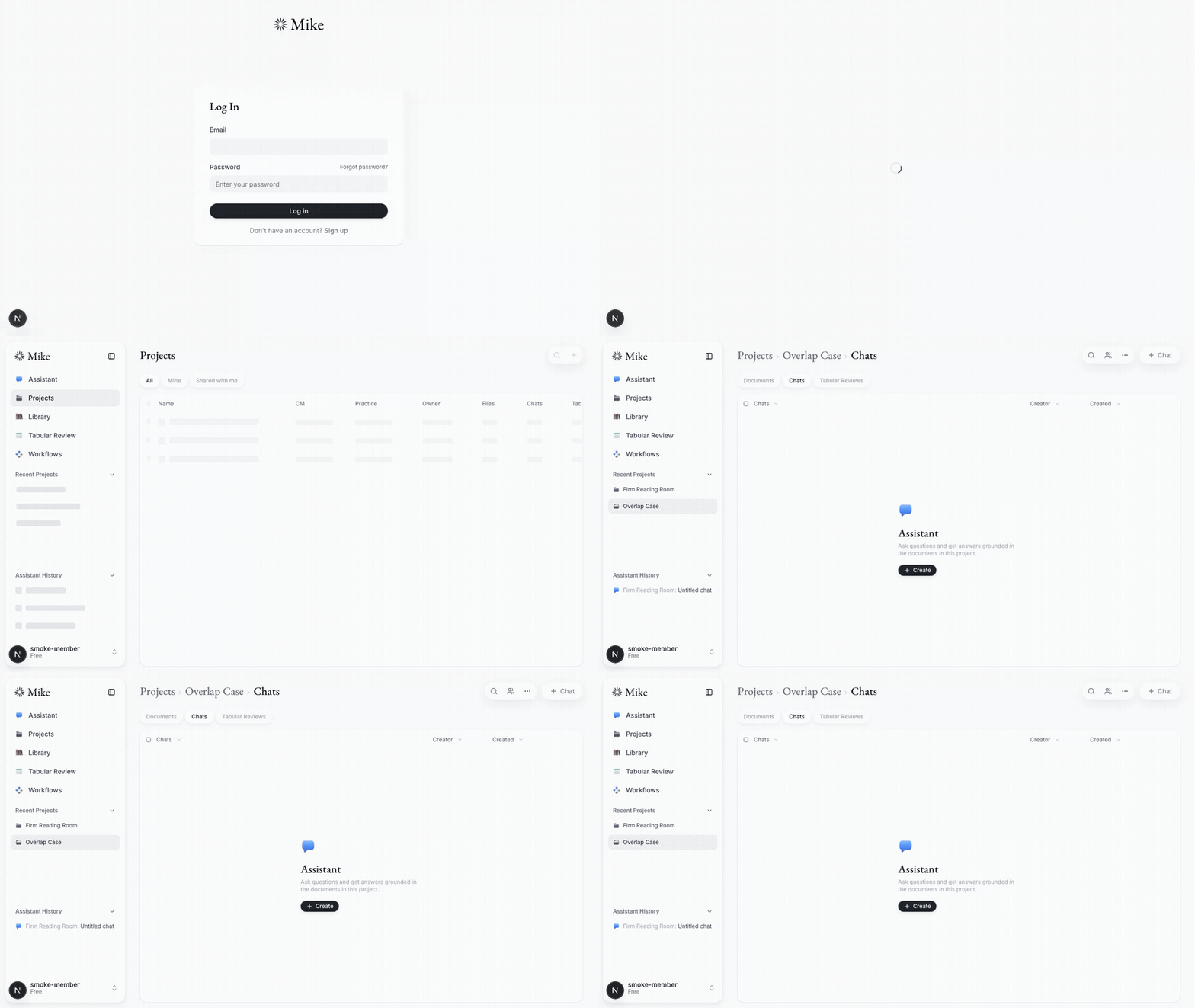
Live smoke evidence — 2026-08-21 (rebased tips + composer fix
|

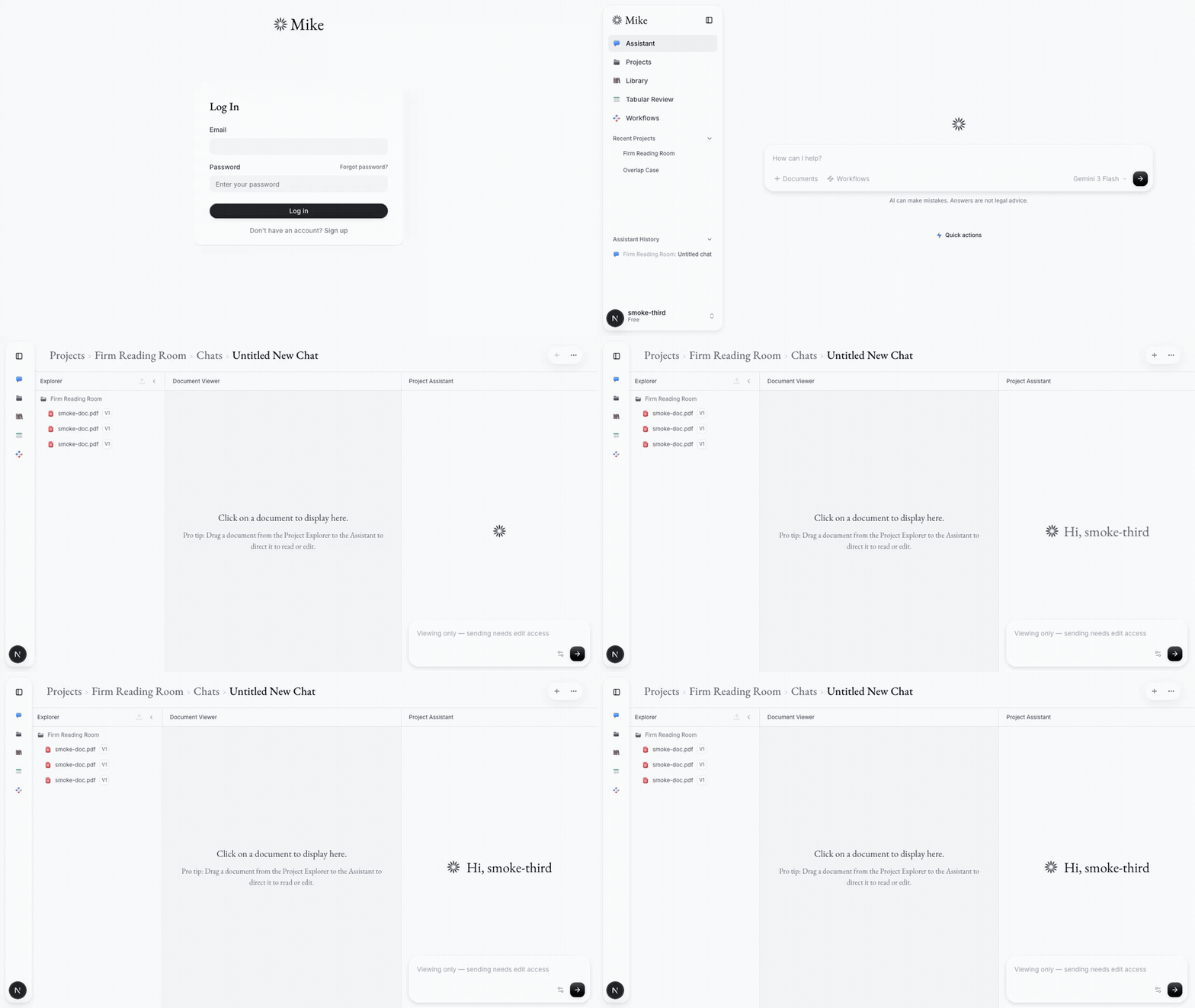
2 participants


Stacked on #267
This PR is the frontend half of the organizations/RBAC feature: it sits on top of #267's branch and carries its two commits — review the top commit only (
feat(frontend): organization management UI + role-aware permission gating). If #267 merges first, this rebases to a single clean commit.#267 shipped the tenant layer and the project role ladder server-side, but nothing in the product surfaced it: no way to create an org, no way to see members, and a UI that still derives every permission from a single
is_ownerboolean (including the org-admin case where the server allows an action but the client renders read-only). This PR closes those UI/UX flows.What it adds
Settings → Organizations (new page, plus a sidebar entry)
409 An organization must keep at least one owner.last-owner protection.Org-scoped project creation
The New Project modal gains an Organization select (default: Personal workspace) populated from
GET /orgs. This is the write path that makes the whole feature real: until now nothing in the UI could create a project with anorg_id.Role-aware permission gating (replaces
is_owner-only logic)frontend/src/app/lib/permissions.tsmirrors the server's capability matrix, and detail pages derive the caller's role from theaccess_rolefield #267 added (falling back to the historicis_ownercontract on list rows). OnecanDo(capability)seam threads through the project workspace:members.manage(manager+)structure.manage(manager+)docs.organize(editor+)content.edit(editor+)structure.manage(manager+)Notable fixes this delivers:
OwnerOnlyPopupgrows arequiredRoletier ("Only the owner or a manager can rename folders.") and now shows the owner's email when known, so a denial tells the user who to ask.project_idwhen it actually changed — moving a review is owner-only server-side, and a manager editing just the title must not 403.Backend (small, additive)
GET /orgs/:orgId/membersandGET /orgs/:orgId/teamsare enriched with mirrored profileemail/display_name(same source as the projects/peopleendpoint) so the client never has to render a UUID.UX walkthrough (screenshots)
Captured against a live local stack (Supabase CLI + MinIO + backend + prod
next start), three users in one org: an owner, an admin (→ manager role on org projects), and a plain member (→ viewer).As the org owner
1 — Organization management (Settings → Organizations): roster with role selects and descriptions, teams with member chips.
2 — Creating a project inside the firm: the new Organization select in the New Project modal.
3 — Owner's project view: full toolset (Folder, Add documents, Actions).
4 — People with access modal.
As a plain org member (viewer)
5 — Same project, read-only: no Folder button, Add documents disabled.
6 — "View details": inputs disabled.
7 — Delete attempt: owner-only popup instead of a silent 404.
As an org admin (manager)
8 — Manager toolset: Folder and uploads available — the previous server-allows/client-forbids inconsistency is gone.
9 — "Edit details": editable, with Update action.
10 — Container deletion still owner-only, even for admins.
Testing
cd frontend && npm test→ 74 passed (10 files), including new suites: the client capability matrix asserted cell-by-cell against the server's, theroleFromfallback contract, OrganizationsPage flows (create org, roster rendering, role change, inline 409 surfacing, member read-only mode), and OwnerOnlyPopup tier copy.cd frontend && npx tsc --noEmit→ clean;npm run lint→ 0 errors;next build→ clean production build.cd backend && npx vitest run→ 307 passed (member/team enrichment covered by the orgs service suite).next start): org create → member add → role change → viewer/editor/manager gating in the project and review UIs.Provenance
All new code written for this PR (no fork port — the fork has no org UI). Follows the existing conventions: account settings tab rail,
AccountSectionglass cards,PillButton/ModalSelect/AddUserInputprimitives,apiRequestclient layer, theOwnerOnlyPopupguard idiom, and testing-library patterns from the frontend harness.🤖 Generated with Claude Code