[Orgs] 3 Chat permission parity: chats join the project role ladder (stacked on #267) - #363
Conversation


|
|


… has

WHY THIS MATTERS
The org/RBAC migration (20260816_01) added org_id to projects, documents,
workflows and tabular_reviews — and skipped chats. That left chats the only
content family still on the pre-RBAC model: no way to share a standalone
chat at all, and no column for the access helpers or the overview RPC to
derive a role from. It also left a real authorization drift: the chat list
RPC took no email parameter, so a collaborator on a shared project could
open a colleague's chat by URL (the detail route checks the project's
shared_with) while the same chat never appeared in their GET /chat list.
List and detail disagreeing about what exists is exactly the failure mode
the overview-RPC lockstep convention (20260816_03's header) exists to
prevent.

WHAT IS THE SHARED PERMISSION SCHEMA
Every shareable resource carries the same three anchors:
  user_id     — the hard ON DELETE CASCADE owner anchor (unchanged);
  shared_with — a per-row email list, so standalone rows can be shared;
  org_id      — a nullable FK with ON DELETE SET NULL, so dropping an org
                never orphan-deletes a user's rows.
From those, lib/access.ts derives one of four roles (owner / manager /
editor / viewer) and routes gate on a capability matrix instead of ad-hoc
ownership checks.

HOW IT WORKS
- 20260820_01 adds chats.org_id + chats.shared_with (+ index) and
  backfills org_id with creation-time semantics: a chat inside a project
  inherits the project's org; everything else lands in the owner's
  PERSONAL org. A personal org has exactly one member, so this stamping is
  the privacy decision in data form — a standalone chat grants nothing to
  anyone until it is explicitly shared, and org visibility only ever flows
  through project membership.
- 20260820_02 drops and recreates get_chats_overview with p_user_email
  and an is_owner output column. The predicate now mirrors
  ensureChatAccess branch for branch: chat owner, chat shared_with, chat
  org membership, or accessible project (owner / shared_with / org). Drop
  rather than overload: the function has exactly one caller, and a
  leftover 3-arg overload would ambiguate PostgREST's named-argument
  resolution.
- schema.sql is updated byte-identically so fresh installs and upgraded
  deployments converge (schema-drift check replicated locally: NO DRIFT).

Part of the chat-permission-parity follow-up to open-legal-products#267.

Co-Authored-By: Claude Fable 5 <noreply@anthropic.com>
WHY THIS MATTERS
Authorization bugs are rarely in the policy — they are in the third,
slightly different copy of the policy. Chats had exactly that: a private
getAccessibleChat helper inside routes/chat.ts that re-implemented part of
the access logic (owner, else delegate to the project) and silently lacked
the rest (no direct-share branch, no org branch, no strongest-wins merge).
Two code paths answering "who can touch this row?" differently is how a
collaborator ends up editor on one endpoint and 404 on another.

WHAT IS STRONGEST-WINS MERGING
A caller can hold several grants at once: org member (viewer tier) AND in
the row's shared_with (editor tier). Branches must merge by taking the
strongest role, never the first match — otherwise adding someone to a
share list can DEMOTE them (the org branch shadowing the share branch was
a real bug caught in open-legal-products#267's post-rebase review). The merge lives in
strongerRole(); every derivation must route through it.

HOW IT WORKS
ensureReviewAccess's body — owner short-circuit, direct shared_with →
editor, project verdict via checkProjectAccess, own-org membership →
manager/viewer, all merged strongest-wins — was already the general
algorithm: nothing in it is review-specific. It is extracted verbatim into
a private ensureSharedResourceAccess, and both exported functions become
three-line delegates:

  ensureReviewAccess(review, ...) -> ensureSharedResourceAccess(review, ...)
  ensureChatAccess(chat, ...)     -> ensureSharedResourceAccess(chat, ...)

Reviews and chats now cannot drift apart: there is one derivation to test,
one to read, and one for the overview RPCs to mirror. ensureChatAccess's
own-org branch is kept for structural symmetry even though standalone
chats are stamped with a single-member personal org (20260820_01), which
makes it a practical no-op — the privacy decision lives in the stamping
policy, not in a special-cased code path.

Part of the chat-permission-parity follow-up to open-legal-products#267.

Co-Authored-By: Claude Fable 5 <noreply@anthropic.com>
… add sharing

WHY THIS MATTERS
Before this commit, three chat endpoints made their own law. PATCH (rename)
and DELETE filtered on `.eq("user_id", userId)` — a raw ownership check
that bypassed the role ladder entirely, so an org admin could rewrite a
chat's title through POST /chat/:id/generate-title (gated content.edit)
but got 404 from PATCH /chat/:id on the very same column. DELETE returned
204 even when it deleted nothing, so a forbidden delete looked like a
successful one. And GET /chat used a list predicate that disagreed with
the detail route, hiding chats the caller could open by URL.

WHAT IS THE DECLARED-CAPABILITY IDIOM
Routes never compare roles or re-derive rights from an isOwner flag; they
declare the capability they need and ask can(role, capability)
(lib/permissions.ts). The whole policy is one table, so tightening or
widening a tier is a one-line diff there — not an audit of every route.

HOW IT WORKS
- getAccessibleChat is now a thin wrapper over ensureChatAccess: it loads
  the row and returns {chat, isOwner, projectRole}. Reads gate on the
  verdict itself (the same convention project/review reads use).
- GET /chat/:chatId returns access_role + is_owner, mirroring the project
  and review detail responses, so clients render per-role affordances
  instead of guessing from one boolean.
- PATCH /chat/:chatId now takes {title?, shared_with?}: title needs
  content.edit (the tier that already writes titles via generate-title),
  shared_with needs members.manage (mirroring the project share PATCH:
  emails lowercased + deduped, self-share and unknown users rejected).
  Chats — including standalone ones — are shareable for the first time.
- DELETE /chat/:chatId needs container.delete: still the top of the
  ladder, but derived — the chat owner, or the owner of the project it
  lives in (who could already delete the whole project). Everyone else
  gets an honest 403/404 instead of a silent no-op 204.
- GET /chat passes the caller's email to get_chats_overview, whose
  predicate now mirrors ensureChatAccess — the list and the detail
  endpoint can no longer disagree about what exists.
- GET /chat/:chatId/people exposes the owner + shared_with roster, the
  same shape as the project/review people endpoints.
- Both chat-create paths (and projectChat's) stamp org_id via
  resolveContentOrgId: project chats inherit the project's org, standalone
  chats land in the caller's single-member personal org — private until
  explicitly shared.

Part of the chat-permission-parity follow-up to open-legal-products#267.

Co-Authored-By: Claude Fable 5 <noreply@anthropic.com>
…th to the access check

WHY THIS MATTERS
Two authorization holes in the review-chat sub-resource, found while
auditing chat permissions for parity:

1. DELETE and PATCH /tabular-review/:reviewId/chats/:chatId never looked
   at reviewId at all — no check that the review exists, that the caller
   can access it, or that the chat even belongs to it. Any chat id could
   be renamed or deleted through any (or a nonexistent) review path. The
   .eq("user_id") filter limited the blast radius to the caller's own
   chats, but a URL path that lies about the resource hierarchy is a bug
   class in itself (IDOR-shaped: object references must be validated
   against their claimed parent, not trusted).

2. Two read routes selected the review row WITHOUT shared_with, which
   silently disabled ensureReviewAccess's direct-share branch — the
   branch can only match against a column that was actually fetched. A
   review-level collaborator could open the review itself (that route
   selects *) but got 404 on its chat list and chat messages.

HOW IT WORKS
- ensureReviewChatWriteAccess centralizes the write preamble: load the
  review (WITH shared_with), run ensureReviewAccess, then verify
  chat.review_id === reviewId. Both writes call it, and their final
  UPDATE/DELETE also filters on review_id so the row touched is provably
  the one the URL named. Writes stay chat-owner-only — review chats are
  personal threads within a shared review, not shared containers.
- The two starved selects gain shared_with, un-breaking direct-share
  collaborators on review-chat reads.

Part of the chat-permission-parity follow-up to open-legal-products#267.

Co-Authored-By: Claude Fable 5 <noreply@anthropic.com>
WHY THIS MATTERS
A capability matrix is only as trustworthy as the tests that pin it. open-legal-products#267
established the pattern — every role x capability cell asserted, plus
regression tests for the overlap-precedence bug its own review caught.
This extends the same rigor to the resource family that just joined the
schema, so a future refactor that quietly re-adds a user_id filter or
drops a merge branch fails a named test instead of shipping.

WHAT IS BEING PINNED
- ensureChatAccess derivation (lib/__tests__/access.test.ts): owner
  branch; case-insensitive direct-share -> editor; project inheritance
  (project owner -> owner, org admin -> manager, org member -> viewer);
  chat-own-org branch; the overlap-precedence regressions (org member +
  direct share must be editor, never viewer; project owner + direct share
  must stay owner); cross-tenant denial; fail-closed with no email.
- Chat route gates (integration/chat.routes.test.ts): rename allowed for
  managers, 403 for viewers; share-list writes manager-only, with the
  normalization (lowercase/trim/dedupe), self-share and unknown-user
  rejections asserted on the exact payload persisted; delete 204 for the
  owner, 403 for an org admin, 404 for a stranger — and the recorded
  update/delete filters are asserted to be [{id}] alone, which is the
  machine-checkable form of "the raw user_id filter is gone, the matrix
  decides now". Also: access_role/is_owner on the detail response, the
  people roster, the RPC receiving p_user_email, and a standalone
  direct-share chat walking read/write/delete tiers.
- Review-chat path binding (integration/tabular.routes.test.ts): rename
  and delete 404 when the review is missing, inaccessible, or the chat
  belongs to a different review; 204 for the owner when review and chat
  line up.

Full backend suite: 712 passed | 27 skipped.

Part of the chat-permission-parity follow-up to open-legal-products#267.

Co-Authored-By: Claude Fable 5 <noreply@anthropic.com>
305db48 to
4aced37
Compare
a280ba9 to
4fcb739
Compare
…a silent 204

The review-chat rename and delete routes gate on review access, then
scope the write itself with .eq("user_id", userId). For a collaborator
who can see the review but did not create the chat, the write matched
zero rows and the route still answered 204 — a success-shaped response
for an update that never happened. Callers (and tests) reading the
status would believe the rename or delete took effect.

ensureReviewChatWriteAccess now selects the chat's user_id and refuses
non-creators with a 403 that says so. The user_id filter on the write
stays as belt and braces; the review-access and review-binding checks
in front are unchanged, so the bogus-review-id 404s still come first
and reads stay at the viewer tier.

Replication (before): share a review with a second account, insert a
chat as the owner, then as the collaborator PATCH or DELETE
/tabular-review/:reviewId/chats/:chatId — 204, but the title and row
are untouched. After: 403 "Only the chat's creator can modify it";
the owner's own writes still 204.

Co-Authored-By: Claude Fable 5 <noreply@anthropic.com>
Claude-Session: https://claude.ai/code/session_0128b5tXqvX4GghBELHhyVnC

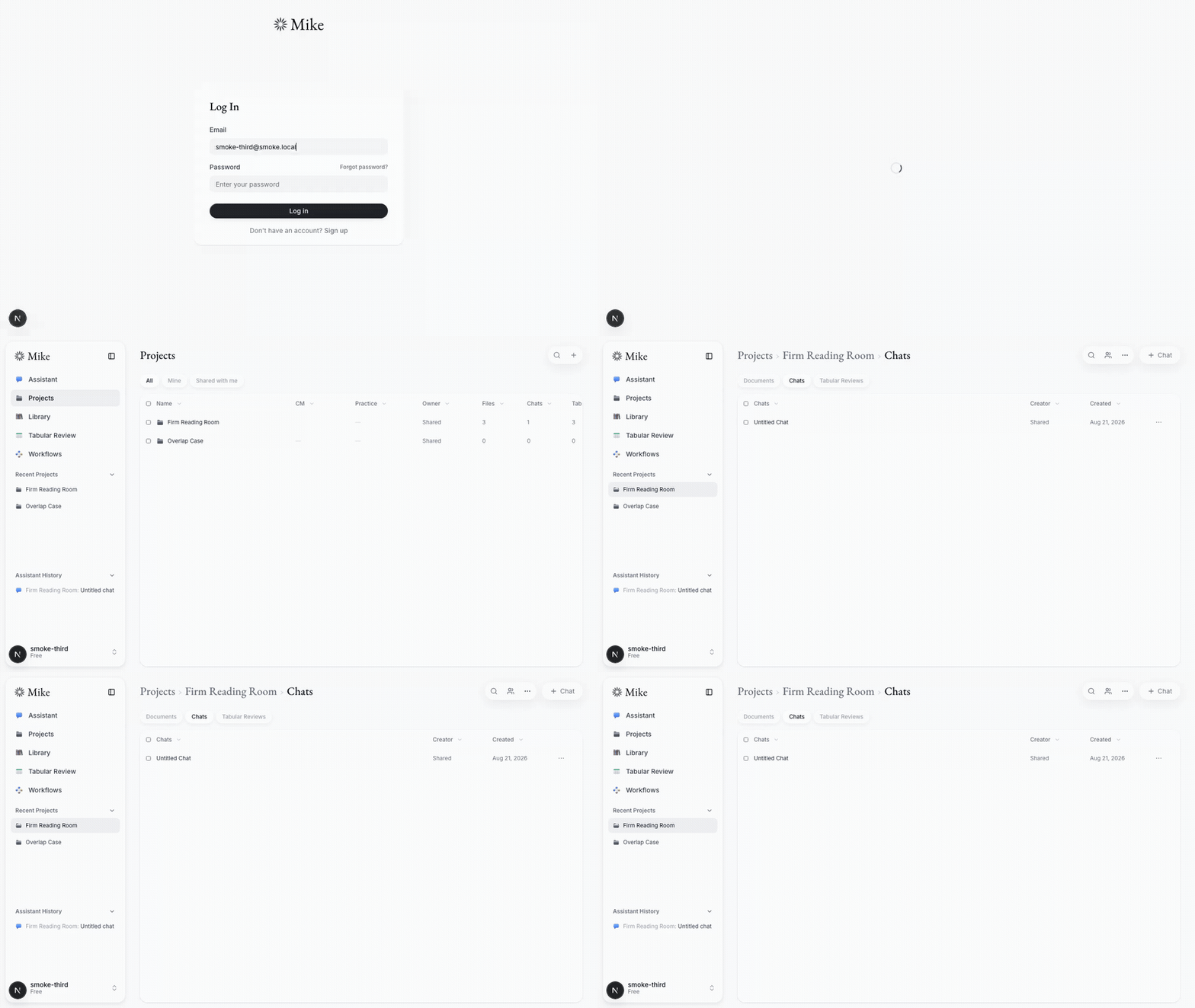
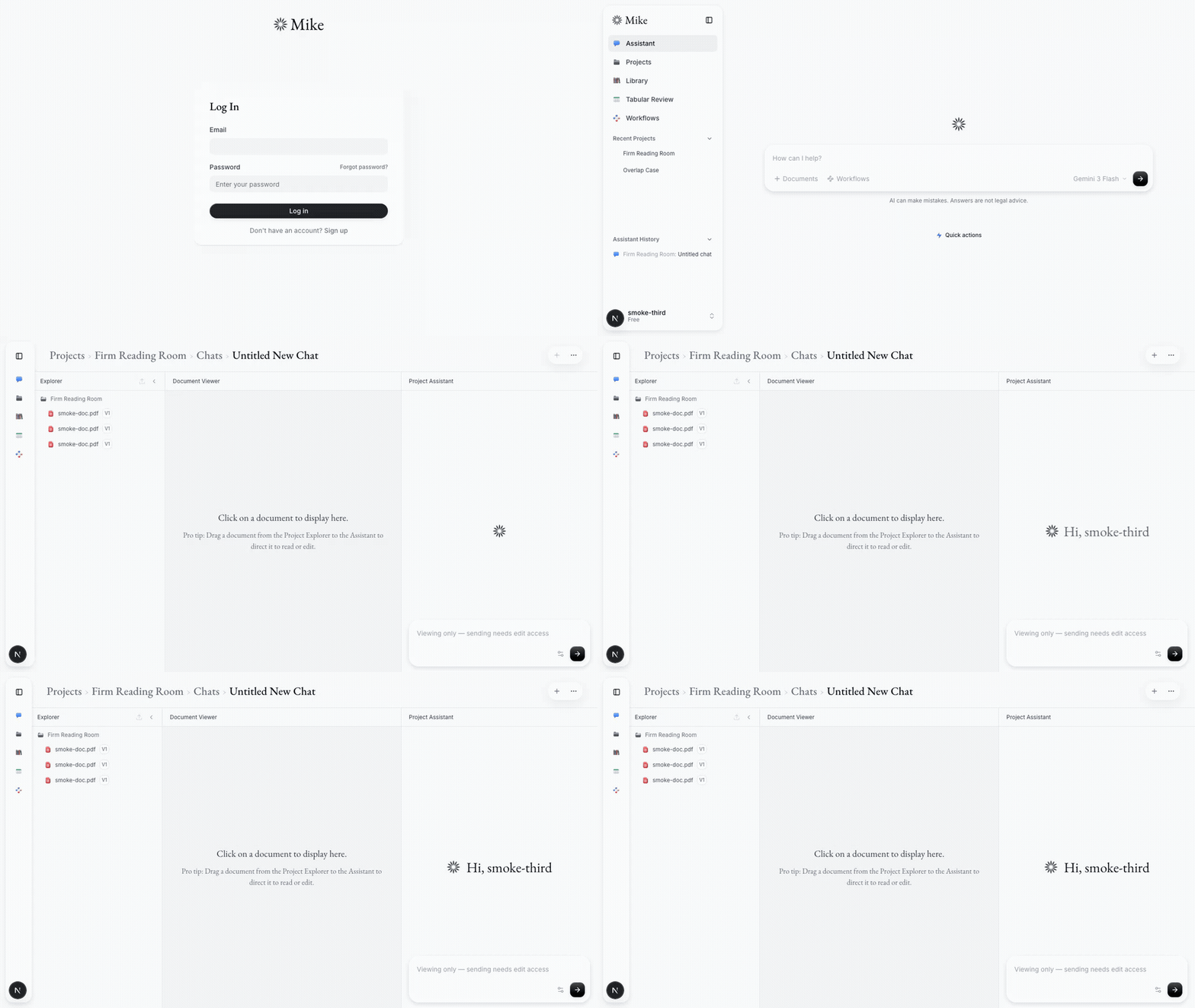
Live verification round — 2026-08-21 (tip
|
2 participants


Stacked on #267 — the base is its branch, so the diff below is just this PR's 5 commits.
What this is
#267 gave projects and tabular reviews one permission model:
shared_with+org_idcolumns, a role ladder (owner/manager/editor/viewer), routes gating oncan(role, capability), and list RPCs that match the detail routes. Chats never got any of it — no columns, an ad-hoc access check private to the route file, rename/delete doing rawuser_idfilters, and a chat list that disagreed with the detail endpoint. This PR makes chats the third resource on the same schema. Nothing new is invented; the existing model is applied.Concretely:
chatsgetsorg_id+shared_with, same shape astabular_reviews(migration + backfill).ensureChatAccessinlib/access.ts. It turns outensureReviewAccesswas already the general algorithm, so both are now thin wrappers over one shared derivation — they can't drift apart again.PATCH /chat/:idacceptsshared_with(manager+), andGET /chat/:id/peoplereturns the roster.get_chats_overviewnow takes the caller's email and returnsis_owner, and its predicate matchesensureChatAccessbranch for branch.access_role+is_ownerlike projects/reviews.Privacy: standalone chats stay private. They're stamped with the owner's single-member personal org, so org visibility only ever flows through project membership. Sharing a standalone chat is explicit, per-email.
Behaviour changes
GET /chat. List and detail now agree.content.edit). This resolves a real contradiction —generate-titlealready rewrote the same column at that tier whilePATCH404'd.container.deleteinstead of auser_idfilter, so a project owner can now delete a collaborator's chat inside their own project. They could already delete the whole project, so no net new power.:reviewIdin the path — previously any chat could be hit through any (or a made-up) review id, with no review access check.shared_with, so direct-share collaborators could open a review but 404'd on its chat list.Replication
Before (on #267): A shares a project with B and chats in it. As B,
GET /chatdoesn't list A's chat butGET /chat/<id>opens it. As B (editor),PATCH /chat/<id> {"title":"x"}→ 404 whilegenerate-titlesucceeds. AndDELETE /tabular-review/<any-uuid>/chats/<chatId>as the chat owner returns 204 despite the bogus review id.After: the chat shows up in B's list with
is_owner: false, the rename works for B (an org viewer gets 403), the bogus review path 404s. New: A shares a standalone chat with B viaPATCH {"shared_with": [...]}— B can open and chat in it (access_role: "editor") but can't delete it; a third user still 404s everywhere.Tradeoffs
content.editrather thanstructure.manage— consistency with the existing title-write path won over narrowness. A chat title is content, not structure.org_idbranch inensureChatAccessis a practical no-op for standalone chats (personal org). Kept anyway for symmetry with reviews — the privacy decision lives in the stamping policy, not in special-cased code.Testing
tsc --noEmitclean;vitest run→ 803 passed | 27 skipped (current tipa5e72d18, after the rebase ontod8183be4). Tests pin the fullensureChatAccessbranch/overlap matrix, the route tier walks (including asserting the update/delete filters are[{id}]alone — i.e. the rawuser_idfilters are really gone), the review-chat binding gates, and the non-creator 403 on review-chat writes.9a1277b+ migrations vs freshschema.sql):NO DRIFT.is_owner: false, private ones invisible; backfill stamps project chats with the project's org and standalone chats with the personal org.20260821_10/11applied over a database carrying real prior-round data — backfill stamped 21/21 existing chats; 8 scripted case groups green end-to-end against the running stack, including one real Anthropic stream through a shared standalone chat; recorded UI flows onassets/orgs-smoke-2026-08-21.a5e72d18from that round: review-chat rename/delete previously answered a success-shaped 204 no-op to a collaborator who wasn't the chat's creator (write scoped byuser_idmatched zero rows after the access gate passed).ensureReviewChatWriteAccessnow refuses non-creators with 403 "Only the chat's creator can modify it"; replicated live before/after.Note for CI: checks cannot run while the base is the
olp-pr/organizations-rbacstaging branch (workflows trigger on PRs tomainonly). Retargeting tomainafter #267/#268 merge gives this PR its first CI run.🤖 Generated with Claude Code