You signed in with another tab or window. Reload to refresh your session.You signed out in another tab or window. Reload to refresh your session.You switched accounts on another tab or window. Reload to refresh your session.Dismiss alert
Can you find a closed formula for the sum of the $p$-th powers of the first $n$ positive integers? That is, we need a closed formulat for the sequence:
$$
h_n=a_p n^p+a_{p-1} n^{p-1}+\cdots+a_1 n+a_0, \quad(n \geq 0)
$$
Solution
The method is to use difference sequences. We already know the following:
$$
1^3 + 2^3 + \ldots + n^3 = (1+2+\ldots + n)^2
$$
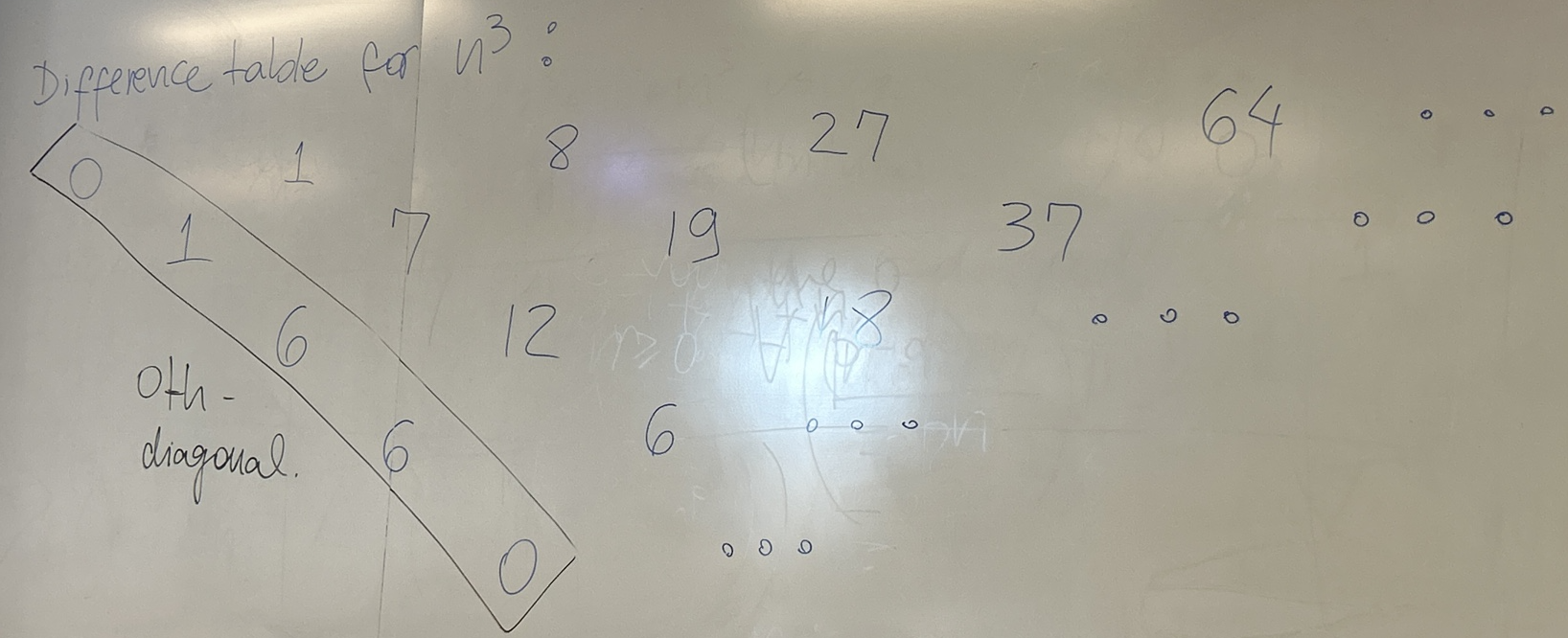
Now we want a new method. First, construct a difference table for $n^3$.
6 \cdot \binom{n+1}{3} + 6 \cdot \binom{n+1}{4}
$$
Use Pascal's formula for the last two terms. Then expand them to verify that this equation is true.
Our goal of this section is to find a general formula for the sequence $h_n = n^p$.
Definition
Let $(h_n){n \geq 0}$ be a sequence of numbers. We define a new sequence:
$$
\Delta h_0, \Delta h_1, \Delta h_2, \ldots, \Delta h_n, \ldots
$$
call the first-order difference sequence of $(h_n){n \geq 0}$ by :
$$
\Delta h_n = h_{n+1} - h_n
$$
Discrete derivative.
Definition
The second-order difference sequence of $(h_n){n \ge 0}$ is defined by
$$
\Delta^2 h_0, \Delta^2 h_1, \Delta^2 h_2, \ldots, \Delta^2 h_n, \ldots,
$$
where
$$
\Delta^2 h_n = \Delta(\Delta h_n) = \Delta h{n+1} - \Delta h_{n}.
$$
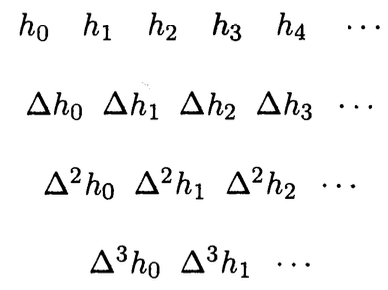
Then we can construct the difference table using this new notation:
Theorem 8.2.1
Let the general term of a sequence be a polynomial of degree $p$ in $n$:
$$
h_n = a_pn^p + a_{p-1}n^{p-1} + \ldots + a_1n + a_0, \quad(n\geq 0)
$$
Then, $\Delta^{p+1} h_n = 0$ for all $n \geq 0$.
Proof
Induction on $p$. IH:
$$
\Delta^{p+1}h_n = 0, \forall n \geq 0, \forall p \text{~-degree sequence } (h_n)_{n\geq 0}
$$
Base case: $p = 0$, then $(h_n){n \geq 0}$ is a constant sequence $\implies \Delta h_n = h{n+1} - h_n = 0$.
Induction step: Assume this holds for $p-1, p \geq 1$. Let's show that this holds for $p$ as well. We have:
$$
\begin{align*}
\Delta h_n = h_{n+1} - h_n &= \left(a_p(n+1)^p+a_{p-1}(n+1)^{p-1}+\cdots+a_1 n+a_0\right)\
& \quad -\left(a_p n^p+a_{p-1} n^{p-1}+\cdots+a_1 n+a_0\right)\
&= (a_p(n+1)^p - a_p n^p) + \text{polynomial with degree }p-1
\end{align*}
$$
By IH, the polynomial with degree $p-1$ goes to zero. Since we want to show that $\Delta^{p+1} h_n$ still goes to zero, we need to show that:
$$
a_p(n+1)^p - a_p n^p = 0
$$
Now, to solve this, we can use binomial theorm:
$$
\begin{align*}
a_p(n+1)^p - a_p n^p &= a_p\left( \sum_{i=0}^{p}\binom{p}{i}n^{i} \right) - a_pn^p\
&= a_p\left( \sum_{i=0}^{p-1} \binom{p}{i}n^i \right) + a_p n^p - a_pn^p\
&= a_p\left( \sum_{i=0}^{p-1} \binom{p}{i}n^i \right)
\end{align*}
$$
Which means that this polynomial also has degree $p-1$. Combining with the term above, we have:
$$
\Delta ^{p+1} = \Delta^p(\Delta h_n) = \Delta^p(\text{Polynomial with degree }p-1) = 0
$$
$\blacksquare$
Lemma Linearity of difference
Let $(f_n){n\geq 0}$ and $(g_n){n\geq 0}$ be two sequences of numbers. Let $(h_n)_{n\geq 0}$ be a sequence defined by:
$$
h_n = g_n + f_n
$$
For every $p \geq 0$ we have:
$$
\Delta^p h_n = \Delta^p g_n + \Delta^p f_n
$$
Proof
It suffices to show that:
$$
\Delta (f_n + g_n) = \Delta f_n + \Delta g_n
$$
Expand this and use commutative property to show this:
Can we recover a sequence by knowing the $0^{\text{th}}$ diagonal of its difference table?
Note that the $0-$diagonal has the terms:
$$
\Delta^0 h_0, \Delta^1 h_0, \Delta^2 h_0, \Delta^3 h_0, \ldots
$$
Lemma
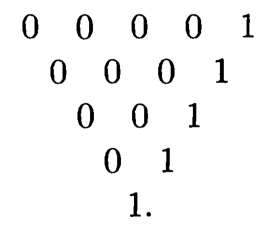
The general term of the sequence $\left(h_n\right){n \geq 0}$ such that the Oth diagonal of its difference table is
$$
\underbrace{000 \cdots 0}{p \text { zeros }} 1000 \cdots
$$
equals to
$$
h_n = \binom{n}{p}
$$
Proof
From the 0-diagonal, we can first try to recover the 1-diagonal, 2-diagonal... and so on:
Say the $1$ is the fifth number to appear in the 0-diagonal, then it also appears at the fifth position in the first row. All the other terms in the first row are zero. We are then looking for a sequence that has the following properties:
$$
h_0 = h_1 = h_2 = h_3 = h_4 = 0, h_1 = 1,
$$
Thus, if $h_n$ is sequence of degree 4, it has roots at $0, 1, 2, 3$. Write out out simple guess, we have:
$$
h_n = c \cdot n \cdot (n-1) \cdot (n-2) \cdot (n-3)
$$
for some constant $c$. To satisfies the term $h_1 = 1$, $c = \frac{1}{4!}$. We discover that $h_n = \binom{n}{4}$. More generally, $h_n = \binom{n}{p}$ if there are $p$ zeros in the beginning of the 0-diagonal.
Intuition: using the linearity property of differences and the fact that the 0th diagonal of a difference table determines the entire difference table, and hence the sequence itself, we obtain the next theorem.
Theorem 8.2.2
The general term of the sequence whose difference table has its 0th diagonal equal to
$$
c_0, c_1, c_2, \ldots, c_p, 0,0,0, \ldots, \quad \text { where } c_p \neq 0
$$
is a polynomial in $n$ of degree $p$ satisfying
$$
h_n=c_0\left(\begin{array}{l}
n \
0
\end{array}\right)+c_1\left(\begin{array}{l}
n \
1
\end{array}\right)+c_2\left(\begin{array}{l}
n \
2
\end{array}\right)+\cdots+c_p\left(\begin{array}{l}
n \
p
\end{array}\right)
$$
Now, we can back to the initial question: can we find a closed formula for the sum of the $p$-th powers of the first $n$ positive integers? Now we have the tools.
We can first write out the difference table. Then, we look at the 0-diagonal, and we reconstruct the sequence, but in the form we see in Theorem 8.2.2. Here is an example:
Exercise
Consider the sequence with general term
$$
h_n=n^3+3 n^2-2 n+1, \quad(n \geq 0)
$$
The 0-diagonal is $1,2,12,6,0,0, \ldots$. By using Theorem 8.2.2, we get:
$$
h_n = \binom{n}{0} + 2\binom{n}{1} +12\binom{n}{2} + 6\binom{n}{3}
$$
Summing them up:
$$
\sum_{k=0}^{n} h_k = \sum_{k=0}^{n}\binom{k}{0} + 2\sum_{k=0}^{n}\binom{k}{1} +12\sum_{k=0}^{n}\binom{k}{2} + \sum_{k=0}^{n}6\binom{k}{3}
$$
By hokey-stick identity, this turns to:
$$
\sum_{k=0}^{n} h_k = \binom{n+1}{1} + 2 \binom{n+1}{2} + 12 \binom{n+1}{3} + 6\binom{n+1}{4}
$$
The general expression of what we have calculated.
Theorem 8.2.3
Assume that the sequence $h_0, h_1, h_2, \ldots, h_n, \ldots$ has a difference table whose 0 th diagonal equals
$$
c_0, c_1, c_2, \ldots, c_p, 0,0, \ldots
$$
More generally, we want to find the patterns of the 0-diagonal of $h_n = n^p$. It has the form:
$$
c(p, 0), c(p, 1), c(p, 2), \ldots, c(p, p), 0,0, \ldots
$$
by Theorem 8.2.2, it follows that
There is a special case: when $p = 0, n^p = n^0 = 1 \implies c(0,0)\binom{n}{0} = 1 \implies c(0,0) = 1$
We rewrite this by introducing a new notation. Let
$$
[n]_k= \begin{cases}n(n-1) \cdots(n-k+1) & \text { if } k \geq 1 \ 1 & \text { if } k=0\end{cases}
$$
$$
S(p, 0)=\frac{c(p, 0)}{0 !}=c(p, 0)
$$
we have
$$
S(p, 0)= \begin{cases}1 & \text { if } p=0 \ 0 & \text { if } p \geq 1\end{cases}
$$
We can also take a look at $S(p, p)$. In the formula
$$
n^p = \sum_{k=0}^p \frac{c(p, k)}{k!}[n]_k
$$
when $k = p$, the last term of the right side is $(c(p,p) / p!) \cdot [n]_p$. Notice that $n$ has degree $p$ in $[n]_p$, and this term is the only one that contributes to degree $p$ on the left side. The coefficient of $n^p$ is 1, which implies $S(p,p) = 1$.
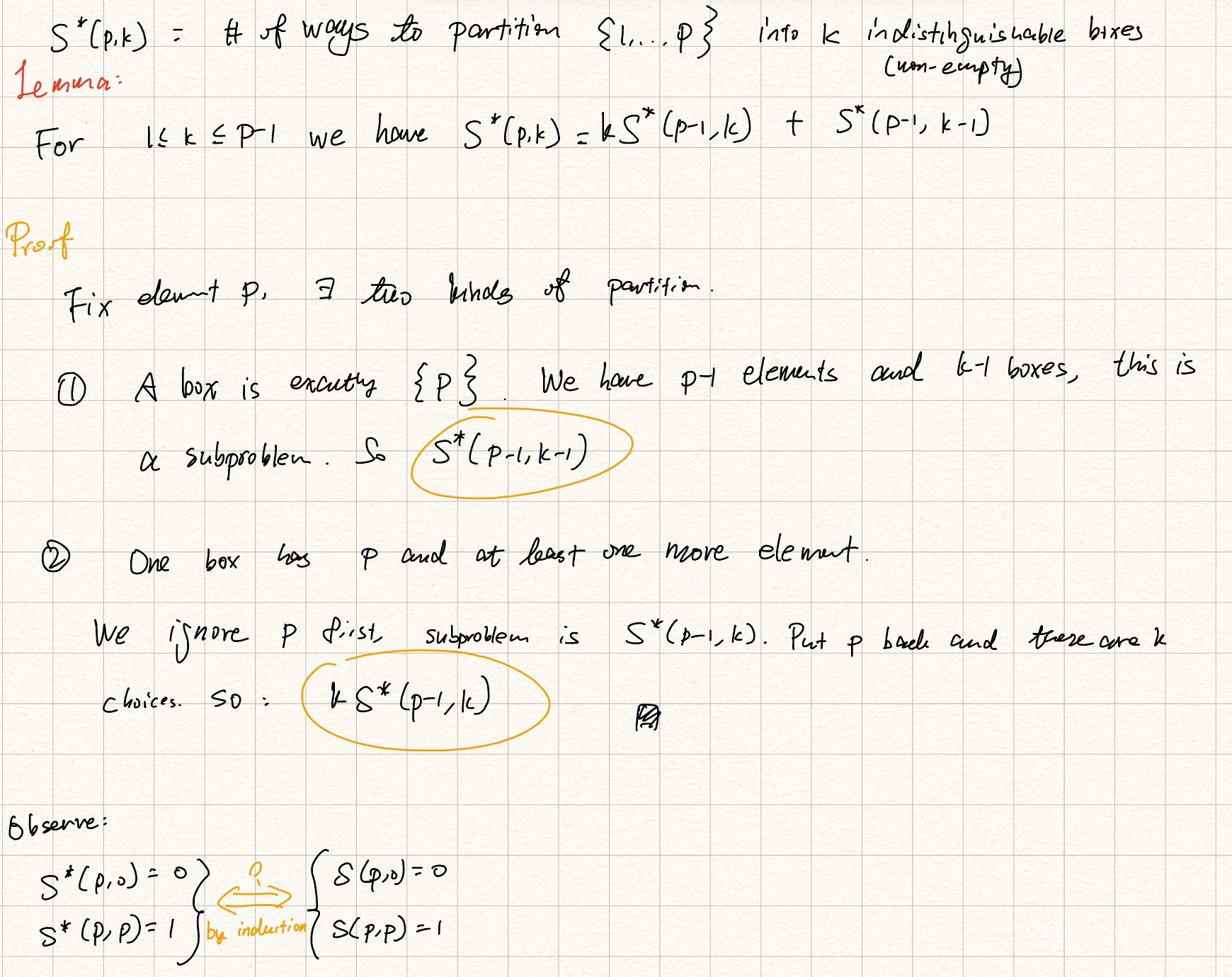
Stirling numbers of the second kind satisfy a Pascal-like recurrence relation.
Theorem
If $1 \le k \le p-1$, then
$$
S(p,k) = kS(p-1,k)+ S(p-1,k-1)
$$
Proof by induction on $n$.
$$
n^{p-1}\cdot n = \left( \sum_{k=0}^{p-1}S(p,k)[n]_k \right) \cdot n
$$
Then just calculation. Focus on the coefficient of $[n]_k$.
Meaning of Stirling number of the Second Kind
The Stirling number of the second kind $S(p, k)$ counts the number of partitions of a set of $p$ elements into $k$ indistinguishable boxes in which no box is empty.
A formula for Stirling numbers of second kind
Let $S^{#}(p,k)$ be the number of partitions of ${1,\ldots,p}$ into $k$ non-empty distinguishable boxes.
For each integer $k$ with $0 \le k \le p$, we have
The Bell number $B_p$ is the number of partitions of a set of $p$ elements into nonempty, indistinguishable boxes. Now we do not specify the number of boxes.
But since no box is to be empty, the number of boxes cannot exceed $p$.
We have
$$
B_p = S(p,0)+S(p,1)+\cdots+S(p,p).
$$
Theorem
If $p \geq 1$, then
$$
B_p = \binom{p-1}{0} B_0 + \binom{p-1}{1}B_1 + \ldots + \binom{p-1}{p-1}B_{p-1}
$$
Proof
Here is the construction:
There are $p$ elements in total, and some boxes.
Fix the element $p$.
Fix $t \in \set{0, \ldots, p-1}$ which chooses the number of elements in the box containning $p$.
Let $a_t = $ number of the choices of elements which are in the box with $p$, which equals $\binom{p-1}{t}$
It remains to partition $p-(t-1)$ elements into indistinguishable non-empty boxes $B_{p-t-1}$ ways. Writing out the relation we get:
==...==
Stirling number of the first kind
The Stirling numbers of the second kind show us how to write $n^p$ in terms of $[n]_0, [n]_1, \ldots,[n]_p$.
The Stirling numbers of the first kind play the inverse role. They show us how to write $[n]_p$ in terms of $n^0,n^1,\ldots,n^p$.
There exist coefficients $s(p,0), s(p,1), \ldots, s(p,p)$ such that
$$
n^p = \sum \limits_{k=0}^p (-1)^{p-k}s(p,k) n^k.
$$
The Stirling numbers of the first kind are the coefficients $s(p,k)$, with $0 \le k \le p$.
Stirling numbers of the first kind is also Pascal like. But I won't show it here.