 Espruino JavaScript
Something is broken in Puck.js SPI in new Espruino versions #3382

Replies: 31 comments

-
|
Posted at 2020-05-19 by @gfwilliams Thanks for letting me know - do you think you could post up the code that has the issue? I think 2v05 added SPI using DMA, which would mean that while the bitrate was the same the SPI data probably got pushed out faster (without gaps). I guess it's possible that caused some problems. |
Beta Was this translation helpful? Give feedback.

-
|
Posted at 2020-05-19 by SergeP Thank you. I flashed v2.05.27 so my experiments were with the version, and I had 1.v92 before. code is just a modified TLE94112 example code: |
Beta Was this translation helpful? Give feedback.
-
|
Posted at 2020-05-19 by SergeP Update: it does not work even at lower speed. I have not recognized still why. Some TLE registers may be written and some may be read but not full control sequence. |
Beta Was this translation helpful? Give feedback.
-
|
Posted at 2020-05-19 by SergeP I'll try to go to v2.04 |
Beta Was this translation helpful? Give feedback.
-
|
Posted at 2020-05-19 by @gfwilliams Could you try replacing: with: Not sure if that'll help but it wasn't really proper JS before. I'll update the example on the Espruino site. You could also try using software SPI: I'm not 100% sure if Espruino on nRF52 ever supported |
Beta Was this translation helpful? Give feedback.
-
|
Posted at 2020-05-19 by SergeP I'm sure it worked at v1.92 more then 3 years 24h without any breaks. Great stability of your Espruino system! |
Beta Was this translation helpful? Give feedback.
-
|
Posted at 2020-05-19 by SergeP It looks like working on 2.04. At least, I see correct voltage transitions on pins. |
Beta Was this translation helpful? Give feedback.
-
|
Posted at 2020-05-19 by SergeP Greenhouse control works at v2.04! |
Beta Was this translation helpful? Give feedback.
-
|
Posted at 2020-05-20 by @gfwilliams Thanks for checking this - and glad you got it working! So you checked the pins? Do you see anything happening at all on 2v05, or is it sending data but not the right data?
As far as I know nothing has changed on OneWire - however because the Bluetooth stack jumps in and does some work in the background, ongoing Bluetooth connections can cause it to be unreliable - that might be what you're hitting here. I doubt anything if different between versions but if you're connected (especially if you sent something to it in the last 2 minutes so it's still in the 'high speed' Bluetooth connection mode) then you will probably see some unreliability. |
Beta Was this translation helpful? Give feedback.
-
|
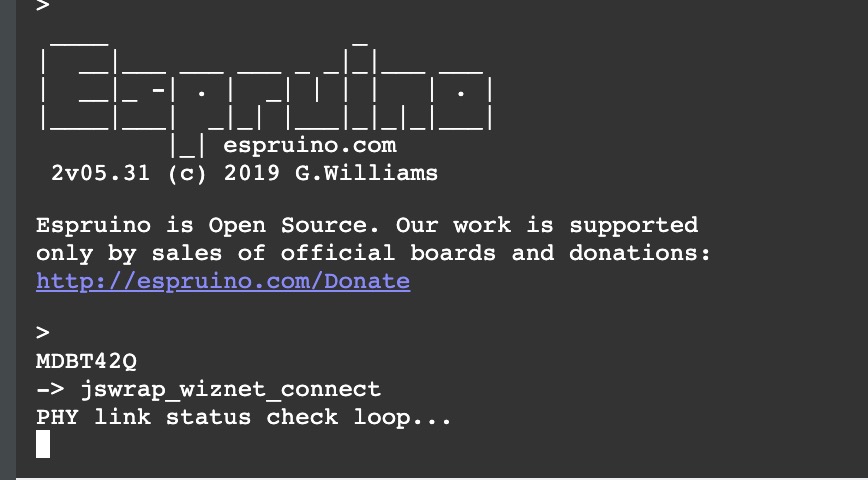
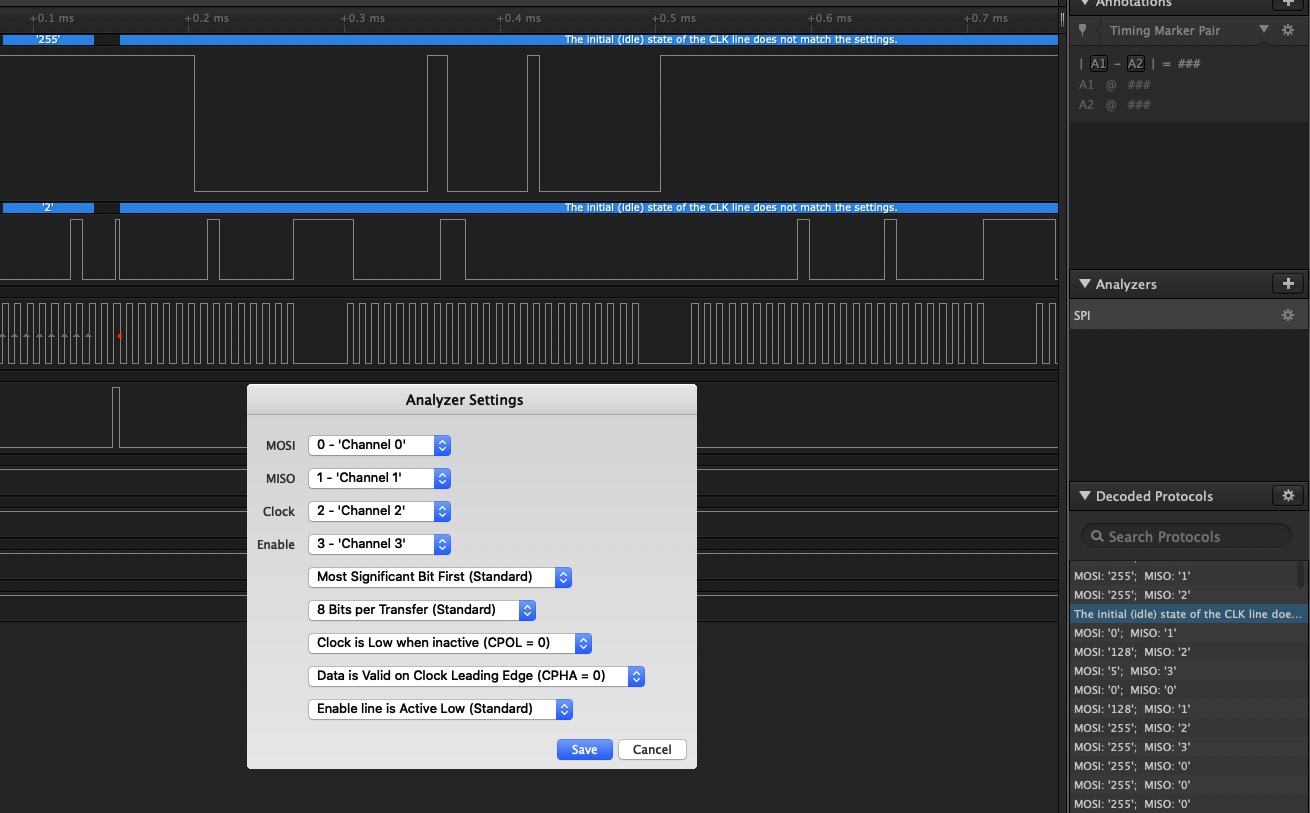
Posted at 2020-05-22 by @MaBecker Used code, stuck in loop with pluged in ethrnet cabel, same module works with PICO Attachments: |
Beta Was this translation helpful? Give feedback.
-
|
Posted at 2020-05-22 by @gfwilliams Do you see anything on the capture? It looks for me like everything is working ok? Is the waveform different to what happens on the Pico? I guess you could try specifying a lower bitrate as @sergep had tried? Maybe SPI send is working ok but receive isn't? But I'm pretty sure that's tested. All I can think is maybe now DMA is used from transfers the CS line isn't being asserted properly? |
Beta Was this translation helpful? Give feedback.
-
|
Posted at 2020-05-22 by @MaBecker
Pico does not have that I will solder devices to a perforated board with female pin header and try again. |
Beta Was this translation helpful? Give feedback.
-
|
Posted at 2020-05-22 by SergeP By the way, usual issue with DMA-controlled serial communications is that CS line is goes back to inactive state too early, when last byte is sent to DMA subsystem or to shift register, not waiting for it is fully goes out of system. I have seen that even in some hardware USARTs. |
Beta Was this translation helpful? Give feedback.
-
|
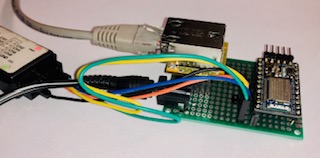
Posted at 2020-05-24 by @MaBecker Ok, back with a soldered setup, see attached picture. Pico can handle WIZ550io and WIZ850io without issues over SPI2 MDBT42Q communication over SPI1. Any hints? Attachments: |
Beta Was this translation helpful? Give feedback.
-
|
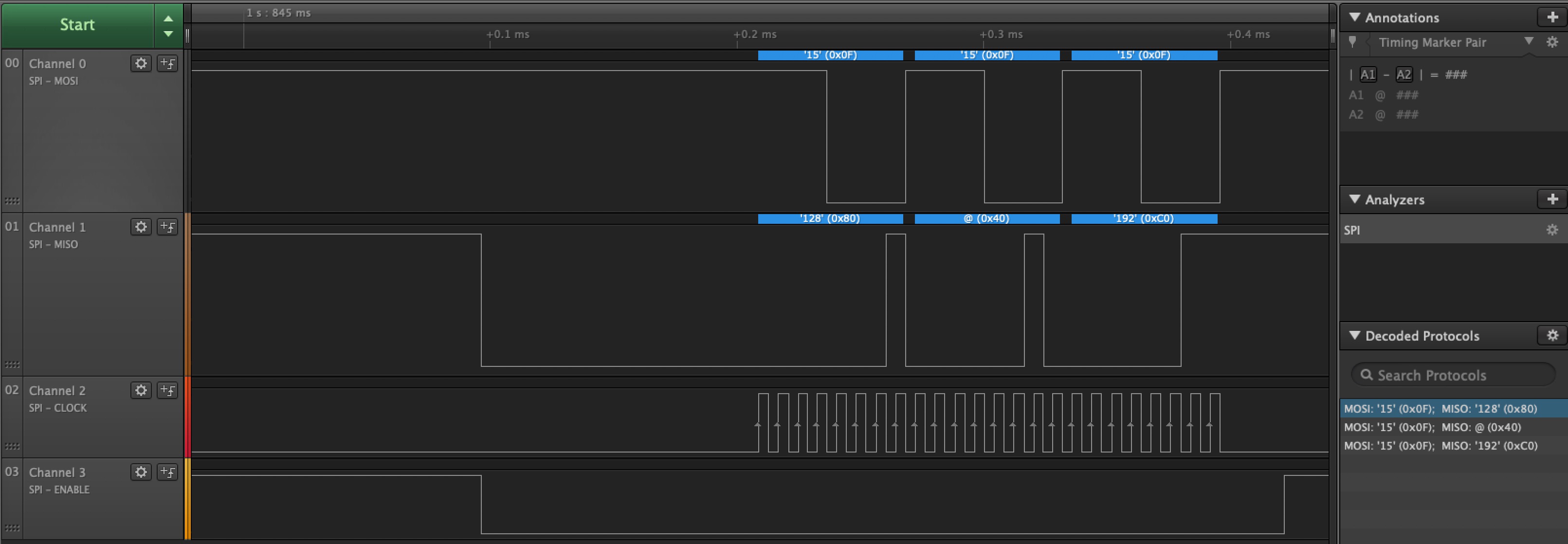
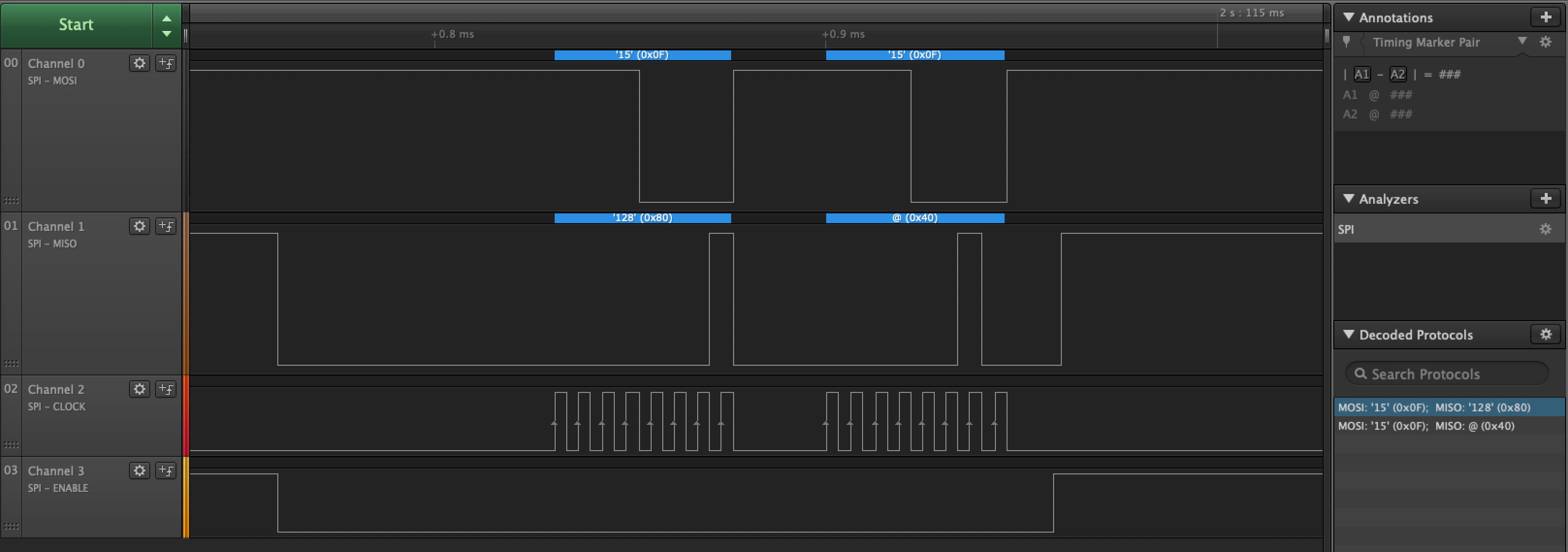
Posted at 2020-05-24 by @MaBecker PICO first 25 decoded SPI traffic MDBT42Q first 25 decoded SPI traffic |
Beta Was this translation helpful? Give feedback.
-
|
Posted at 2020-05-25 by @fanoush not sure if it is related or there already is fix in espruino code for this issue but there is known bug when sending and receiving one byte over nrf52 spi with DMA, see https://devzone.nordicsemi.com/f/nordic-q-a/16401/sending-single-bytes-over-hw-spi-0xff-appended-every-other-time with link to workaround zip with source or see directly https://infocenter.nordicsemi.com/topic/errata_nRF52832_Rev2/ERR/nRF52832/Rev2/latest/anomaly_832_58.html?cp=4_2_1_0_1_8 for issue described |
Beta Was this translation helpful? Give feedback.
-
|
Posted at 2020-05-25 by @MaBecker Wow - thanks for posting! |
Beta Was this translation helpful? Give feedback.
-
|
Posted at 2020-05-25 by @fanoush would that explain the issue you see or it is something else? happens only if you are both reading and writing exactly one byte over spi with dma, looks like tx cannot stop after first byte properly if it is waiting for receiving byte. if you don't read and just write one byte it works ok. |
Beta Was this translation helpful? Give feedback.
-
|
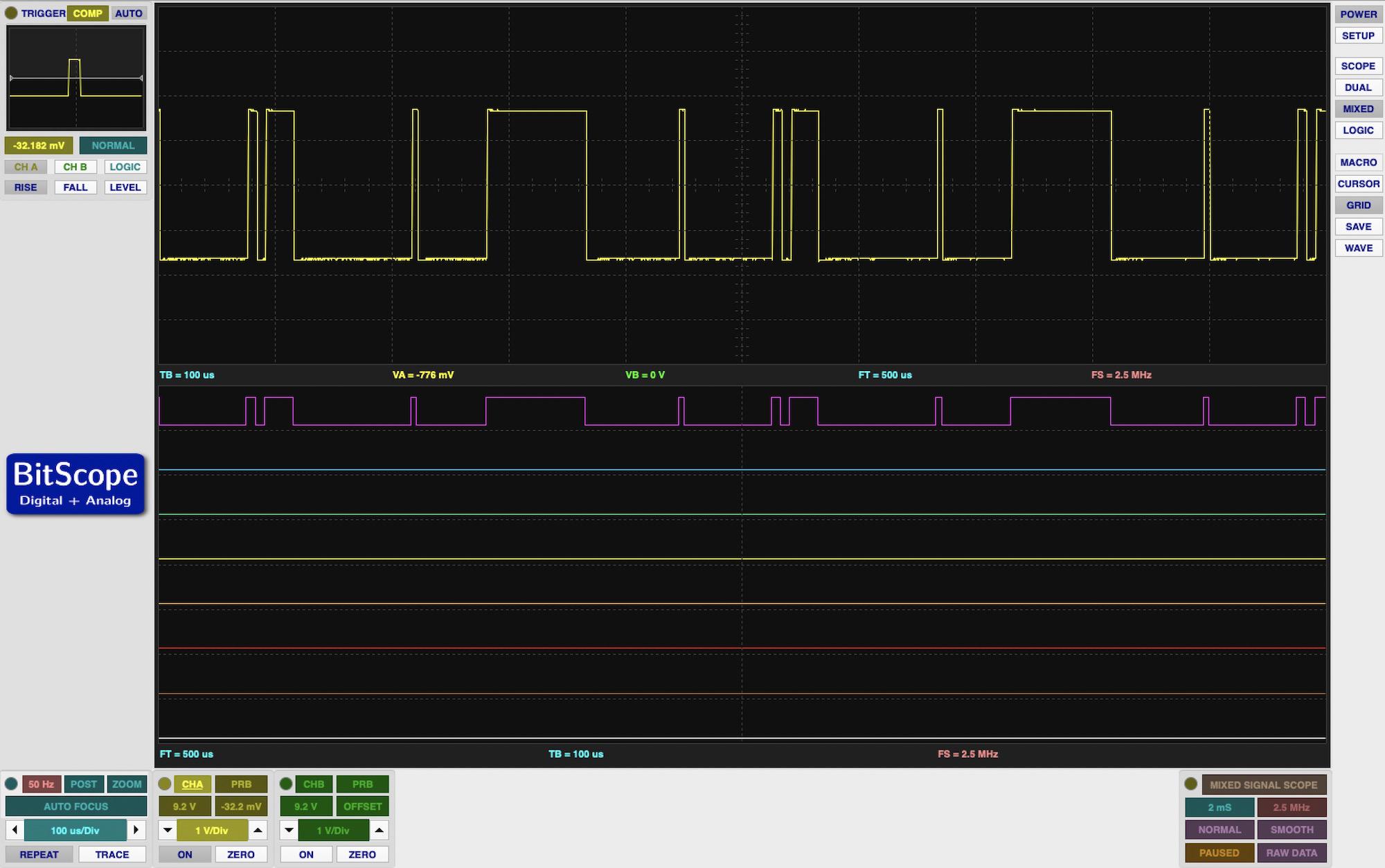
Posted at 2020-05-25 by @MaBecker Recording MOSI from a MDBT42Q: analog and digital show the same. Attachments: |
Beta Was this translation helpful? Give feedback.
-
|
Posted at 2020-05-25 by SergeP @MaBecker, could you add clk and, may be, cs? it is too hard to read SPI data without clk. |
Beta Was this translation helpful? Give feedback.
-
|
Posted at 2020-05-25 by @MaBecker Attachments: |
Beta Was this translation helpful? Give feedback.
-
|
Posted at 2020-05-25 by @MaBecker And this is what we get when using a PICO Attachments: |
Beta Was this translation helpful? Give feedback.
-
|
Posted at 2020-05-25 by @allObjects
as in post #14 by @sergep is not necessarily a surprise to me... switching from code controlled / bit-banged-like IO to DMA controlled IO, means that any dependent follow-up line behavior has to be handled with callbacks / interrupts. When Espruino firmware does handle this correctly, there may be an issue when done in the application, as I've done in the past... Setting the CS line before an unknown sequence of IO calls without passing the ns (NegativeSelect / CS) pin argument except for the last one should always work, since I expect the Espruino firmware takes correct care for he CS line. |
Beta Was this translation helpful? Give feedback.
-
|
Posted at 2020-05-26 by @MaBecker @gfwilliams any hint how to fix this? |
Beta Was this translation helpful? Give feedback.
-
|
Posted at 2020-05-26 by @gfwilliams I think the issue is as @fanoush says. Frustrating as I'd come across this years ago and just assumed that at some point they would have added the workaround to the SDK itself :( Annoyingly it always worked fine for me because I sent more than one byte at a time for my tests. I'll look into adding a workaround for this. |
Beta Was this translation helpful? Give feedback.
-
|
Posted at 2020-05-26 by @gfwilliams Ok, just fixed. If you pull the latest from http://www.espruino.com/binaries/travis/master it should be sorted! |
Beta Was this translation helpful? Give feedback.
-
|
Posted at 2020-05-26 by @MaBecker Just tested
|
Beta Was this translation helpful? Give feedback.
-
|
Posted at 2020-05-26 by @fanoush It doesn't matter much for 1 byte transfers but in theory the test could be if (count==1 && rx) because it is rx dma what triggers the bug, sending one byte without receiving anything (i.e RXD.MAXCNT==0) works fine. not sure what is actually faster or make more sense - using dma for sending just 1 byte or disabling it, sending and enabling back. |
Beta Was this translation helpful? Give feedback.
-
|
Posted at 2020-05-27 by @gfwilliams
Thanks - actually that goes a long way towards explaining how this slipped through! Now I've made the change that disables DMA for one byte (I don't know why Nordic's solution was that nasty hack with PPI) I was wondering about using it for 2 bytes too. In terms of performance it seems it's probably better not to use DMA in those cases. |
Beta Was this translation helpful? Give feedback.
-
|
Posted at 2020-05-27 by @fanoush
I think they wanted to avoid reconfiguring SPI interface from the new EasyDMA SPIM to the older SPI one (as it is actually somehow different HW block inside). That saves them to touch/reset lot of registers including speed, mode, interrupt flags etc. Maybe for some engineer it was not nasty but neat and clever trick to use PPI so it could stay working in DMA mode. But still your fix may be actually more practical. |
Beta Was this translation helpful? Give feedback.


Uh oh!
There was an error while loading. Please reload this page.
-
Posted at 2020-05-18 by SergeP
Hi!
After long time I've started to update my greenhouse controller. It is based on Puck.js, whick is glued in center of the box.
First of all I upgraded Puck.js firmware from v1.92 to have working BLE characteristics (there were bugs with BLE at the old version). After the upgrade I've found that my greenhouse is dry, because TLE94112 is not response.
I made a few tests and discovered that maximal SPI speed to have it responsible is now 740000 baud (and 750000 is already too much) while at v1.92 it works at 1000000 baud and more. So, I think, something is wrong in SPI in new versions. Or, may be, somethink was wrong in old one. In any case, compatibility is broken.
I will change my soft, of course. But be aware because it may be invisible evil bug in the code ;)
Beta Was this translation helpful? Give feedback.
All reactions