English | 简体中文
A partial-rollout pipeline for synchronous RL training, designed to reclaim GPU bubbles caused by long-tail response lengths via sample supplementation and mid-generation interruption with cross-step resume.
⚠️ Don't confuse this with the fully-async framework's partial rollout. This pipeline still runs the synchronous loop "rollout → wait for batch → one train step"; the only twist is that long-tail samples can be interrupted mid-rollout and resumed in a later step. Trainer and rollout phases remain serial. If you want the trainer/rollout fully decoupled and advancing concurrently, seeverl/experimental/fully_async_policy/— not here.
🔗 Verl dependency. Pinned against
verl-project/verl@60546ef2(on GitHub). Exactpip install/git checkoutrecipe in REQUIRED_VERL.txt. Rolling againstmain; bump the pin when refreshing.
Synchronous PPO/GRPO training in verl waits for every prompt in a batch to finish generating before stepping. RL training datasets are highly right-skewed in response length: empirically a small fraction of samples (~3%) emit dramatically longer responses than the median, and these long-tail samples are often the harder, more informative ones — you can't drop them without hurting accuracy. The whole batch stalls on the slowest few; GPUs idle.
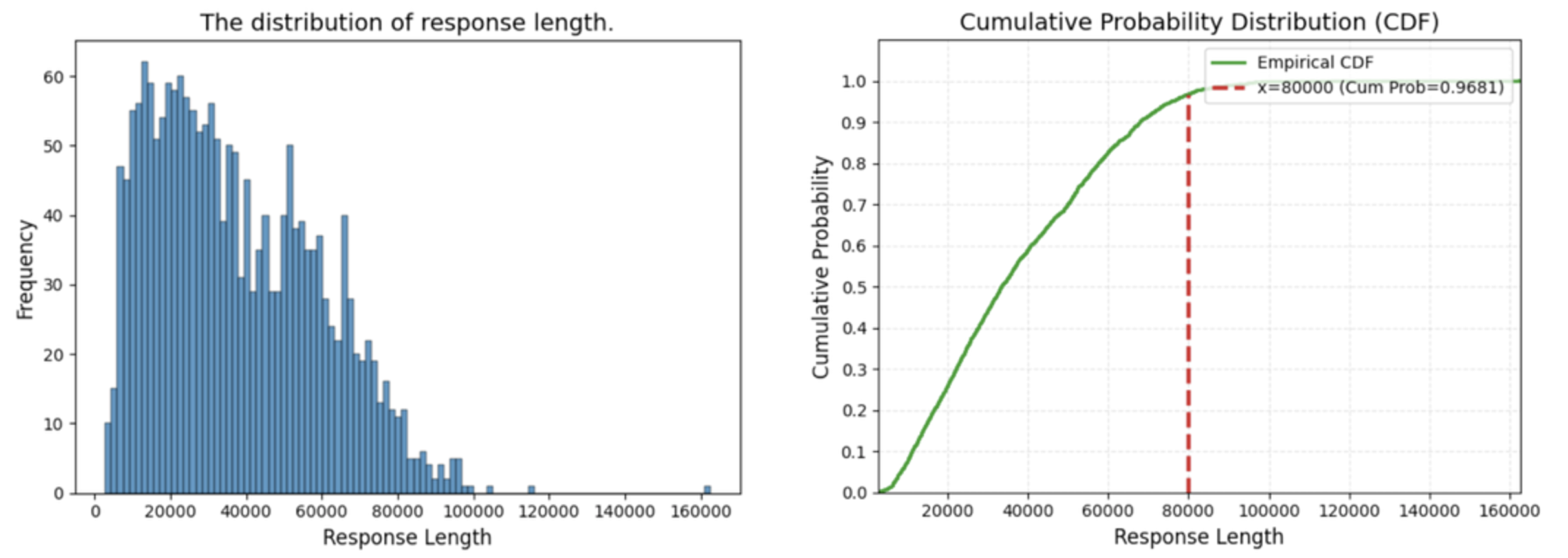
Partial rollout closes this bubble with two ideas (see the APRIL paper for the academic treatment):
- Sample supplementation: when faster workers run out of work, immediately top them up with the next prompt — don't sit idle waiting for the long tail.
- Mid-generation interruption + cross-step resume: when the batch's "done" target is met but a few samples are still mid-generation, interrupt them at the step boundary, cache their KV state, and resume them in the next training step. The recipe pays one weight-version drift per resumed sample, corrected by token-level rollout importance sampling (off-policy correction).

Net effect: convert long-tail GPU bubbles into useful work on the next batch's prompts, at the cost of mild off-policy drift on resumed samples — which token-level IS handles cleanly.
Use it when:
- The dataset has a long-tailed response length distribution (a small fraction of very long samples drags down each step).
- Synchronous PPO/GRPO shows a visible GPU bubble waiting on those long-tail samples.
- Training tolerates mild off-policy drift — partial rollout inherently spans multiple weight versions; pair it with IS correction.
- Multi-turn / tool-call workloads — upstream vLLM ≥ 0.12's
pause_generation+ abort is enough; no recipe-side server fork.
Skip it when:
- Response lengths are uniform with no long-tail bubble — the plain synchronous trainer is simpler.
- Strict on-policy is required (every trajectory must come from the current weights).
- You need to mix this pipeline with the upstream sync trainer's batch-shape assumptions — PartialRollout-specific fields (dummy
gen_batch, continuous-worker semantics) would break them.
                 trainer (PartialRolloutRayPPOTrainer)
                        │
            push_batch  │  pull_batch
                        ▼
         ┌──────────────────────────────────┐
         │   RolloutPromptManager (Ray)     │
         │                                  │
         │   pending ─pull─► ongoing ─push─► done
         └──────────────────────────────────┘
                        │
            pull_prompts│push_prompts
                        ▼
              PartialRolloutAgentLoopWorker  ×N   (run_continuous loop)
                        │
              llm_client│ generate (FullyLLMServerClient retries aborted)
                        ▼
              PartialRolloutvLLMReplica  ×replicas
                ↳ PartialRolloutvLLMHttpServer  (Python `paused` gate + abort drain)
                        ▲
              cancel/   │
              resume    │
                        │
              PartialRolloutLLMServerManager
| Component | File | Role |
|---|---|---|
PartialRolloutRayPPOTrainer |
ray_trainer.py |
Main trainer loop. _fit_generate pushes prompts into the manager, awaits one full batch via async_rollout_manager.generate_sequences, runs log_prob / advantage / policy update, then update_weights. |
RolloutPromptManager |
prompt_manager.py |
Single-threaded Ray actor holding the three queues (pending / ongoing / done). pull_batch and pull_prompts both block on asyncio.Events — no busy polling, no per-empty-pull RPCs. |
PartialRolloutAgentLoopManager / PartialRolloutAgentLoopWorker |
agent_loop/agent_loop.py |
Worker runs a persistent loop (run_continuous) sharing one asyncio.wait across the pull RPC, the _run_one rollout tasks, and a slot-wait sentinel. Instead of overriding upstream generate_sequences (left intact for the validation path), the worker adds generate_for_prompt, which is upstream's generate_sequences with the trailing outputs = await asyncio.gather(*tasks) replaced by an asyncio.wait(FIRST_COMPLETED) loop that decrements self.inflight_traj and signals self._slot_event after each trajectory completion. The outer loop pulls the next prompt as soon as inflight_traj + n <= max_inflight_prompts * n — so a long-tail trajectory doesn't block other in-flight prompts from making room for the next pull. Manager exposes cancel() / resume() (delegated to PartialRolloutLLMServerManager) for trainer-side bracketing of update_weights. |
PartialRolloutvLLMHttpServer / PartialRolloutvLLMReplica |
vllm_rollout/vllm_async_server.py |
vLLM HTTP server with a Python-side _resume_event gate (vLLM <0.12 lacks pause_generation). cancel() clears the gate so new generate() calls hang at the wrapper layer, then loops abort_all_requests(reset_prefix_cache=False) until in-flight drains. resume() sets the gate, releasing queued callers. Drop this whole layer once vLLM ≥0.12 is the floor. |
PartialRolloutLLMServerManager |
llm_server.py |
Thin override of upstream LLMServerManager: swaps rollout_replica_class to PartialRolloutvLLMReplica, forces get_client(fully_async=True) so callers receive the retry-on-abort FullyLLMServerClient, and fans cancel / resume out to each replica. Installed via a monkey-patch in PartialRolloutRayPPOTrainer.init_workers because upstream has no FQN config knob for LLMServerManager. |
- Prompt ownership during scheduling: at any instant a prompt lives in exactly one of pending / ongoing / done.
pull_promptsmoves pending→ongoing;push_promptsis ongoing→done — terminal only. There is no aborted-back-to-pending re-queue path, becauseFullyLLMServerClient.generate()absorbs the abort/retry cycle inside one logical generate call. - Cross-step abort/resume bracket:
PartialRolloutAgentLoopManager.generate_sequencesrunsawait self.resume()at entry andawait self.cancel()afterpull_batchreturns. The naivecheckpoint_enginebackend (PartialRollout's default) short-circuits before its own abort, so the recipe wires this itself; workers' abortedclient.generate(...)calls wait insideFullyLLMServerClient's retry loop until the next step'sresume(). - Per-sample weight-version tracking lives in
gen_batch.meta_info["global_steps"](set by the trainer) andFullyLLMServerClient.generate()(records the actual versions each retry submitted against). The worker does no per-call version tracking. - Continuous worker loop + trajectory-grained pull pacing: each
PartialRolloutAgentLoopWorkerrunsrun_continuousfor the actor's lifetime. Budget is counted in trajectories (max_inflight_prompts * n), not prompts. Inside each in-flight prompt,generate_for_promptawaits the n trajectories viaasyncio.wait(FIRST_COMPLETED)— every completion decrementsself.inflight_trajand setsself._slot_event, waking the outer loop to pull the next prompt as soon as a prompt's worth of trajectory slots have freed up across all in-flight prompts (no need to wait for any one prompt to fully complete). Pull RPC,_run_onetasks, and the slot-wait sentinel all live in the sameasyncio.wait(running)set; identity checks dispatch the three task kinds. - The dummy
gen_batchmust carryuid: when the dataloader is exhausted at the end of an epoch, the placeholder batch built to drain in-flight prompts still needsnon_tensor_batch["uid"], otherwise the manager can't compute the row count. - Stateful dataloader resume:
PartialRolloutRayPPOTrainer.fit()resumes via the stateful dataloader automatically — don't add manual skip-on-resume logic. - No graceful shutdown:
run_continuousruns for the actor's lifetime; Ray terminates workers at process exit (afterfit()returns). Any rollouts in flight at exit time are abandoned — acceptable because the trainer isn't going to consume them anyway.
Single-turn:
bash recipe/partial_rollout/run/run_qwen3-0.6b_gsm8k_grpo.shMulti-turn with tool calls — first generate the tool-agent dataset:
python3 examples/data_preprocess/gsm8k_multiturn_w_tool.py \
    --local_save_dir $HOME/data/gsm8k_tool
then launch:
bash recipe/partial_rollout/run/run_qwen3-0.6b_gsm8k_grpo_tool.shSame model / data / batch / hyperparameters; the only differences from the PR variants are the upstream entry, the upstream agent loop, and no IS correction:
bash recipe/partial_rollout/run/run_qwen3-0.6b_gsm8k_grpo_baseline.sh
bash recipe/partial_rollout/run/run_qwen3-0.6b_gsm8k_grpo_tool_baseline.sh| Key | Value | Notes |
|---|---|---|
actor_rollout_ref.rollout.agent.default_agent_loop |
single_turn_agent / tool_agent |
Use upstream agent loops directly — FullyLLMServerClient handles abort/retry, no PartialRollout wrapper needed. |
+async_training.partial_rollout |
True |
Gates the retry-on-abort path inside FullyLLMServerClient. Required for any PartialRollout run; set via Hydra + (the key isn't pre-declared in the trainer config). |
algorithm.rollout_correction.rollout_is |
token (recommended) / sequence |
Sequence-level ratios easily hit the exp(±20) safety clamp once rollouts span several weight versions. |
algorithm.rollout_correction.rollout_is_threshold |
2.0 |
TIS upper bound; for IcePop pass "0.5_5.0". |
actor_rollout_ref.rollout.multi_turn.enable |
True (tool variant only) |
Enables multi-turn. |
actor_rollout_ref.rollout.multi_turn.tool_config_path |
YAML path | Tool registry; shared across backends. |
partial_rollout/
├── README.md / README_zh.md / REQUIRED_VERL.txt
├── main_ppo.py                # @hydra entry; wraps PartialRolloutTaskRunner
├── ray_trainer.py             # PartialRolloutRayPPOTrainer
├── prompt_manager.py          # RolloutPromptManager (Ray actor)
├── llm_server.py              # PartialRolloutLLMServerManager (force fully_async + cancel/resume)
├── agent_loop/
│   └── agent_loop.py          # PartialRolloutAgentLoopManager / PartialRolloutAgentLoopWorker
├── vllm_rollout/
│   └── vllm_async_server.py   # PartialRolloutvLLMHttpServer / PartialRolloutvLLMReplica (paused gate)
└── run/
    ├── gsm8k_tool_config.yaml                      # tool registry for the tool variants
    ├── run_qwen3-0.6b_gsm8k_grpo.sh                # PR, single-turn
    ├── run_qwen3-0.6b_gsm8k_grpo_tool.sh           # PR, tool-call
    ├── run_qwen3-0.6b_gsm8k_grpo_baseline.sh       # baseline, single-turn
    ├── run_qwen3-0.6b_gsm8k_grpo_tool_baseline.sh  # baseline, tool-call
    └── run_{dapomath,gsm8k}_{nopr,pr}_grpo_4b_*.sh # 4B Qwen3 ports of the recipe PR