Structured Business Systems — 10x Faster Than Traditional Frameworks


Building custom business applications is expensive and slow:
- Traditional development: 6-12 months for a basic business application
- Proprietary enterprise platforms: High recurring licensing costs + vendor lock-in
- Customizing platforms: Expensive and complex
- No-code tools: Limited power for complex business logic
Define your business app declaratively in YAML/XML. SaltOS 4 automatically generates:
- ✅ Full REST API with authentication
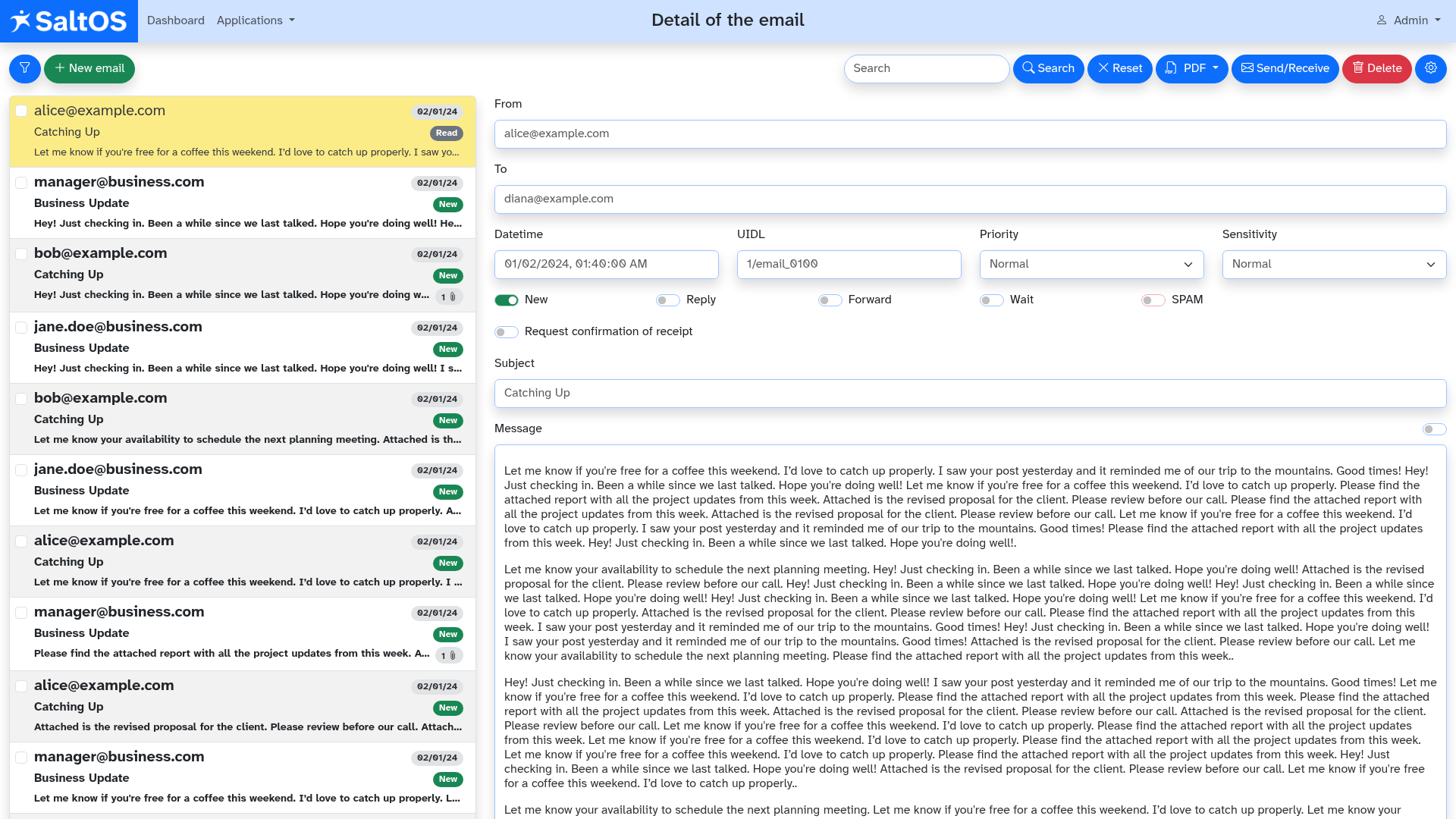
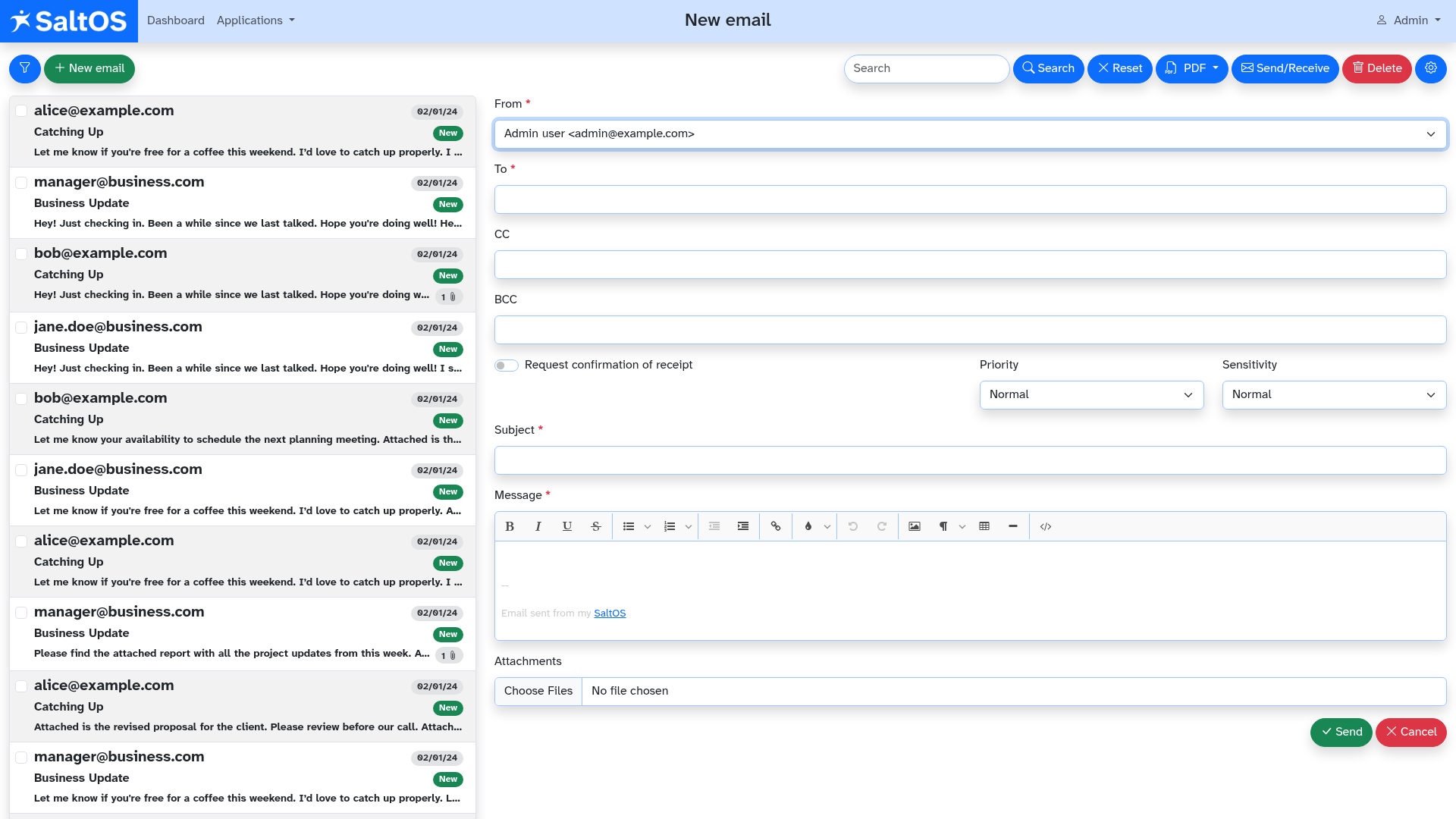
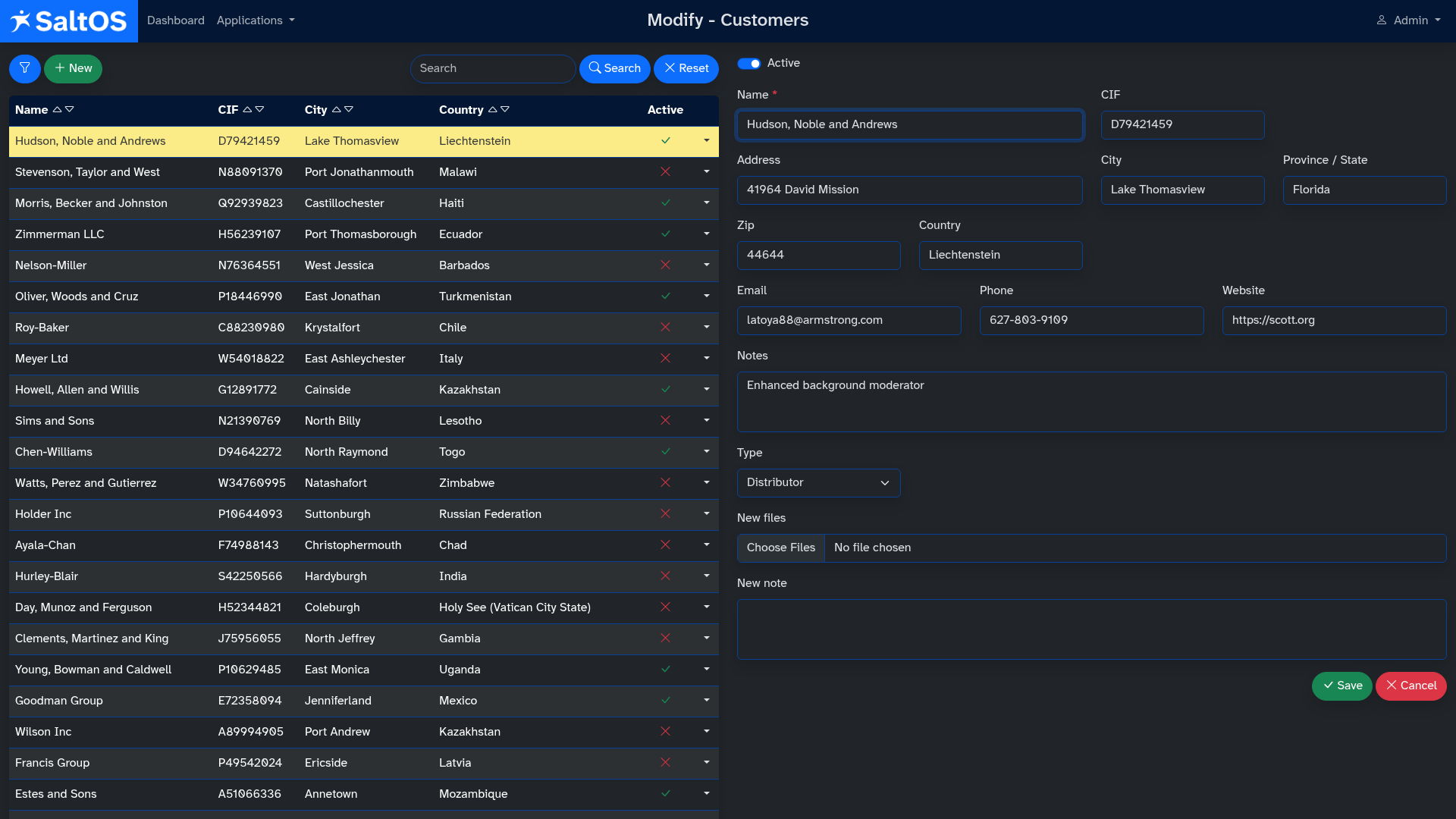
- ✅ Responsive web UI (desktop + mobile)
- ✅ Complete audit trail with blockchain integrity
- ✅ Multi-language support (EN/ES/CA)
- ✅ Offline-first Progressive Web App
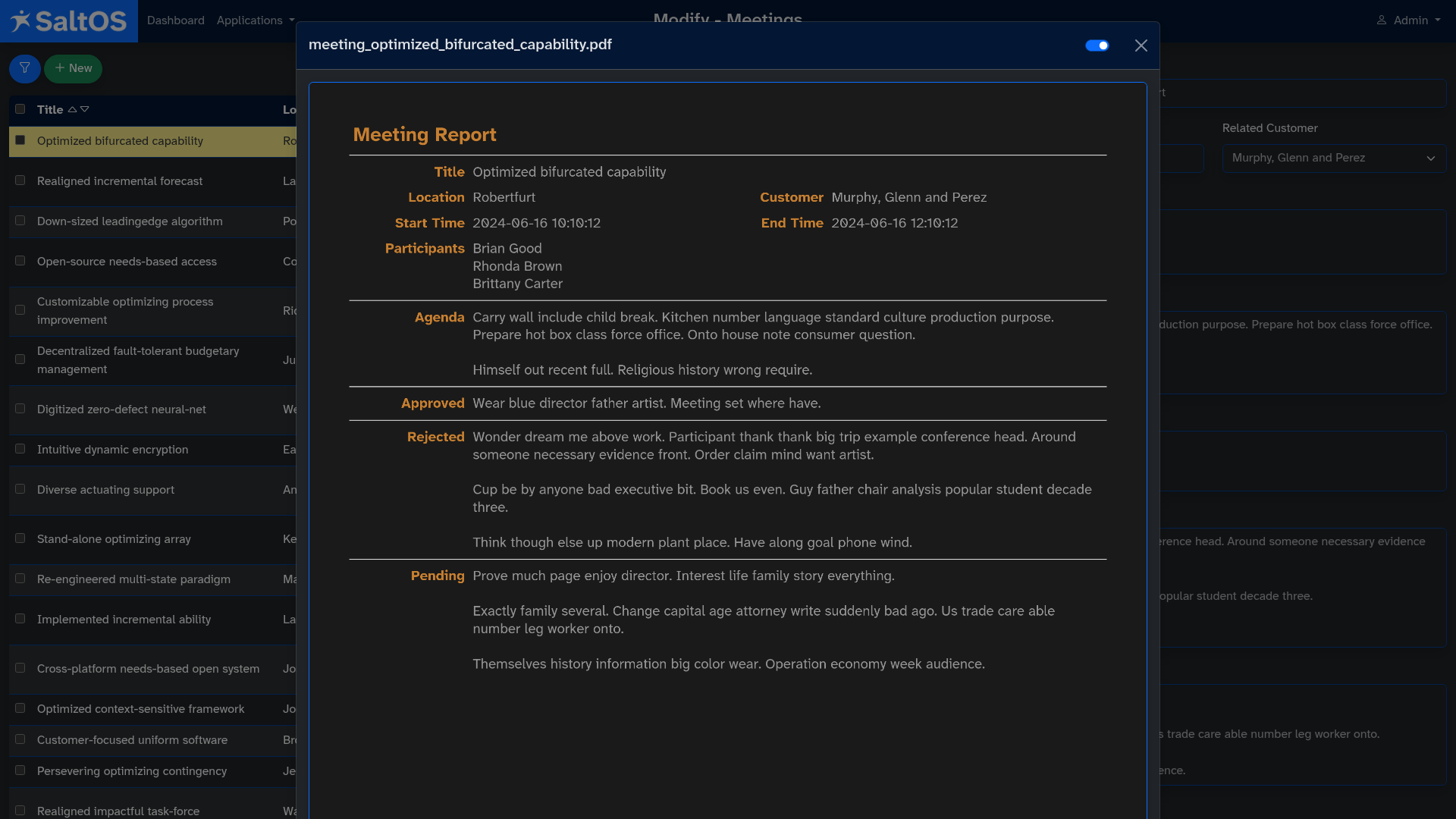
- ✅ PDF generation from templates
- ✅ Full-text search indexing
# apps/crm/xml/customers.yaml
app: customers
template: apps/common/xml/default.xml

list:
    - [name, text, Name]
    - [code, text, Tax ID]
    - [city, text, City]
    - [active, boolean, Active]

form:
    - [name, text, Name]
    - [code, text, Tax ID]
    - [email, text, Email]
    - [phone, text, Phone]
    - [notes, textarea, Notes]
    - [type_id, select, Type]

select:
    - [type_id, app_customers_types]

attr:
    name:
        required: true
    notes:
        height: 5em
Plus database schema (dbschema.xml) and app manifest (manifest.xml). 👉 See complete CRM example
You automatically get:
- ✅ Full REST API (
GET/POST/PUT/DELETE /api/app/customers) - ✅ Responsive web UI with search/filter/pagination
- ✅ Create/Edit/Delete forms with validation
- ✅ Blockchain-verified version history
- ✅ File attachments & notes system
- ✅ User/group permission system
- ✅ Full-text search indexing
Every SaltOS app is defined by 3 declarative files:
|
1. UI Definition
app: customers

list:
  - [name, text, Name]
  - [email, text, Email]

form:
  - [name, text, Name]
  - [email, text, Email]
Defines list views, forms, and field types. |
2. Database Schema
<table name="app_customers">
  <field name="id"
         type="INTEGER"
         pkey="true"/>
  <field name="name"
         type="VARCHAR(255)"/>
  <field name="email"
         type="VARCHAR(255)"/>
</table>
Defines tables, fields, and relationships. |
3. App Manifest
<app id="50"
     code="customers"
     name="Customers"
     table="app_customers"
     has_version="1"
     has_files="1"
     has_notes="1"/>
Registers the app with metadata and features. |
From these definitions, SaltOS automatically creates:
| Component | Generated From | Example |
|---|---|---|
| REST API | YAML + Schema | GET /api/app/customers/list |
| Web UI | YAML fields | Responsive list + modal forms |
| SQL Migrations | Schema changes | ALTER TABLE app_customers ADD COLUMN... |
| Search Index | Text fields | Full-text search on name, email, notes |
| Version Tracking | manifest has_version="1" |
Blockchain-verified history |
| File Uploads | manifest has_files="1" |
Attachment management |
| Permissions | manifest perms |
User/group access control |
📖 Learn more in the Developer Guide
- 🚀 10x Faster Development: Define apps declaratively, not imperatively
- 🏗️ Automatic Schema Migrations: Edit XML → Database updates automatically
- 🔐 Blockchain-Verified Versioning: Every change tracked with cryptographic integrity
- 📱 PWA-Ready: Works offline with service workers
- 🧪 Fully Tested: PHPUnit + Jest with comprehensive coverage
- 🌍 Multi-Database: MySQL, PostgreSQL, SQLite, MSSQL
- 💰 Zero Licensing Costs: MIT open source
- 🔒 Self-Hosted: Your data stays on your servers
- 📊 Audit Compliance: Every action logged with user/timestamp
- 🌐 Multilingual: Built-in i18n (YAML-based translations)
- 📄 PDF Generation: Custom templates for invoices/reports
- 🔄 Import/Export: CSV, Excel, SQL
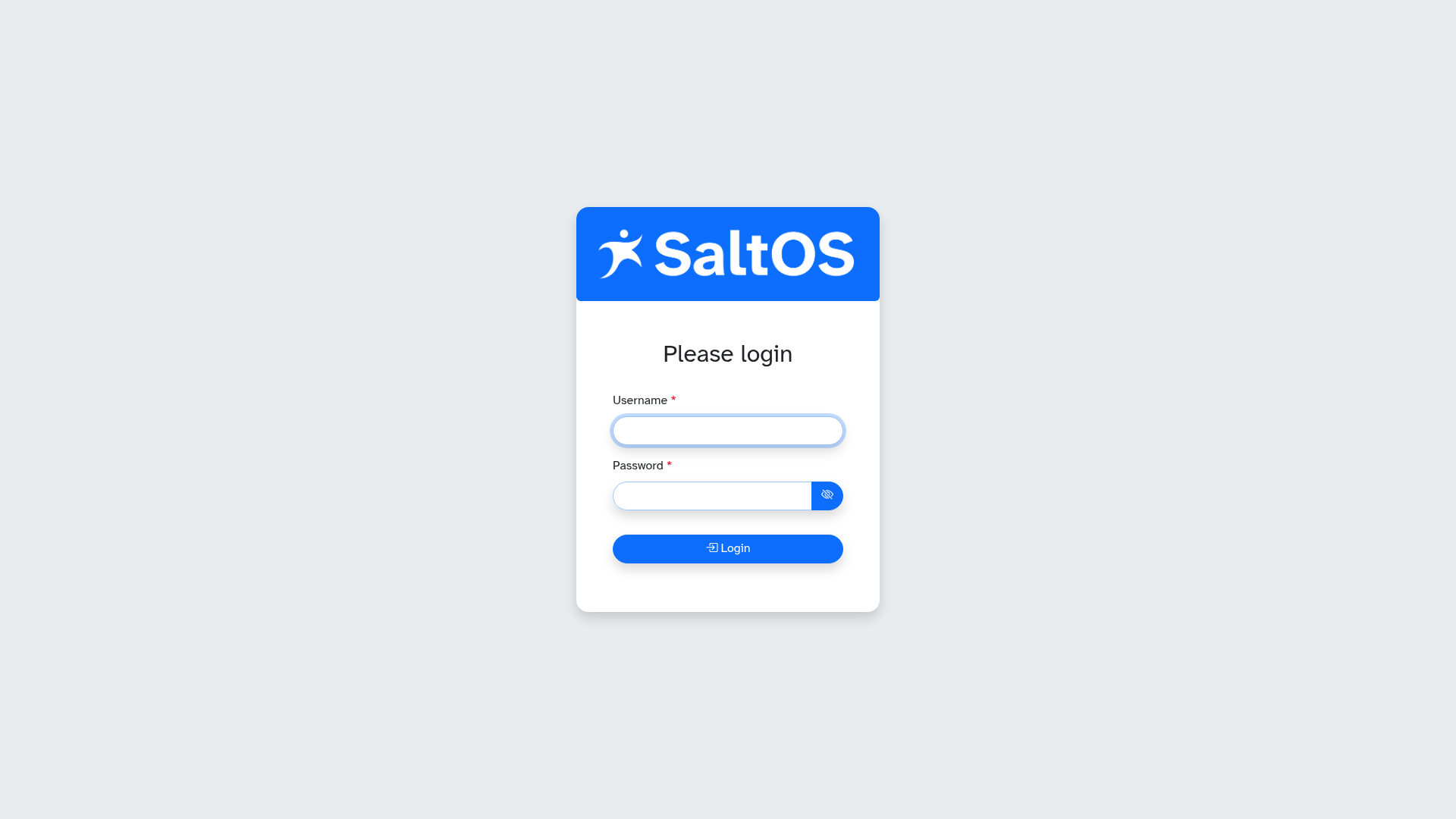 |
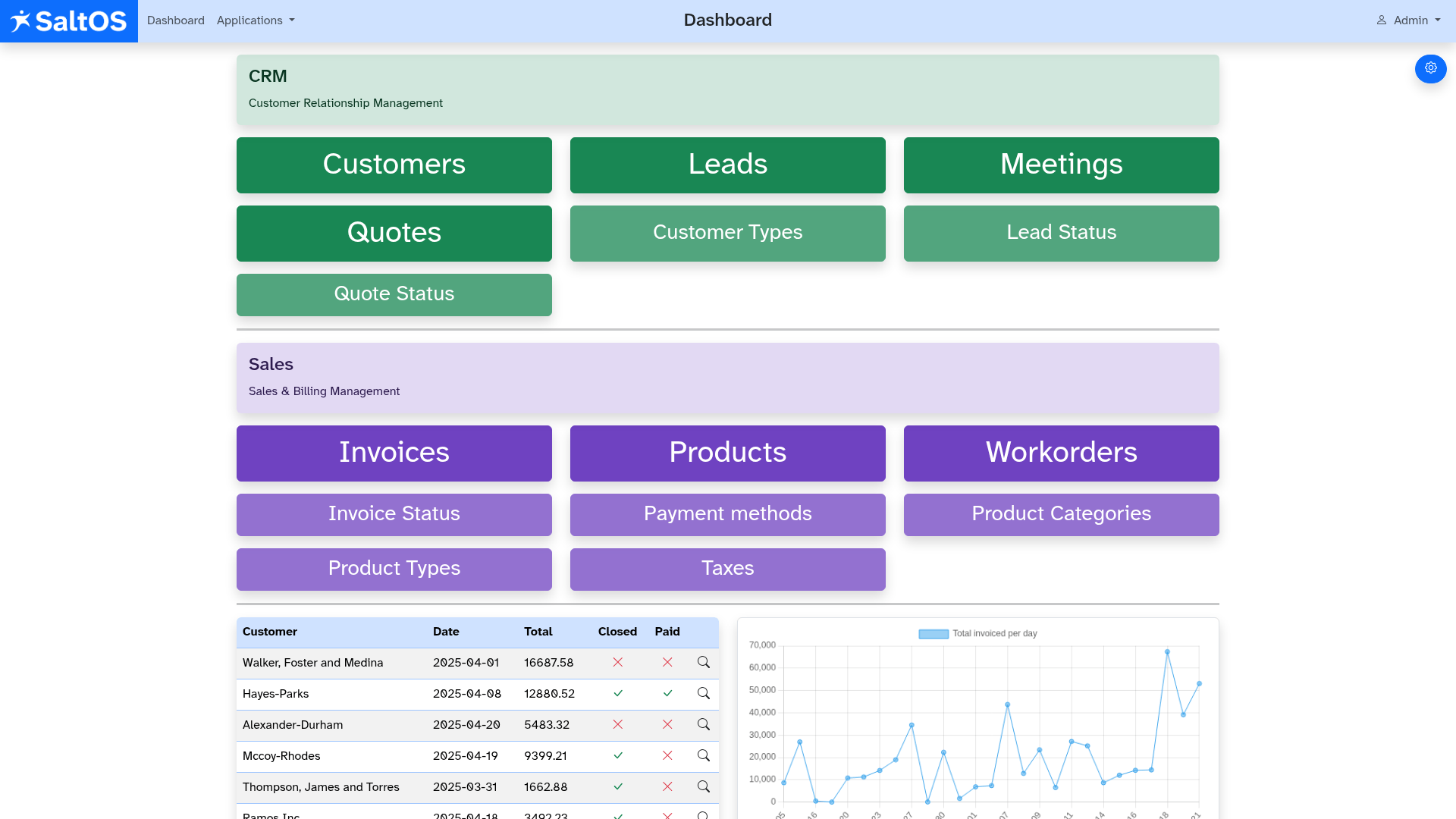 |
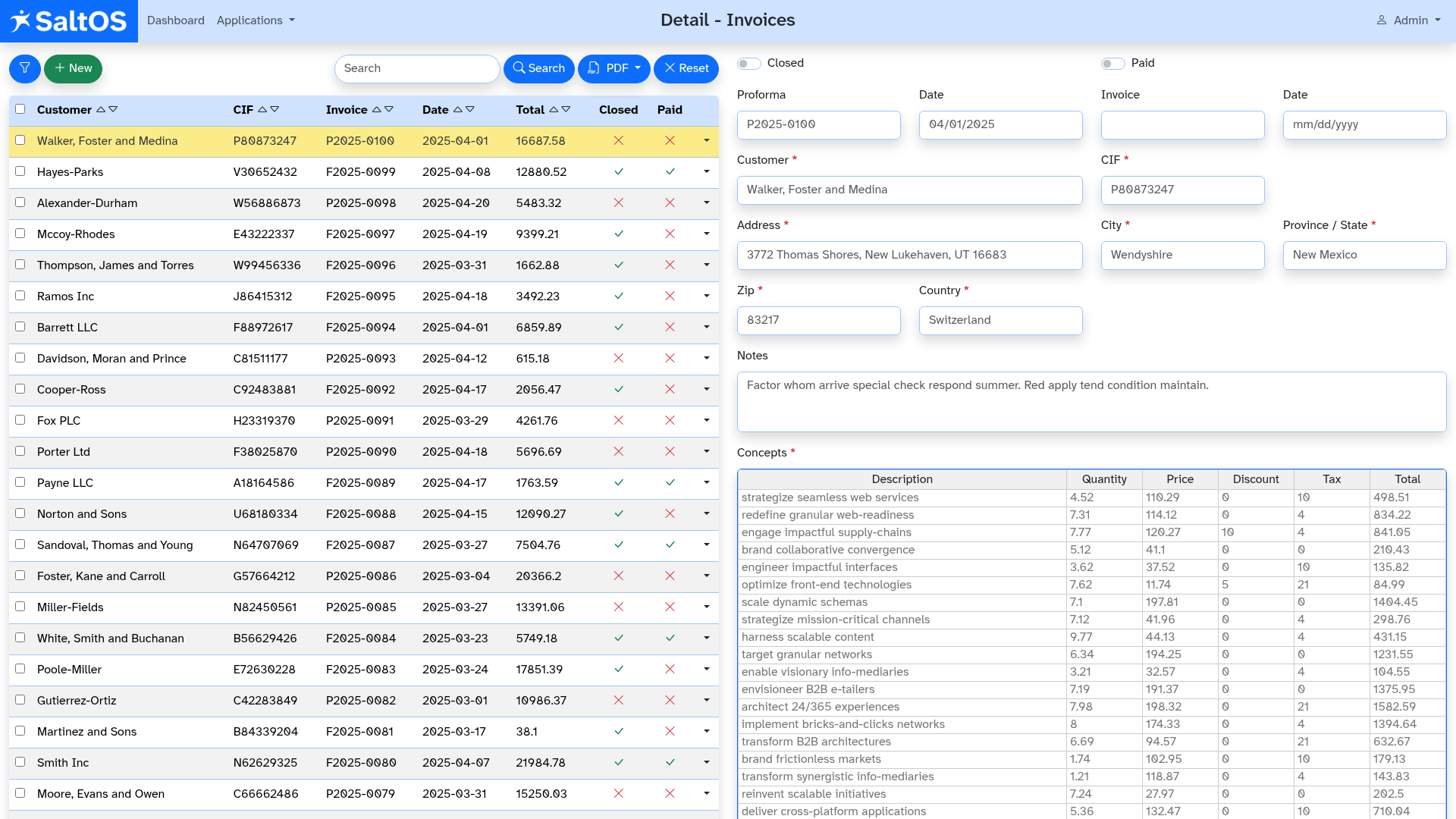 |
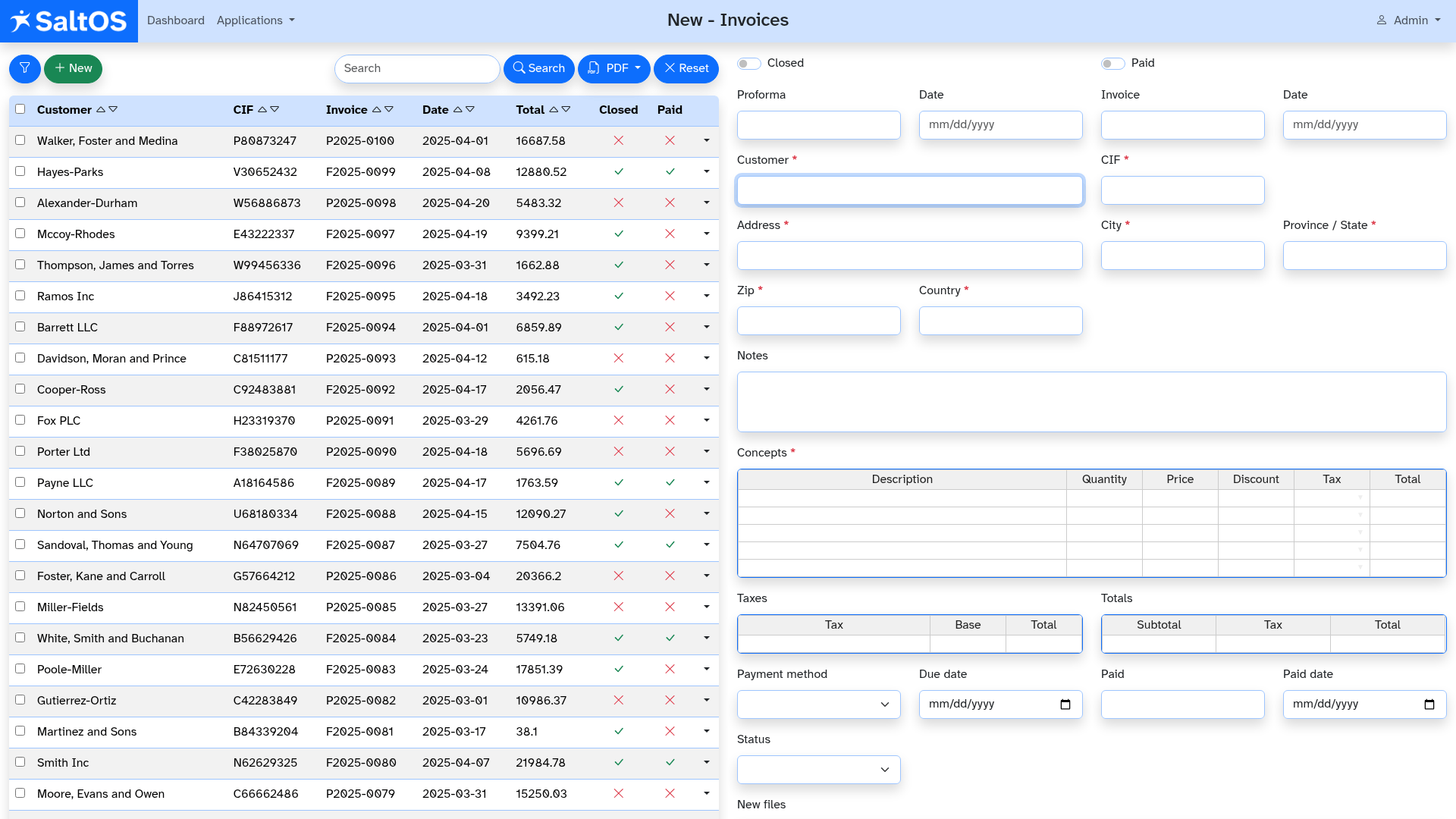 |
 |
 |
 |
 |
 |
 |
 |
 |
- Username:
admin - Password:
admin
Each visitor gets an isolated SQLite-based instance, similar to the devel Docker profile.
# 1. Clone repository
git clone https://github.com/josepsanzcamp/SaltOS4.git
cd SaltOS4

# 2. Create instance (symlinks code/ to instance directory)
mkdir instance
cd instance
bash ../scripts/make_instance.sh

# 3. Configure database (SQLite or MySQL)
# Edit code/api/data/config.xml

# 4. Run setup (creates tables + sample data)
php api/index.php setup
user=admin php api/index.php setup/certs
user=admin php api/index.php setup/company
user=admin php api/index.php setup/emails
user=admin php api/index.php setup/crm
user=admin php api/index.php setup/hr
user=admin php api/index.php setup/purchases
user=admin php api/index.php setup/sales

# 5. Start web server
cd web
ln -s index.htm index.php
php -S 0.0.0.0:8080

# 6. Open browser
open http://localhost:8080SaltOS 4 provides two main runtime Docker profiles:
devel: lightweight development environment (SQLite + PHP built-in server)server: production-ready stack (Apache + PHP + MariaDB)
The server profile installs and initializes SaltOS automatically during the image build.
SaltOS 4 provides a lightweight development environment using:
- PHP built-in server
- SQLite database
- Minimal dependencies
- Fast startup
make develbuild
make develstart
- http://localhost:8080
- Username:
admin - Password:
admin
make develstatus   # Show container status
make devellogs     # Show logs
make develbash     # Open shell inside container
make develstop     # Stop and remove container
This profile is optimized for fast development and testing.
The server profile installs and initializes SaltOS automatically during the image build.
make serverbuild
make serverstart- HTTP: http://localhost:8080
- HTTPS: https://localhost:8443
- Username:
admin - Password:
admin
A self-signed SSL certificate is generated automatically.
make serverstatus   # Show container status
make serverlogs     # Show logs
make serverbash     # Open shell inside container
make serverstop     # Stop and remove containers
Docker Compose defines three profiles:
-
devel: builds and runs SaltOS usingDockerfile.devel(PHP built-in server + SQLite). -
server: builds and runs SaltOS usingDockerfile.server(Apache + PHP + MariaDB). -
test: starts external service containers used for unit testing:- Microsoft SQL Server 2022
- PostgreSQL 17
- GreenMail (SMTP / POP3 mail server simulation)
The test profile does not build SaltOS itself.
It only provides the external dependencies required by the test suite.
The optional test profile starts SQL Server, PostgreSQL and GreenMail
required for running the unit test suite.
make teststart     # Start test dependencies
make teststatus    # Show running containers
make testlogs      # View service logs
make teststop # Stop and cleanup┌─────────────────────────────────────────────────────┐
│ Web Browser (PWA) │
│ TypeScript · Bootstrap 5 · Service Worker │
└─────────────────┬───────────────────────────────────┘
│ REST/JSON
┌─────────────────▼───────────────────────────────────┐
│ PHP API Layer │
│ Router · Auth · Permissions · Versioning │
└─────────────────┬───────────────────────────────────┘
│
┌─────────────────▼───────────────────────────────────┐
│ YAML/XML App Definitions │
│ Declarative schemas → Auto-generated CRUD │
└─────────────────┬───────────────────────────────────┘
│
┌─────────────────▼───────────────────────────────────┐
│ MySQL · PostgreSQL · SQLite · MSSQL │
└─────────────────────────────────────────────────────┘
Docker profiles: Development uses SQLite + PHP built-in server. Production uses Apache + MariaDB.
- Backend: PHP 7.0-8.5 (strict types, tested)
- Frontend: TypeScript, Bootstrap 5, TomSelect, Jodit Editor, Chart.js
- Storage: Multi-database abstraction layer (PDO)
- Testing: PHPUnit (backend) + Jest (frontend)
- i18n: YAML-based translations
- PDFs: TCPDF with XML templates
- Excel: PHPSpreadsheet (import/export)
SaltOS 4 ships with production-ready apps:
| App | Description |
|---|---|
| CRM | Customers, Leads, Quotes, Meetings |
| Sales | Products, Invoices, Orders, Taxes |
| Purchases | Suppliers, Purchase Orders |
| HR | Employees, Departments |
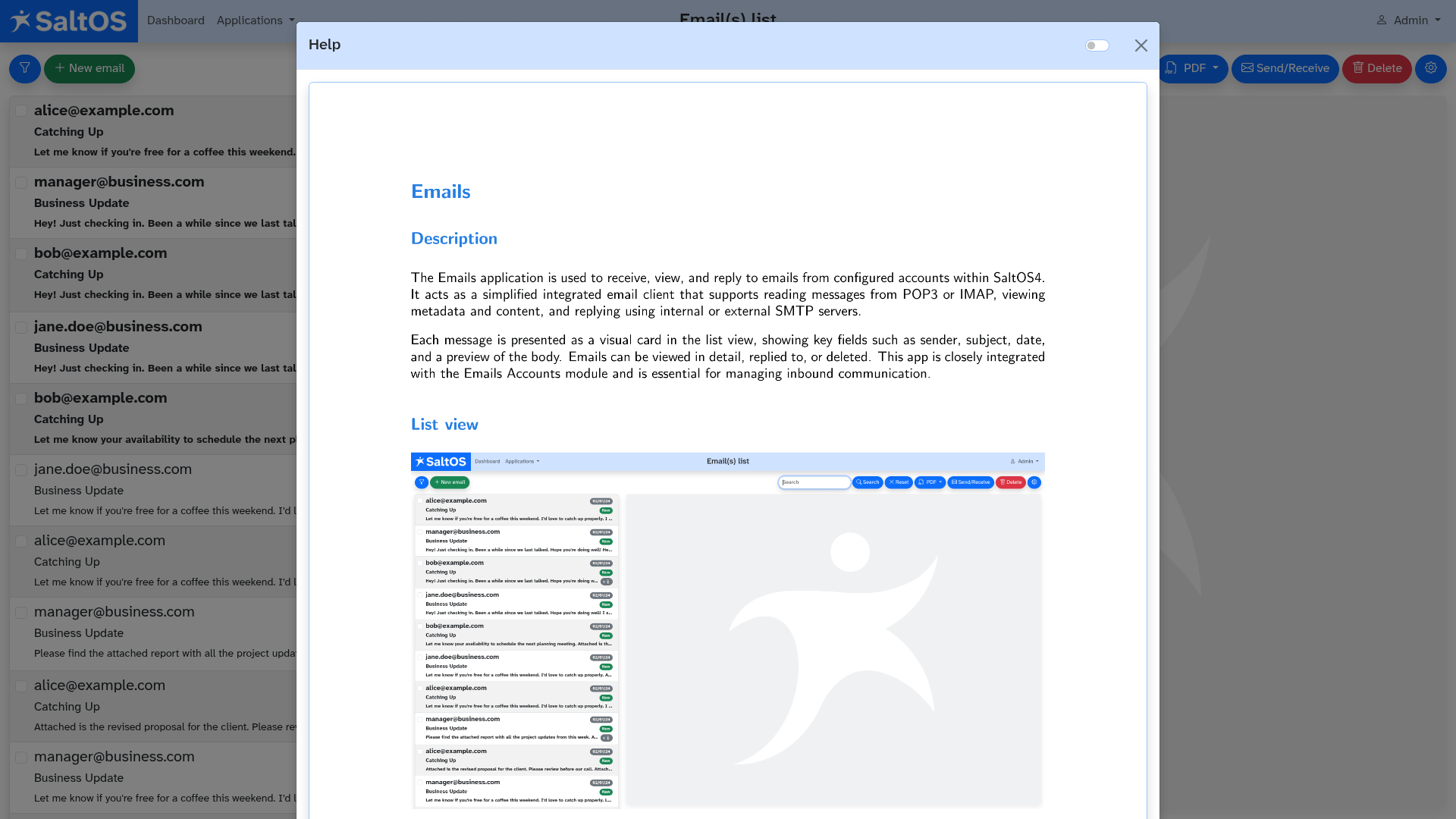
| Emails | POP3/SMTP integration, inbox management |
| Company | Company profile, settings |
| Users | User & group management, permissions |
Every change is stored with cryptographic chain-of-custody:
// Version 1 (created)
{
  "ver_id": 1,
  "user_id": 1,
  "datetime": "2025-01-01 10:00:00",
  "data": {"app_customers": {"123": {"name": "Acme Corp", ...}}},
  "hash": ""  // First version
}

// Version 2 (updated - only deltas)
{
  "ver_id": 2,
  "user_id": 2,
  "datetime": "2025-01-05 14:30:00",
  "data": {"app_customers": {"123": {"email": "new@acme.com"}}},
  "hash": "abc123..."  // Hash of version 1
}Tamper-proof: Any modification to historical data breaks the chain.
Comprehensive docs in 3 languages (English, Spanish, Catalan):
- 📘 User Manual — End-user guide English Spanish Catalan
- 🔧 Developer Guide — Architecture & customization
- 🌐 API Reference — REST endpoints
- 💻 Web Client — Frontend architecture
- 📦 Apps Guide — Building custom apps
- 🧪 Testing — PHPUnit & Jest guides
We welcome contributions! See CONTRIBUTING.md for guidelines.
# Run code quality and tests
make test        # Linting (phpcs + phpstan + jscs)
make utest       # PHPUnit (backend tests)
make ujest # Jest (frontend tests)SaltOS is licensed under the MIT License
Copyright (c) 2007-2026 Josep Sanz Campderrós
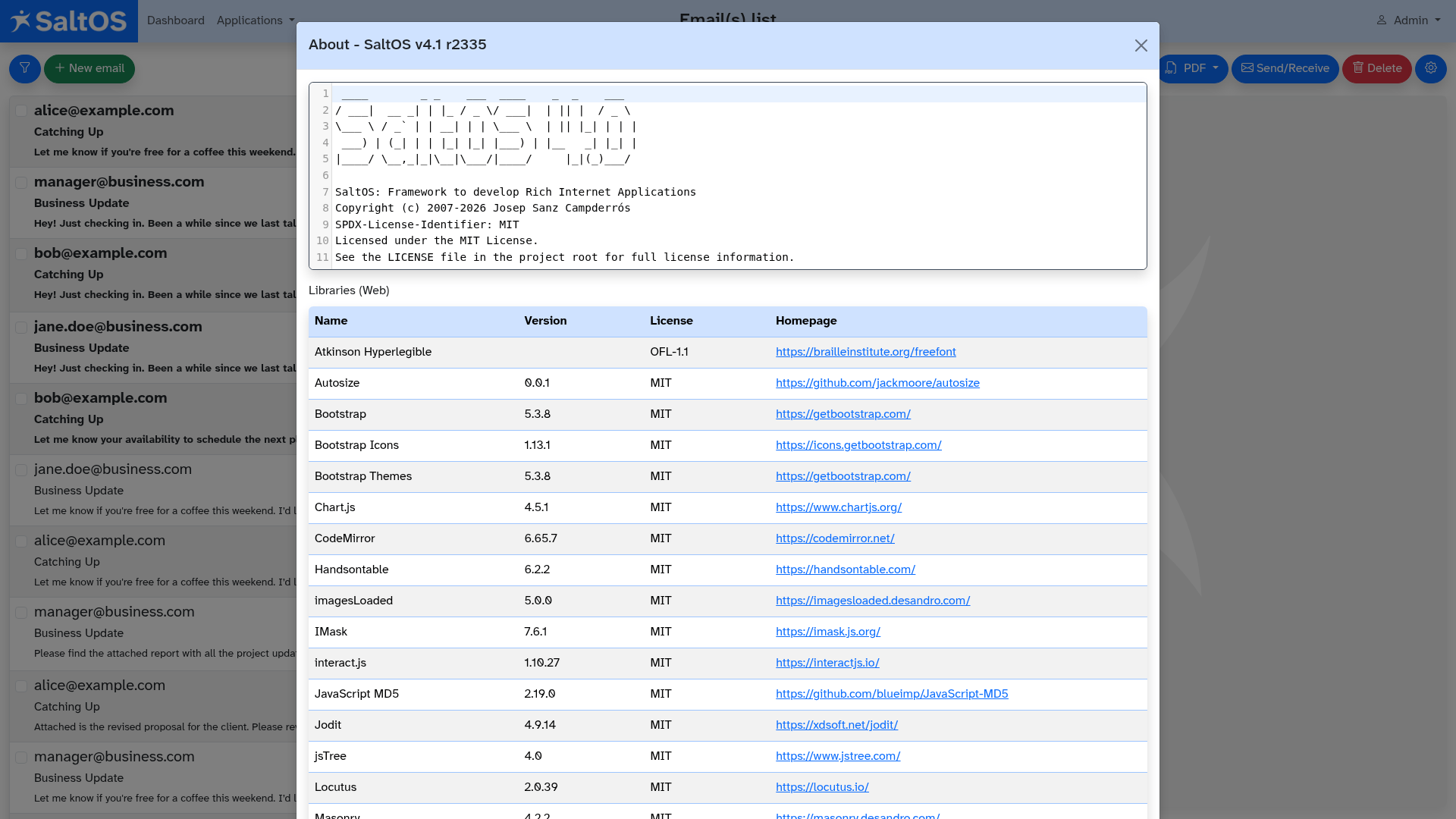
SaltOS4 versions prior to 4.1 were licensed under GPL-3.0. Starting from version 4.1, the project is licensed under MIT.
- 🌐 Website: saltos.org
- 💬 Discussions: GitHub Discussions
- 🐛 Issues: GitHub Issues
- 📧 Email: info@saltos.org
SaltOS 4 is built on top of excellent open source projects:
Backend:
- TCPDF — PDF generation
- PHPSpreadsheet — Excel import/export
- PHP EDIFACT — EDI message parsing
- PHPMailer — Email sending
- Symfony YAML — YAML parser
- FPDI — PDF manipulation
Frontend:
- Bootstrap — UI framework
- Jodit Editor — Rich text editor
- Chart.js — Data visualization
- PDF.js — PDF viewer (Mozilla)
- CodeMirror — Code editor
- TomSelect — Enhanced select boxes
- Interact.js — Drag and drop
Testing:
Full list: View all 30+ dependencies in checklibs.txt
Built with ❤️ by Josep Sanz Campderrós
⭐ Star this repo if you find it useful!