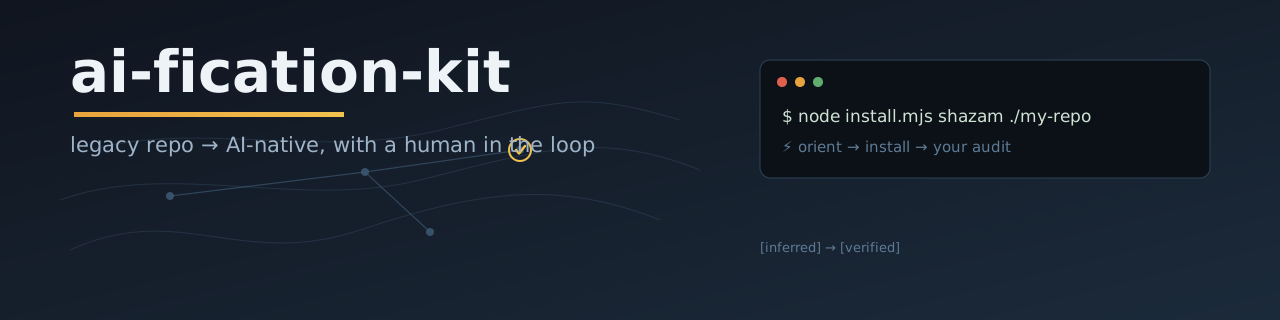






A Toolkit to Give AI Coding Agents a Trusted Map of Any Existing/Legacy Repo
-
Drafted by AI Agents, verified by Humans, and kept mechanically honest.
-
One command scaffolds it, and depending on the complexity of the codebase, it can be made trustworthy in 30 minutes to a few hours.
-
Two outcomes from one workflow: it makes your codebase AI-native, and it produces AI-Powered Repo Intelligence — a human-approved knowledge-base (
ai/) that lets a new teammate onboard instantly.
- The Three Pillars
- Quick Start
- How It Works
- What You Get
- The Bridge to AI-Native Onboarding
- The Problem & The Solution
- New to AI Coding Agents? Start Here
- Security & Trust Guarantees
- How This Toolkit Differs
- Contributing
- Citation
- License
- Acknowledgments
Transforming a legacy repository into a trusted AI-native environment rests on three mechanisms:
- 🏗️ Agent Scaffolding: Stamps agent instructions (
CLAUDE.md,AGENTS.md), slash commands (/cold-start,/add-feature), subagent personas (repo-explorer,feature-builder), and reusable skills into.claude/— plus native GitHub Copilot equivalents in.github/and Google Antigravity equivalents in.agents/. - 🧠 Repository Context: Generates a structured
ai/folder — a centralized, human-readable map of conventions, architecture, modules, and features that agents query instead of crawling raw source. - 🤝 Human-in-the-Loop Trust: Every agent-drafted claim starts as
[inferred]and is promoted to[verified]only by a human. Deterministicverifyanddriftchecks fail CI when the docs no longer match the file tree — a ready-made GitHub Actions workflow (ai-check.yml) ships with the kit — so the maps cannot silently fall out of sync.
Tip
Brand new here? Follow the one linear path in docs/GETTING-STARTED.md (zero → trusted map in five steps), and keep the Glossary open for any unfamiliar term ([inferred], Stability, slash command, …). New to AI coding agents specifically? Jump to the 2-minute primer first. The full manual — tutorials, audit guide, CLI reference, methodology — lives in the docs/ hub.
Get up and running in under five minutes.
Prerequisites: Node.js ≥ 18 or Python ≥ 3.8 — pick whichever you prefer. Both installers are feature-identical and zero-dependency (stdlib only, no packages to install).
Tip
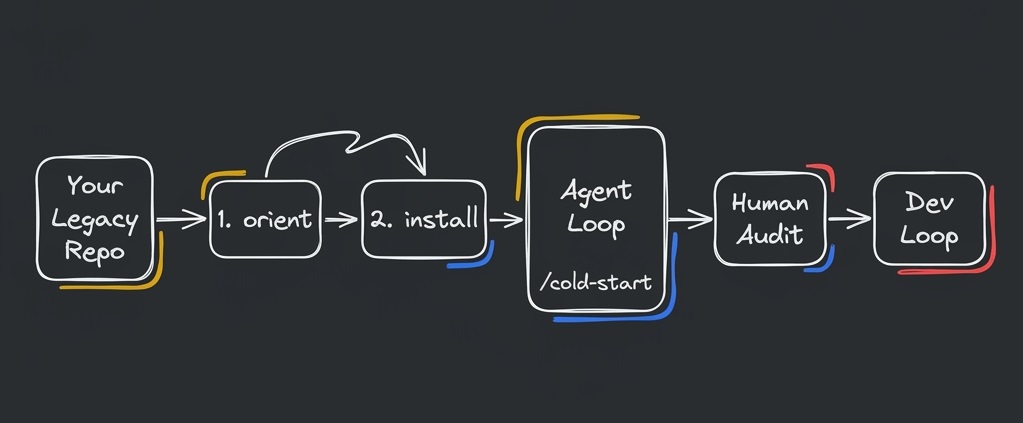
The name shazam is inspired by the magic word: the idea is to transform a repository into an AI-native repository with a single command. Under the hood, shazam runs check-repo-maturity → orient → starts the intake wizard → stamps the intelligence layer → prints clear next steps.
Select one of the options (A or B) below depending on your stack and preferences:
Run the installer directly using npx against the GitHub repository:
# 1 · Preview the installation (writes nothing, dry-run)
npx github:kunalsuri/ai-fication-kit shazam /path/to/your/repo --dry-run

# 2 · Run the live installation
npx github:kunalsuri/ai-fication-kit shazam /path/to/your/repoClone the repository and run the scripts locally (pure Node.js or Python stdlib):
# Clone the repository
git clone https://github.com/kunalsuri/ai-fication-kit.git
cd ai-fication-kit

# Run with Node.js
node install.mjs shazam /path/to/your/repo

# OR run with Python (pure stdlib, no external dependencies)
python install.py shazam /path/to/your/repo
Two more deterministic commands worth knowing (no LLM, seconds to run — see docs/CLI-REFERENCE.md for every command, flag, and exit code):
# Deeper analysis: dependency graph, code metrics, structural health scores
#   → ai/repo-indepth.json   (or pass --analysis-level indepth to shazam)
node install.mjs indepth /path/to/your/repo

# Changed your mind? Removes exactly what the installer wrote
#   (reads ai/install-manifest.json; timestamped backups are preserved)
node install.mjs uninstall /path/to/your/repoOpen your target repository in Claude Code (or your agent of choice) and run:
/cold-startThis command could take 5 minutes or more depending on the size of the repository as the agent scans the codebase and drafts the initial map.
Open ai/guide/MODULE_MAP.md to review the generated draft:
- Define each module's Stability (
frozen/stable/ours/?). - Mark verified entries as
[verified]. - Keep the docs mechanically honest — at any time, cross-check every file-path claim in the maps against the real tree (deterministic, no LLM):
# Every file-path claim in the knowledge docs must exist on disk
node install.mjs verify /path/to/your/repo --strict

# The reverse check: code the map no longer covers (--git also flags
# [verified] rows whose underlying code has changed since the audit)
node install.mjs drift /path/to/your/repo --git
The stamped GitHub Actions workflow (.github/workflows/ai-check.yml) runs both checks on every push and pull request, so the map cannot silently rot.
Tip
The audit is the step that makes everything else trustworthy. See docs/AUDIT-GUIDE.md for a step-by-step walkthrough, and docs/FAQ.md for answers to common questions.
This kit scaffolds a minimal, highly structured knowledge directory inside your target repository. Once /cold-start has populated it and a human has verified it, this ai/ directory is your AI-Powered Repo Intelligence — the knowledge-base that both agents and new teammates read to get up to speed:
your-repo/
├── CLAUDE.md                   # auto-loaded by Claude Code (thin; points everywhere else)
├── AGENTS.md                   # same rules for Cursor, Copilot, Codex, Windsurf
├── CLAUDE_bkp_*.md             # (Process 2 only) timestamped backup of prior config
├── AGENTS_bkp_*.md             # (Process 2 only) timestamped backup of prior config
├── ai/
│   ├── INDEX.md                # role → path manifest (prompts reference roles, not paths)
│   ├── repo-profile.json       # machine-readable facts from orient (deterministic)
│   ├── repo-indepth.json       # (optional) indepth: dependency graph, metrics, health scores
│   ├── install-manifest.json   # what the installer wrote + content hashes (clean uninstall, safe re-runs)
│   ├── guide/                  # navigation, loaded every session
│   │   ├── MODULE_MAP.md       # directory → responsibility → Stability  ← START HERE
│   │   ├── PROJECT_OVERVIEW.md · ARCHITECTURE.md · FEATURE_MAP.md · CONVENTIONS.md
│   ├── analysis/               # generated artifacts, loaded on demand
│   │   ├── FEATURE_CATALOG.md  # feature → files index (+ _BACKEND/_FRONTEND splits)
│   │   ├── diagrams/           # Mermaid; regenerate, don't hand-maintain
│   │   ├── audit-reports/      # verification, drift, & maturity reports
│   │   └── problems/           # dated analyses of specific issues
│   └── lab/                    # development intelligence: specs/, decisions/ (ADRs),
│                                 evaluations/, experiments/
├── .claude/                    # Claude Code: commands (/cold-start, /add-feature, …),
│                                 subagents (repo-explorer, feature-builder, test-runner),
│                                 and the add-feature skill
├── .github/                    # GitHub Copilot: copilot-instructions.md, prompts/*.prompt.md
│                                 (same commands), chatmodes/*.chatmode.md (same subagents)
└── .agents/                    # Google Antigravity: workflows/*.md (same commands),
                                  skills/add-feature/ (shared Agent Skills format)
- Root Guides (CLAUDE.md / AGENTS.md): Thin root files that point the agent to the
ai/folder. - Knowledge Guide (
ai/guide/): Core maps (MODULE_MAP.mdis your starting point!), conventions, and architectural overviews loaded by the agent every session — and, once verified, the first thing a new team member reads to onboard. - Analysis Outputs (
ai/analysis/): Deep analytical results generated by the agent (e.g. diagrams, feature catalogs, and problems logs). - Lab Space (
ai/lab/): A dedicated area for specifications (RFCs), architecture decision records (ADRs), and evaluations. - Agent Operations (
.claude/,.github/,.agents/): Reusable workflow commands, helper subagents (repo-explorer,feature-builder,test-runner), and custom agent skills — stamped natively for Claude Code, GitHub Copilot, and Google Antigravity in one install.
Every command ships in three native formats — Claude Code slash command (.claude/commands/), Copilot prompt (.github/prompts/), and Antigravity workflow (.agents/workflows/):
| Command | What it does |
|---|---|
/cold-start |
Bootstrap the ai/guide/ maps and diagrams; drafts everything as [inferred] for a human to audit. |
/add-feature |
Safeguarded implementation: spec first, locate via the maps, surgical diffs, tests before done, knowledge updated after. |
/check-drift |
Run the verify + drift checks and report missing documentation or stale references. |
/create-feature-catalog |
Deep-mine the source to discover implemented features; writes ai/analysis/FEATURE_CATALOG.md. |
/review-agent-config |
Read-only diagnostic of CLAUDE.md/AGENTS.md for completeness, consistency, and stale artifacts. |
/post-cold-start-verification |
Audit every ai/ file for gaps, stale placeholders, and inconsistencies after cold-start. |
/verify-ai-readiness |
Holistic assessment of the knowledge layer on a 5-level maturity scale; flags agent-blocking gaps. |
/perform-feature-add-simulation |
Dry-run the add-feature workflow for a proposed feature — friction report and readiness score, no code written. |
The diagram below shows both installation paths from initial scan through to safeguarded development:
flowchart TD
    %% ─── Entry ───
    Repo[("Your Repository")] --> Maturity["0. check-repo-maturity<br/>(11 deterministic checks)"]
    Maturity --> Orient["1. orient<br/>(detect stack)"]
    Orient --> Profile[["ai/repo-profile.json"]]
    Profile --> Decision{"Process 1 or 2?"}

    %% ─── Process 1: Legacy ───
    Decision -- "Process 1 (Legacy)<br/>→ No prior config" --> Install1["2. install<br/>(stamp templates)"]
    Install1 --> Scaffolded1[["CLAUDE.md + AGENTS.md<br/>+ ai/ knowledge layer"]]

    subgraph P1["Process 1 — Legacy Repo (from scratch)"]
        Install1
        Scaffolded1
    end

    %% ─── Process 2: Modern ───
    Decision -- "Process 2 (Modern)<br/>→ User-authored config" --> Backup["2a. Backup existing files<br/>CLAUDE_bkp_YYYYMMDD_HHmmss.md"]
    Backup --> Install2["2b. install<br/>(overwrite after backup)"]
    Install2 --> Scaffolded2[["CLAUDE.md + AGENTS.md<br/>+ ai/ + timestamped backups"]]

    subgraph P2["Process 2 — Modern Repo (backup + upgrade)"]
        Backup
        Install2
        Scaffolded2
    end

    %% ─── Shared: Cold-Start ───
    Scaffolded1 --> ColdStart
    Scaffolded2 --> ColdStart

    subgraph AgentLoop["Agent Loop (Inferred)"]
        ColdStart["3. /cold-start<br/>(agent infers maps)"]
        Step05{"Process 2?<br/>Backup files exist?"}
        ColdStart --> Step05
        Step05 -- "Yes" --> Extract["Step 0.5: Extract knowledge<br/>from *_bkp_*.md backups"]
        Extract --> InferredMap
        Step05 -- "No" --> InferredMap[["MODULE_MAP.md<br/>[inferred]"]]
    end

    %% ─── Shared: Human Gate ───
    subgraph HumanGate["Human Gate (Trust Verification)"]
        InferredMap --> Audit["4. Human Audit<br/>(set Stability, flip tags)"]
        Audit --> VerifiedMap[["MODULE_MAP.md<br/>[verified]"]]
    end

    %% ─── Shared: Dev Loop ───
    subgraph DevLoop["Development (Safeguarded)"]
        VerifiedMap --> Verify["5. verify + drift<br/>(mechanical checks)"]
        Verify --> AddFeature["6. /add-feature<br/>(safe implementation)"]
    end

    %% ─── Styling ───
    class Repo repo;
    class Maturity,Decision gate;
    class Orient,Install1,Backup,Install2 setup;
    class Profile,Scaffolded1,Scaffolded2,InferredMap,VerifiedMap files;
    class ColdStart,Step05,Extract,Verify,AddFeature agent;
    class Audit human;

    classDef repo fill:#2d3748,stroke:#1a202c,stroke-width:2px,color:#fff;
    classDef gate fill:#d69e2e,stroke:#975a16,stroke-width:2px,color:#fff;
    classDef setup fill:#2b6cb0,stroke:#1a365d,stroke-width:2px,color:#fff;
    classDef files fill:#553c9a,stroke:#322659,stroke-width:2px,color:#fff;
    classDef agent fill:#2f855a,stroke:#1c4530,stroke-width:2px,color:#fff;
    classDef human fill:#c53030,stroke:#742a2a,stroke-width:2px,color:#fff;

    style P1 fill:none,stroke:#2b6cb0,stroke-width:1.5px,stroke-dasharray: 5 5;
    style P2 fill:none,stroke:#d69e2e,stroke-width:1.5px,stroke-dasharray: 5 5;
    style AgentLoop fill:none,stroke:#2f855a,stroke-width:1.5px,stroke-dasharray: 5 5;
    style HumanGate fill:none,stroke:#c53030,stroke-width:1.5px,stroke-dasharray: 5 5;
    style DevLoop fill:none,stroke:#00a3c4,stroke-width:1.5px,stroke-dasharray: 5 5;
Click to Expand: Process Flow Explained
This is the original flow. The kit creates everything from scratch:
check-repo-maturity→ detects no user-authoredCLAUDE.md/AGENTS.md→ Process 1orient→ reads marker files, writesai/repo-profile.jsonwithmaturity.process: 1install→ stamps all templates (CLAUDE.md,AGENTS.md,ai/tree)/cold-start→ agent draftsai/guide/docs from the code, all tagged[inferred]
For repos that already have a hand-written CLAUDE.md or AGENTS.md:
check-repo-maturity→ detects user-authored files (no<!-- Installed by ai-fication-kitfooter) → Process 2- Backup → copies
CLAUDE.md→CLAUDE_bkp_20260617_221847.md(timestamped, never conflicts) orient→ reads marker files, writesai/repo-profile.jsonwithmaturity.process: 2install→ overwrites the backed-up files with kit templates, stampsai/tree/cold-startStep 0.5 → reads*_bkp_*.mdfiles, extracts knowledge (conventions, architecture, gotchas, module descriptions) → merges intoai/guide/docs tagged[inferred — from prior config]/cold-startcontinues normally → drafts remaining docs from code
[!IMPORTANT] Nothing is lost. Backup files are preserved through uninstall. The prior config becomes seed knowledge for the new
ai/layer — the best of both worlds.
| Step | Owner | Description |
|---|---|---|
0️⃣ check-repo-maturity |
Script (Seconds) | Read-only diagnostic. 11 deterministic checks (version control, build system, tests, CI/CD, docs, locks, code structure, license, AI config). Scores 0–100, determines Process 1 or 2. No LLM, no writes. |
1️⃣ orient |
Script (Seconds) | Deterministic observation. Reads marker files (package.json, pom.xml, pyproject.toml, *.csproj/*.sln, CMakeLists.txt, go.mod, Cargo.toml, etc.) and writes ai/repo-profile.json (languages, build/test commands, fork status, maturity data). No LLM. Nothing executed. |
2️⃣ install |
Script (Seconds) | Scaffolding. Process 2: backs up existing files first. Then stamps templates into your repository. Records every written file in an install manifest so uninstall can perform a clean removal. |
3️⃣ /cold-start |
Agent (~5 Mins) | Model inference. Process 2: Step 0.5 extracts knowledge from *_bkp_*.md backups first. Then drafts MODULE_MAP.md, diagrams, and candidate features. Every claim is tagged [inferred]. |
| 4️⃣ Your Audit | You (~30 Mins) | The trust verification. Review the map, set module stability (frozen / stable / ours / ?), and flip confirmed rows to [verified]. |
| 5️⃣ Verify (Recommended) | Script + Agent | Stability checks. verify (script, no LLM) mechanically cross-checks every file-path claim in the docs against the real tree → VERIFICATION_MANIFEST.json + report. Then /post-cold-start-verification (semantic gap report), /verify-ai-readiness (maturity rating), or /perform-feature-add-simulation (simulated friction check). |
6️⃣ /add-feature |
Agent | Safeguarded development. The agent builds specs, navigates using the maps, runs tests, and updates the knowledge layer without touching frozen code. |
Tip
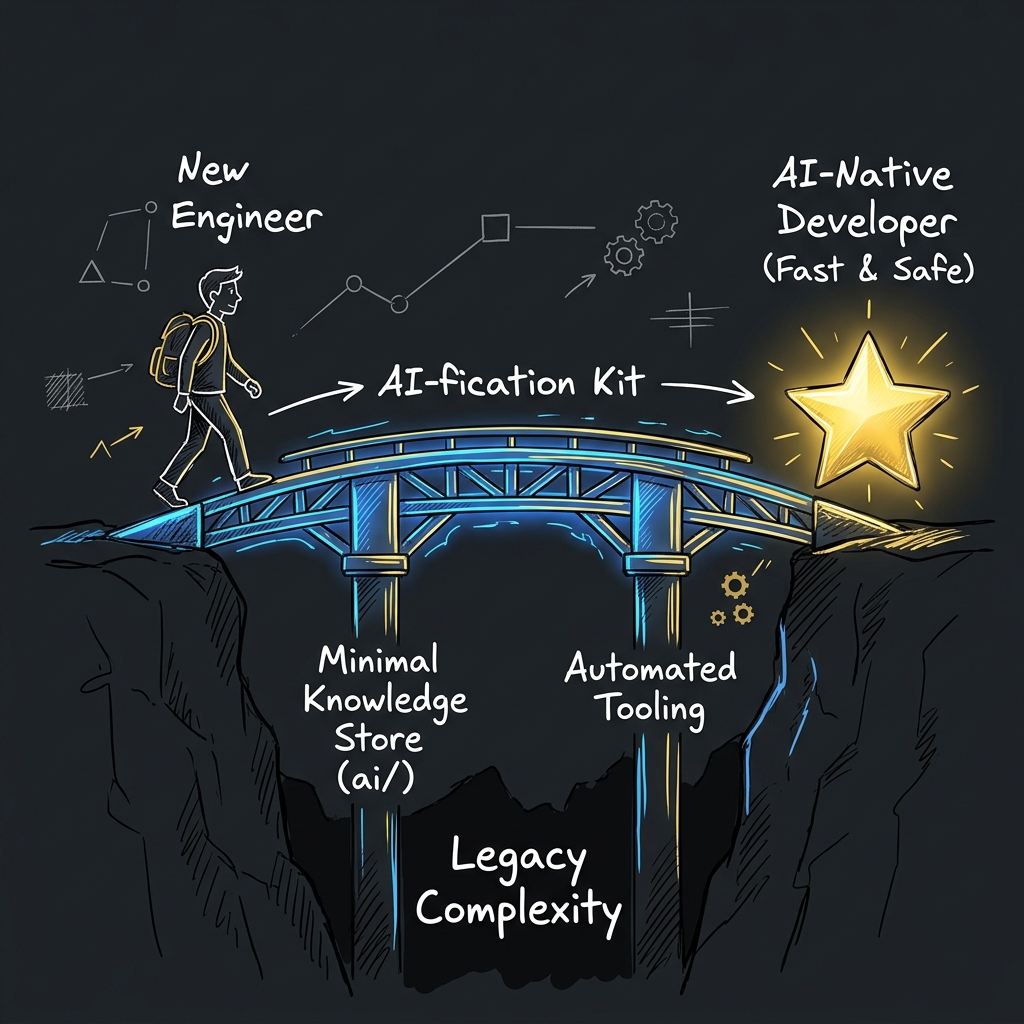
For engineers onboarding onto a complex codebase, the learning curve is historically steep. AI coding agents can accelerate this transition, but they get lost without a reliable map. This kit acts as a bridge: combining a minimal knowledge store (the ai/ folder) with automated tooling to help developers and AI agents collaborate safely. It is designed to help engineers adapt and become AI-native very fast.
Running this kit delivers two outcomes at once:
1. It makes your codebase AI-native. Agents stop guessing. They read a compact, provenance-tracked map instead of re-crawling the tree every session, so they edit the right module and respect what's off-limits.
2. It produces AI-Powered Repo Intelligence. When you run /cold-start, the agent gathers everything it can learn about the repository — module responsibilities, architecture, feature touch-points, conventions, diagrams — and writes it into the ai/ folder. A human then approves it (the [inferred] → [verified] flip). At that point ai/ is no longer scaffolding: it is a verified knowledge-base, a single trustworthy source of truth about the repo that both humans and agents can rely on.
Once the knowledge-base is verified, the payoff isn't limited to AI agents — it's for people too.
Historically, a new engineer joining a complex or legacy codebase spends days (sometimes weeks) reverse-engineering it: which module does what, what's safe to touch, where a feature actually lives, why a decision was made. That tribal knowledge usually lives in a few people's heads.
With a verified ai/ knowledge-base in place, a new teammate can onboard almost instantly:
- They read
ai/guide/MODULE_MAP.mdto see, at a glance, every module, its responsibility, and whether it'sfrozen/stable/ours. - They follow
PROJECT_OVERVIEW.md,ARCHITECTURE.md, andFEATURE_MAP.mdfor the why and the where. - They (or their AI agent) can ask questions against the knowledge-base and trust the answers, because a human signed off on every
[verified]claim.
The same human-verified map that keeps AI agents honest becomes the fastest onboarding doc your team has ever had — and because the verify step keeps it mechanically honest, it stays accurate as the code evolves.
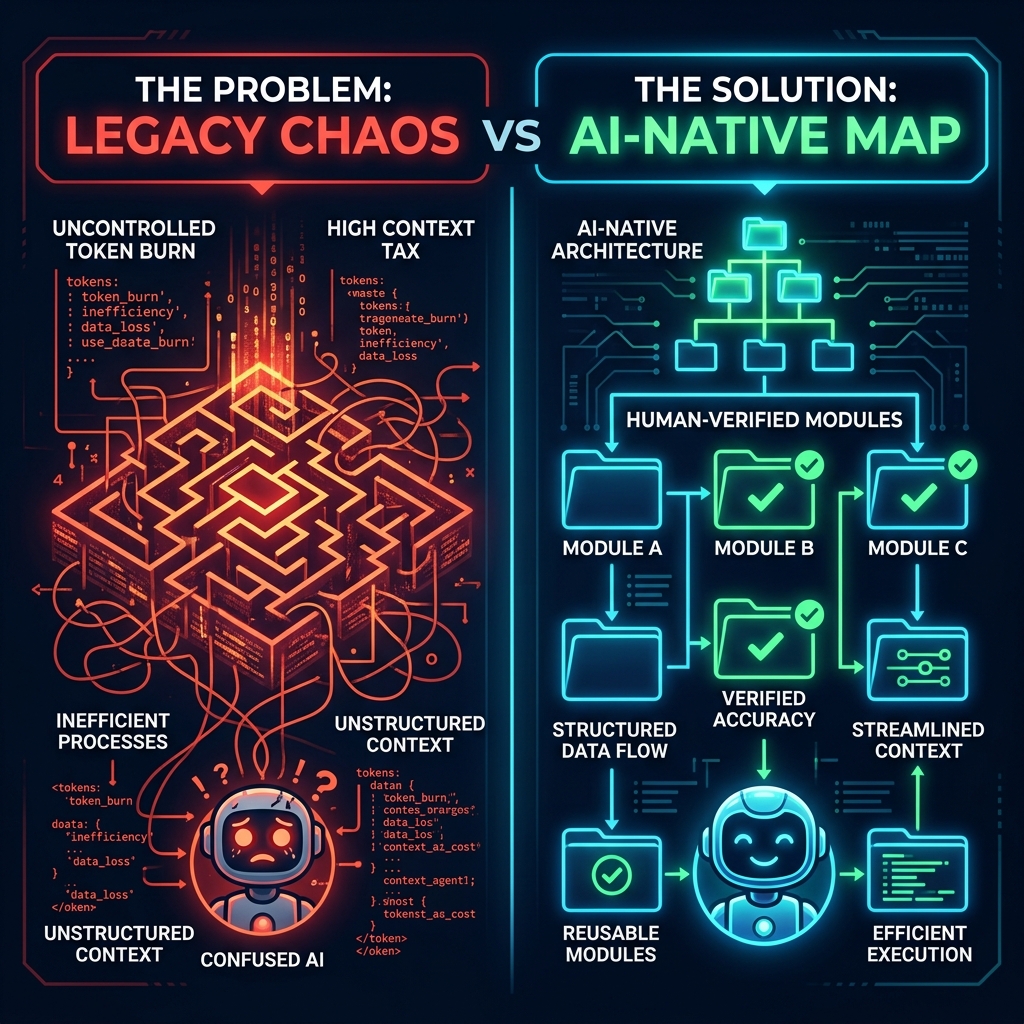
AI coding agents (such as Claude Code, Cursor, Copilot) are highly capable, but they are context-blind on large or legacy repositories.
- Token Burn: They re-read the directory tree every session.
- Guesswork: They guess which files are safe to modify, burning through your context windows.
- Dangerous Hallucinations: An agent-hallucinated map is worse than no map: the agent will confidently edit the wrong module.
The answer isn't to rewrite your code. It's to give the agent a provenance-tracked map where every claim must be validated by you:
[inferred]➔ Scaffolds and maps drafted by the AI agent or installer.[verified]➔ Human-checked and confirmed repository facts.- 🚫 Strict Security: AI agents are forbidden from marking their own drafts as
[verified]. The flip is your signature.
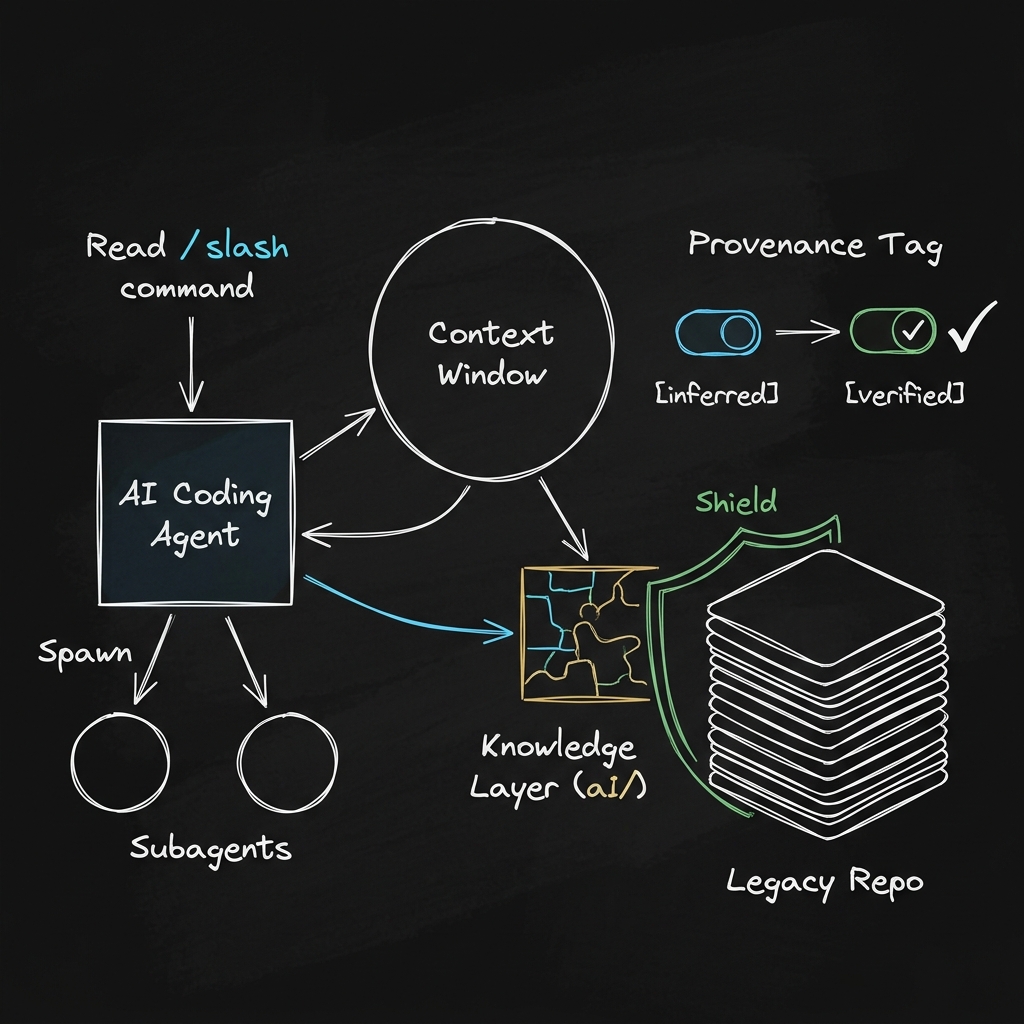
If slash commands and "context windows" are new to you, here is a quick terminology orientation:
🤖 AI Coding Agent An autonomous assistant (like Claude Code, Cursor, or Copilot) that goes beyond simple autocomplete. It can read files, execute terminal commands, and perform edits across your codebase.
💻 Claude Code
Anthropic's command-line coding agent. In the Claude Code interface, commands are prefixed with a slash (like /cold-start or /add-feature).
🧠 Context Window & Tokens
The active working memory of an AI agent. Because large codebases easily overwhelm this memory, this kit builds a compact ai/ directory map so the agent reads key maps instead of crawling the entire project.
🏷️ Provenance Tagging The trust boundaries of the repository:
[inferred]: Scaffolding and drafts generated automatically by the AI agent.[verified]: Human-checked, finalized files. AI agents are structurally restricted from modifying verified code.
👥 Subagents
Helper assistant processes (repo-explorer, feature-builder, test-runner) spawned by the main agent to perform specific, isolated tasks.
The knowledge layer is tool-agnostic — every agent reads the same AGENTS.md rules and ai/ maps — and the workflow automation is now native in more tools than Claude Code:
- GitHub Copilot — one install stamps
.github/copilot-instructions.md, native prompt files for every workflow command (/cold-start,/add-feature, …), and chat modes mirroring therepo-explorer/feature-builder/test-runnersubagents. - Google Antigravity — the same commands as native workflows in
.agents/workflows/, plus theadd-featureskill in the shared Agent Skills (SKILL.md) format. - Cursor, Codex, Windsurf — read
AGENTS.mdnatively; drive the workflow by hand, e.g. paste the contents of.claude/commands/cold-start.mdas a prompt to run the cold-start pass.
See docs/MULTI-TOOL-SETUP.md for the full per-tool guide.
⚖️ Click to Expand: How This Toolkit Differs
While other tools scaffold files or evaluate repositories, this kit focuses on trust through provenance, with the human as the authority:
| Design Pillar | How We Implement It |
|---|---|
| Deterministic Scan vs. Model Inference | A strict separation between deterministic environment checks (orient) and model generation (/cold-start). |
| Provenance Tracking | The strict [inferred] ➔ [verified] progression ensures you always know what has been human-checked. |
| Fork-Aware Stability | Classified stability markers (frozen / stable / ours / ?) prevent the agent from touching upstream or legacy modules. |
| Active Verification | The verify command deterministically cross-checks every file-path claim in the knowledge docs against the source tree (manifest + report, no LLM); agent workflows then cover the semantic checks a script cannot judge. |
| Drift Detection | The drift command catches the reverse problem as code evolves — directories the map no longer covers, entries that have vanished, and (with --git) [verified] rows whose code changed — so the map ages with the repo instead of silently rotting. |
| Dual-Mode Installation | Automatic detection of legacy vs. modern repos. Process 2 preserves prior knowledge through timestamped backups and feeds it into /cold-start as seed intelligence — no user work is lost. |
| Incremental Re-Runs (child-lock) | Re-running install/shazam is safe by construction: a hash-verified three-way compare brings in new kit assets, refreshes untouched kit files, and keeps anything you edited. Files carrying a human [verified] tag are never overwritten — even with --force. |
The full trust model and workflow rationale, in depth: docs/METHODOLOGY.md.
🔒 Click to Expand: Security & Trust Guarantees
We designed the installer to be lightweight and safe:
- 🪶 Zero Dependencies – Node stdlib / Python stdlib only. No external npm packages.
- 🔒 No Network or Execution – It only copies and stamps text files. No remote API calls or arbitrary code runs.
- 🛡️ Safe Scoping – It only writes files inside your target directory.
- 🔍 Dry-Run Support – Run with
--dry-runto see exactly what files will be created before writing anything. - 🧹 Clean Removal – The installer writes
ai/install-manifest.json. Theuninstallcommand reads it to remove exactly what was written, leaving no trace. - 🔁 Safe Re-Runs & Upgrades – The manifest records a SHA-256 hash for every stamped file. Re-running the installer keeps your edits, and a file carrying a human
[verified]tag is never overwritten — even with--force. The only way through that child-lock is the explicit--force-verifiedflag, which quotes exactly what would be lost and requires typed consent (backups are still taken).
For more details, read both installers or refer to SECURITY.md.
See CONTRIBUTING.md for guidelines. Issues, example repos, and template improvements are the most helpful contributions right now. The project is pre-v1.0 and maintained by a single author — feedback from running the kit on real legacy repositories is especially valuable.
If you use this kit in academic or research work, please cite it:
@software{suri2026aificationkit,
  author    = {Suri, Kunal},
  title     = {ai-fication-kit: a methodology for making legacy codebases AI-native and trustworthy through scaffolded, human-verified context},
  year      = {2026},
  url       = {https://github.com/kunalsuri/ai-fication-kit},
  doi       = {10.5281/zenodo.20860637},
  version   = {0.1.0},
  license   = {Apache-2.0}
}
See CITATION.cff for the machine-readable format.
This project is licensed under the Apache License 2.0.
Ongoing R&D work at CEA LIST, France.
Author: Kunal Suri (@kunalsuri)