


Welcome to Ikanos, the first Open Source project for Spec-Driven Integration — reinventing API integration for the AI era with governed, versatile capabilities that streamline the API sprawl created by massive SaaS and microservices growth.
Ikanos comes from the Greek ικανός — capable.
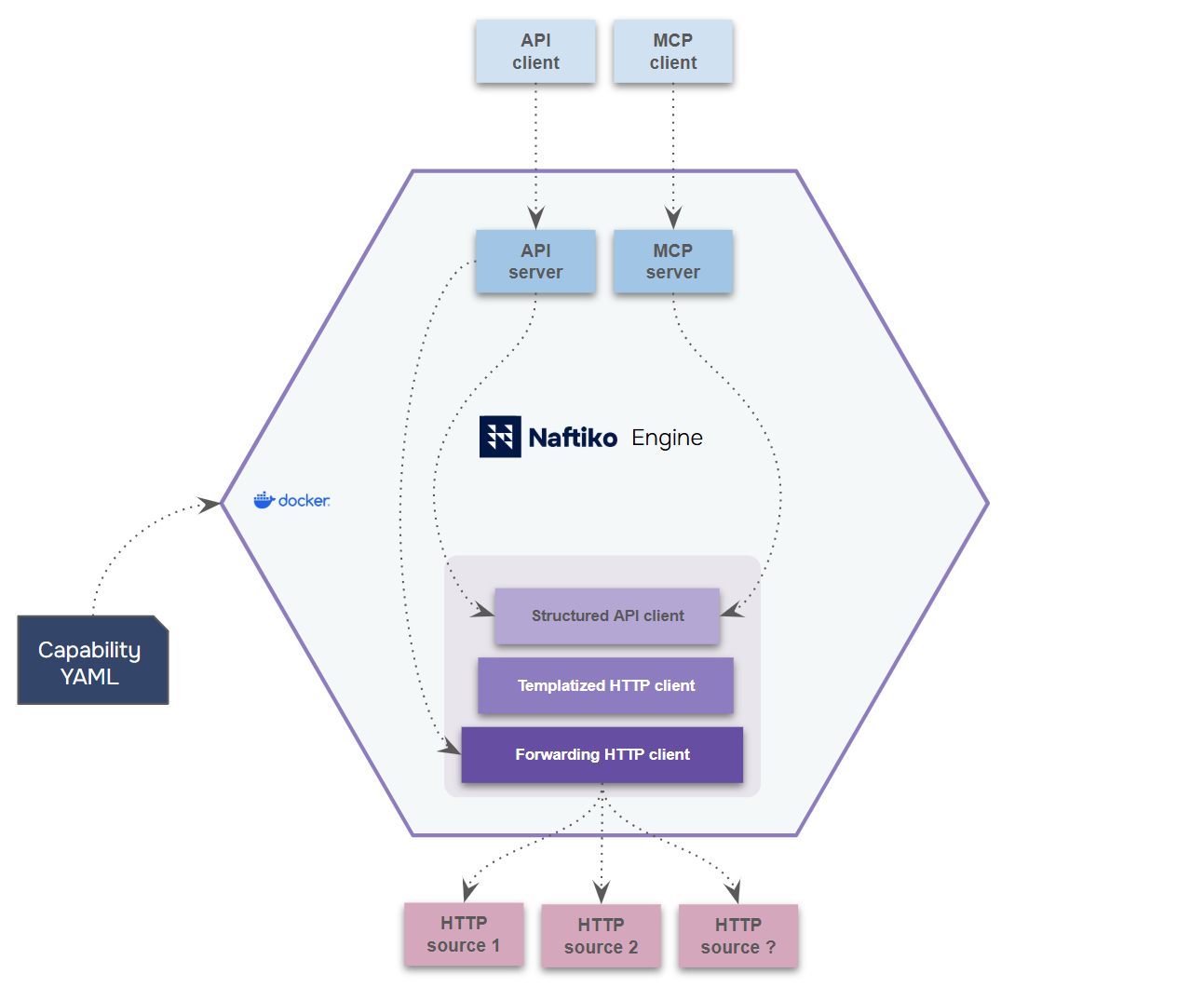
Ikanos is a capability engine that reads an Ikanos YAML specification at startup and immediately serves it as a multi-protocol server — MCP, Skill, REST, and Control — with no code generation and no compilation step. The spec is the artifact and the runtime contract.
Each capability is a coarse-grained slice of a domain. It consumes existing HTTP-based APIs, optionally orchestrates and transforms the data, then exposes the result in several protocols so that AI agents, web apps, and partners can all consume it the same way. The project ships as three pieces:
In production, one Ikanos process serves one capability as a Docker container. Multiple capabilities running in the same Kubernetes cluster constitute a ship while larger organizations operate a fleet federating several ships. This is where Naftiko Fleet can help you scale Ikanos from development to governance.
- Not a code generator. Tooling can scaffold the YAML spec for you, and Ikanos can export artifacts from it — such as OpenAPI contracts — but the running capability never compiles or executes generated source. At runtime it does one thing: interpret the YAML spec directly. The spec is the deliverable — and because that deliverable is plain, declarative YAML rather than generated code, it's especially well-suited to Generative AI: an LLM can author, edit, and reason about a capability end to end, with no build step in the loop.
- Not a service mesh A classic mesh wraps every pod in a sidecar (or an ambient data plane) to add resiliency, transport security, and traffic control underneath your services. Ikanos builds those same concerns into the capability engine itself such as retries, timeouts, circuit breaking, and rate limiting today, mTLS verification on both sides and traffic controls like load-based routing planned next. When your traffic is Ikanos capabilities talking to Ikanos capabilities, there's no sidecar to inject and no mesh to operate — the engine is the data plane.
- Not a workflow engine. Ikanos already orchestrates multi-step capabilities; as it grows to cover Agent Orchestration in v1.0+, it adds long-running workflows, durable agent memory, and checkpoints natively — without the bespoke DSLs, BPMN diagrams, or separate runtime of a classic workflow engine. Orchestration stays inside the capability contract and is consumable by AI agents the moment it's declared.
| Feature | Description |
|---|---|
| Spec-Driven Integration | Declare capabilities entirely in YAML — no Java required |
| Multi-Protocol Servers | Expose capabilities via MCP, Skill, REST, or Control out of the box |
| Data Format Conversion | Transform Protobuf, XML, YAML, CSV, TSV, PSV, Avro, HTML, and Markdown payloads into JSON |
| HTTP API Consumption | Connect to any HTTP-based API with built-in authentication support |
| Templating & Querying | Use Mustache templates and JSONPath expressions for flexible data mapping |
| Inline Scripting | Embed sandboxed JavaScript, Python, or Groovy transformations between API calls (GraalVM) |
| Domain-Driven Aggregates | Define reusable domain functions once, expose via multiple adapters — inspired by the DDD Aggregate pattern |
| Server Authentication | Secure exposed endpoints with Bearer, API Key, Basic, Digest, or OAuth 2.1 out of the box |
| AI Native | Designed for Context Engineering and Agent Orchestration, making capabilities directly consumable by AI agents |
| OpenAPI Interoperability | Import Swagger 2.0, OAS 3.0/3.1 into consumes adapters; export REST adapters as OpenAPI documents |
| Control Port | Built-in management plane with health, metrics, traces, and status endpoints |
| Cloud Native Operations | OpenTelemetry tracing & RED metrics, Prometheus scrape, single Docker image for all capabilities |
| Extensible | Open-source core extensible with new protocols and adapters |
Increasingly, developers don't hand-write this integration layer at all — they describe what they want and let generative AI produce the artifact. That shifts the question from "which tool is nicest to code in?" to "which artifact can an AI reliably generate, and can a human still review and govern it?" The answer depends on what each tool asks the AI to emit:
- Agentic coding frameworks — LangChain, LangChain4j, LlamaIndex, Spring AI. The AI has to write tools, retrievers, and orchestration as Python/Java — full application code that must compile, run, and be trusted.
- MCP server frameworks — FastMCP, Spring AI MCP, the official MCP SDKs. The AI writes an MCP server and its tool handlers — again, code to build and maintain.
- MCP proxy generators — Stainless, APIMatic, Speakeasy, Mintlify. No AI authoring here; they mechanically turn one OpenAPI document into a 1:1 SDK or MCP server.
Ikanos asks the AI for something simpler and safer: a declarative YAML capability validated against a stable schema. Generated YAML is easier for a model to get right than framework code, it shows up as a readable diff in a pull request, and it can be linted (with Polychro) before it ever runs — so a human stays in control of what the AI produced. One capability can also consume and compose several upstream APIs (for example, joining a customer, their orders, and their open tickets from three services) and expose the result over MCP, Skill, and REST at once.
Ikanos is also designed to fit alongside these tools rather than replace them: it imports OpenAPI, exposes MCP, and integrates with LangChain4j as in-process tools, so adopting it usually means keeping your runtime and replacing hand-written glue with an AI-authored, reviewable spec.
For a dimension-by-dimension comparison, and guidance on when another tool is a better fit, see the Comparison guide on the Shipyard.
You can run Ikanos with the native CLI or the Docker image. The CLI has the least friction, so start there.
# Create a minimal, valid capability interactively
ikanos create capability

# Validate it against the latest schema
ikanos validate my-capability.yml

# Serve it locally (Ctrl-C to stop)
ikanos serve my-capability.yml
The CLI can also bootstrap a capability from an existing OpenAPI document (ikanos import openapi ...) and export a REST adapter back to OpenAPI (ikanos export openapi ...).
# Pull the image (pin to a release tag, or use latest for the newest snapshot)
docker pull ghcr.io/naftiko/ikanos:latest

# Serve a capability file (mount it at /app/ikanos.yaml — the image serves it by default)
docker run -p 8081:3001 \
  -v "$PWD/my-capability.yml:/app/ikanos.yaml" \
  ghcr.io/naftiko/ikanos:latest
Full installation steps for the CLI, Docker, and every platform are in the Installation guide on the Shipyard.
The complete, always-up-to-date Ikanos documentation lives on the Naftiko Shipyard. Start here and keep exploring:
- 🧭 Concepts — Spec-Driven Integration
- 🚣 Installation
- ⛵ Tutorials — guided tracks from your first capability to platform operations
- 🚢 Use Cases
- ⭐ Features
- 🔍 Linting Guide — pair Ikanos with Polychro
- ⚓ Specification — Schema
- 📐 Specification — Ruleset
- ⌨️ CLI Reference
- 🌊 FAQ
- 📣 Releases
- 🔭 Roadmap
- 🔩 Contribute
Want to see Ikanos in action without installing anything? The upcoming Shipyard Playground lets you author a capability, lint it live with Polychro, and serve it with Ikanos — all from your browser. Keep an eye on the Shipyard for its release.
Ikanos is part of the Naftiko Fleet (Community Edition), which adds free complementary tools:
| Tool | What it does |
|---|---|
| Polychro | Polyglot linter that validates Ikanos capabilities against the schema and ruleset. |
| Crafter | Free Naftiko extension for Visual Studio Code to help with editing and linting Ikanos capabilities. |
| Warden | Naftiko custom templates for CNCF's Backstage to help with scaffolding and cataloguing Ikanos capabilities. |
| Skipper | Operator and Helm chart for CNCF's Kubernetes to help with the operations of Ikanos capabilities. |
Please join the community of users and contributors in this GitHub Discussion forum!