SAMMOO: System Advisor Model Multi-Objective Optimization
Python-based Framework for Multi-Objective Optimization of Renewable Energy Systems using NREL's System Advisor Model (SAM)
Optimization of Solar Industrial Process Heat (SIPH) systems using Concentrated Solar Power (CSP) technologies through the NREL PySAM package (System Advisor Model). This project was developed in the context of my Master's Thesis in Research in Industrial Technologies at the Universidad Nacional de Educación a Distancia (UNED), Spain.

This Python package integrates:
- System Advisor Model (SAM) via NREL PySAM for the simulation of parabolic trough systems.
- ParMOO for multi-objective optimization using surrogate models.
It allows you to:
- Run parametric studies on industrial CSP systems.
- Optimize system configurations with multiple economic and technical objectives.
- Analyze Pareto fronts and export results.
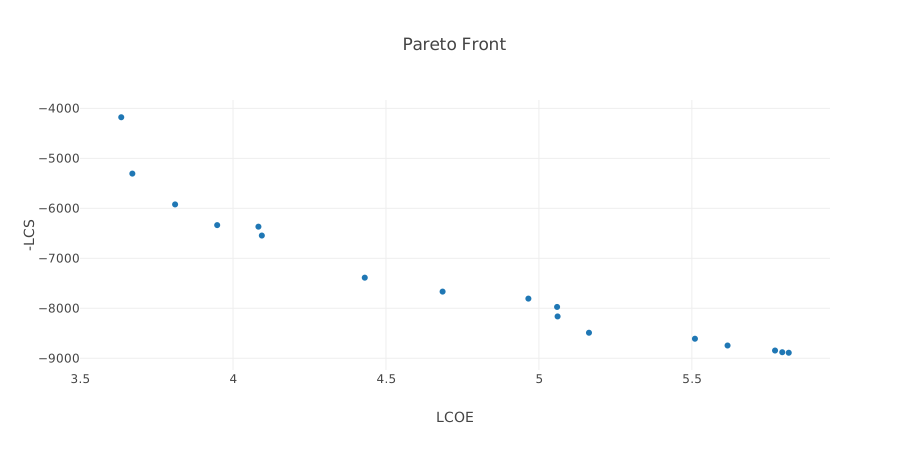
- Modular simulation wrapper (
ConfigSelection) for different SAM configurations. - Integration with PySAM modules:
TroughPhysicalIph,LcoefcrDesign,CashloanHeat, etc. - Multi-objective optimization engine (
ParMOOSim) using ParMOO. - Automatic switching from sequential to batch acquisition.
- Exportable plots and CSV reports.
The ThermalLoadProfileLPG class generates a realistic hourly thermal load profile from monthly LPG consumption (in tonnes), compatible with SAM’s “User-defined thermal load profile” input.
- Working schedule: Monday to Friday, 6:00–19:00
- Outputs hourly thermal demand in kJ/h, kWh, and kW
- Includes:
- Yearly and weekly plotting
- CSV export
- Energy balance summary
from sammoo.profiles.thermal_load_lpg import ThermalLoadProfileLPG

monthly_data = {1: 5000, 2: 4000, ..., 12: 3000}
profile = ThermalLoadProfileLPG(monthly_data)
profile.plot_year()
profile.export_csv("thermal_profile.csv")sammoo/
├── sammoo/ # Core package
│ ├── __init__.py
│ ├── version.py
│ ├── config_selection.py # ConfigSelection class
│ ├── parmoo_simulation.py # ParMOOSim class
│ ├── components/ # New components module (v0.2.0)
│ │ ├── __init__.py
│ │ ├── thermal_load_lpg.py # ThermalLoadProfileLPG class (enhanced)
│ │ ├── weather_design_point.py # Weather-based DNI calculation helper
│ │ └── solar_loop_configuration.py # Solar field / loop setup helpers
│ ├── resources/
│ │ ├── solar_resource/
│ │ │ └── seville_spain.csv # Default weather CSV
│ │ └── collector_data/
│ │ └── iph_collectors_parameters.csv # Industrial Process Heat collectors database
│ └── templates/ # JSON SAM templates
│ ├── __init__.py
│ └── iph_parabolic_commercial_owner/
│ ├── __init__.py
│ └── *.json
├── examples/ # Example usage scripts
│ ├── op1_single_objective_comparison.py
│ ├── opt2_design_point_multiobj.py
│ ├── opt3_multiobj_row_distance.py
│ └── opt4_startup_shutdown.py
├── README.md
├── CHANGELOG.md
├── pyproject.toml
├── MANIFEST.in
├── LICENSE
The examples/ folder contains several usage scenarios of the sammoo package:
opt1_single_objective_comparison.py: Compare optimal designs for different single-objective formulations (e.g., LCOE, Payback, LCS, NPV).opt2_design_point_multiobj.py: Multi-objective optimization at a fixed design point (e.g., SM and storage hours), optionally applying a thermal load profile.opt3_multiobj_row_distance.py: Multi-objective optimization of solar field row spacing (Row_Distance) using ParMOO.opt4_startup_shutdown.py: Optimization focusing on startup/shutdown temperatures and their impact on techno-economic performance.
💡 Note: Example scripts (examples/) are not included in the PyPI installation.
If you want to explore the examples, please clone the GitHub repository.
pip install sammooYou can now use the package in Python:
from sammoo import ConfigSelection, ParMOOSim💡 Note: Example scripts (
examples/) are not included in the PyPI installation.
If you want to explore examples, clone the GitHub repository instead:
git clone https://github.com/ppadillaq/sammoo.git
cd sammoo
python examples/single_objective_comparison.pyIf you want to work with the source code:
git clone https://github.com/ppadillaq/sammoo.git
cd sammoo
pip install -e .python examples/opt1_single_objective_comparison.py- Python ≥ 3.10
- NREL PySAM
- ParMOO
- NumPy
- Matplotlib (for plotting)
Install them via:
pip install pysam parmoo numpy matplotlib
# Minimal example: multi-objective optimization with a thermal load profile

from sammoo import ConfigSelection, ParMOOSim
from sammoo.components import ThermalLoadProfileLPG

# 1) (Optional) Generate an hourly thermal load profile from monthly LPG consumption (kg)
monthly_kg = {1: 11000, 2: 9000, 3: 8000, 4: 9500, 5: 9200, 6: 9800,
              7: 8600, 8: 8700, 9: 9000, 10: 9400, 11: 8800, 12: 9600}
profile = ThermalLoadProfileLPG(monthly_kg=monthly_kg)  # uses default efficiency and PCI

# 2) Define the design space (use "continuous" / "integer")
design_vars = {
    "specified_solar_multiple": ([1.0, 3.0], "continuous"),
    "tshours": ([2, 8], "integer"),
}

# 3) Define objectives (minimize LCOE, maximize LCS)
selected_outputs = ["LCOE", "-LCS"]

# 4) Create the SAM configuration (optionally set collector/HTF)
cfg = ConfigSelection(
    config="Commercial owner",
    selected_outputs=selected_outputs,
    design_variables=design_vars,
    collector_name="Power Trough 250",   # optional
    htf_name="Therminol VP-1",           # optional
    verbose=0
)

# Apply the demand profile → sets timestep_load_abs and sizes q_pb_design
profile.apply_to_config(cfg)

# 5) Run the optimization (increase search_budget and sim_max for better results)
opt = ParMOOSim(cfg, search_budget=20, auto_switch=True)
opt.solve_all(sim_max=50)

# 6) Display results
print(opt.get_results())The simulation requires a weather file (file_name) in CSV format. You can:
- ✅ Provide your own via
user_weather_file="path/to/weather.csv" - 🔁 Or let the framework use a built-in default (Tucson, AZ)
Your custom weather files must follow the TMY3 format used by SAM.
Version 0.3.0 of this project was used in the development of the following master's thesis in the Master's programme in Research in Industrial Technologies (Energy Engineering track), UNED (Spain):
- Padilla-Quesada, P. (2025). Sammoo: Un marco de optimización multiobjetivo basada en simulaciones para el diseño de sistemas solares térmicos de calor de proceso industrial [Trabajo Fin de Máster, Universidad Nacional de Educación a Distancia (UNED)]. https://hdl.handle.net/20.500.14468/31636
Future versions may include broader support for other CSP technologies, reinforcement learning-based controllers, and integration with digital twin platforms.
This project is licensed under the BSD 3-Clause License.
See the LICENSE file for full text.
Pedro Padilla Quesada
MSc in Research in Industrial Technologies
UNED, Spain