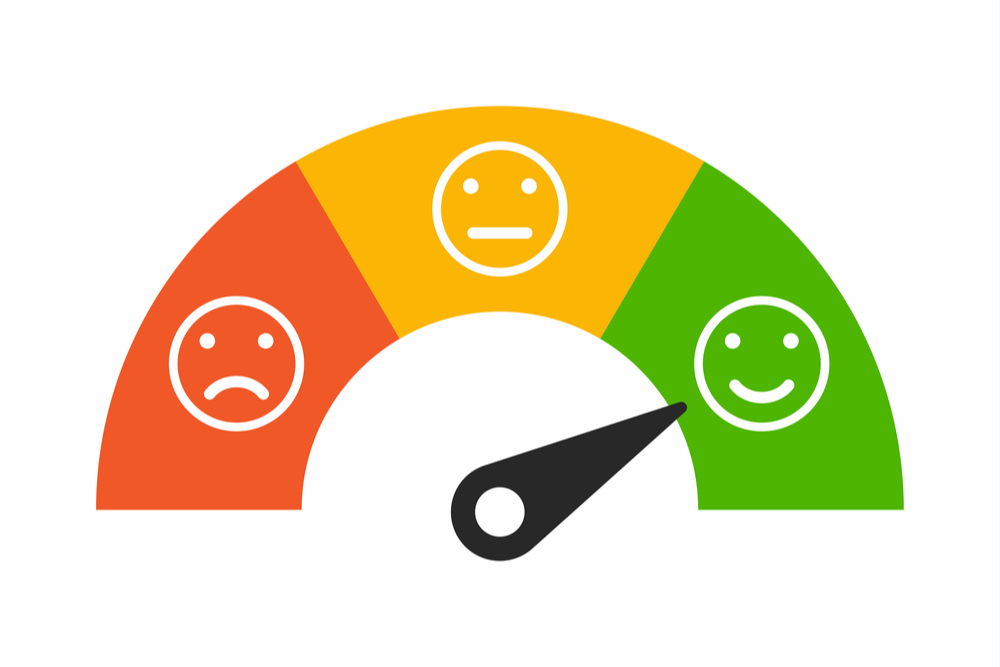
Sentiment analysis refers to the use of natural language processing, text analysis, computational linguistics, and biometrics to systematically identify, extract, quantify, and study affective states and subjective information.
Sentiment analysis helps data analysts within large enterprises gauge public opinion, conduct nuanced market research, monitor brand and product reputation, and understand customer experiences.
In addition, data analytics companies often integrate third-party sentiment analysis APIs into their own customer experience management, social media monitoring, or workforce analytics platform, in order to deliver useful insights to their own customers.
Basic sentiment analysis of text documents follows a straightforward process:
Break each text document down into its component parts (sentences, phrases, tokens and parts of speech) Identify each sentiment-bearing phrase and component Assign a sentiment score to each phrase and component (-1 to +1) Optional: Combine scores for multi-layered sentiment analysis As you’ll see, the underlying technology is very complicated. But for a simple explanation of sentiment analysis, consider these sentences:
Terrible pitching and awful hitting led to another crushing loss. Bad pitching and mediocre hitting cost us another close game. Both sentences discuss a similar subject, the loss of a baseball game. But you, the human reading them, can clearly see that first sentence’s tone is much more negative.
Your brain figures this out by looking for and interpreting sentiment-bearing phrases – that is, words and phrases that carry a tone or opinion. These usually appear as adjective-noun combinations. In the examples above, the sentiment-bearing phrases are:
Terrible pitching | awful hitting | crushing loss
Bad pitching | mediocre hitting | close game
You have encountered words like these many thousands of times over your lifetime across a range of contexts. And from these experiences, you’ve learned to understand the strength of each adjective, receiving input and feedback along the way from teachers and peers.
When you read the sentences above, your brain draws on your accumulated knowledge to identify each sentiment-bearing phrase and interpret their negativity or positivity. Usually this happens subconsciously. For example, you instinctively know that a game that ends in a “crushing loss” has a higher score differential than the “close game”, because you understand that “crushing” is a stronger adjective than “close”.