




Your thinking starts in Claude Desktop, not in Obsidian. You research, draft, argue with the model, and when something's worth keeping you say "save this to my vault." It lands in the right place: your template, your properties, today's daily note, wired into your link graph. No tab-switch, no copy-paste.
Installing this? Start at Install. One prompt in Claude Code handles the whole setup.
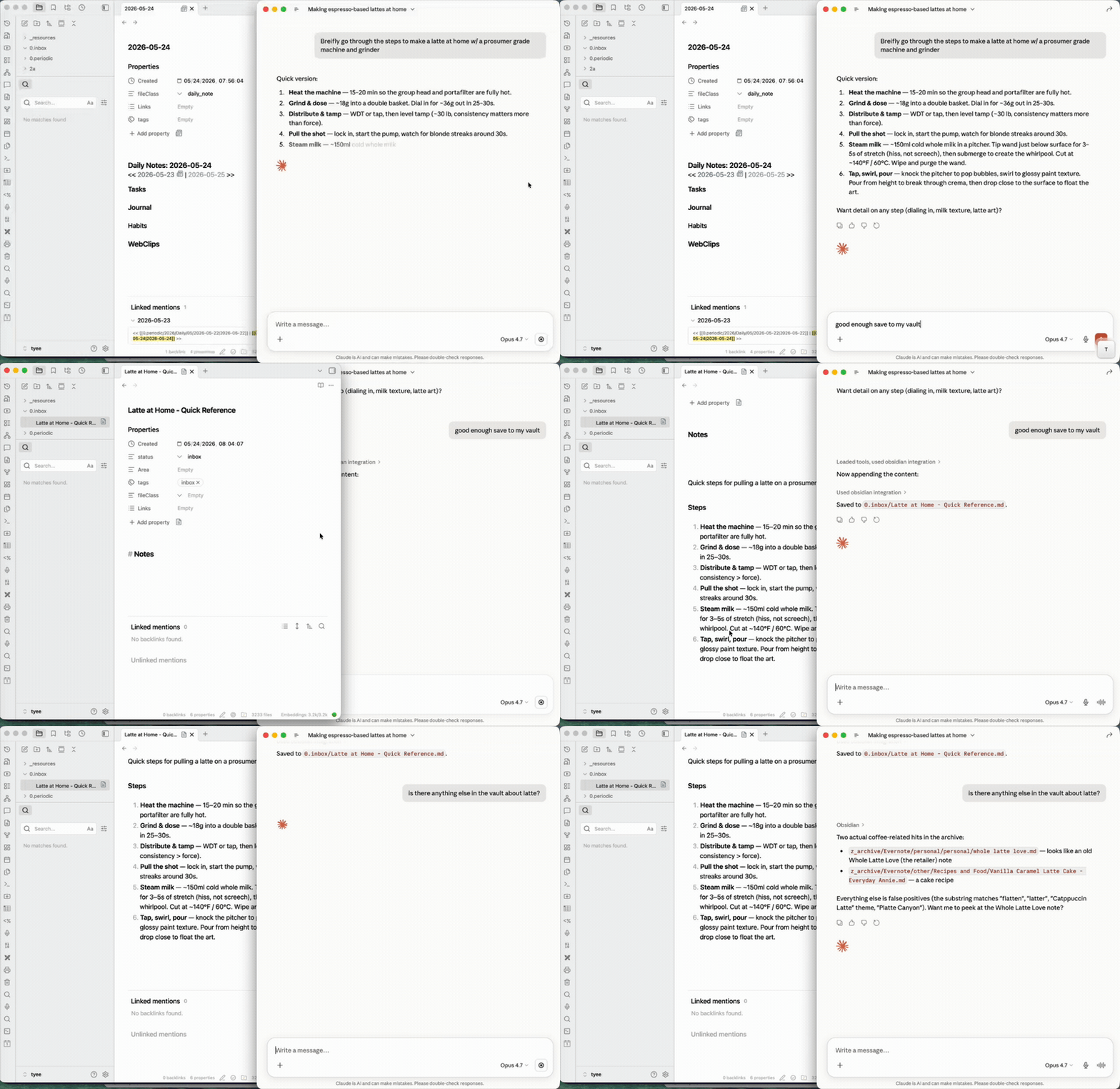
Two halves:
- Capture — turn a conversation into a real note, filed where it belongs.
- Augment — pull what's already in the vault (backlinks, full-text search) back into the chat to inform or update a note.
Needs Obsidian running. It can sit minimized, so you never switch to it.
Using this from Claude Code? The native obsidian-cli skill fits better there: direct CLI, no MCP layer. Installing is separate. The prompt below runs in Claude Code.
Run the prompt below in Claude Code. It checks Node, enables the Obsidian CLI, writes your Claude Desktop config, and verifies the connection. Only hand-edit the config if that path fails.
Fetch https://raw.githubusercontent.com/stonematt/mcp-obsidian-cli/master/docs/INSTALL.md
and follow it end to end to install the mcp-obsidian-cli MCP server for my Claude Desktop.
Ask me for my Obsidian vault name and folder path, then handle everything else — check Node,
enable the Obsidian CLI, edit my Claude Desktop config, and verify it works.
Full walkthrough, including failure modes: docs/INSTALL.md.
Run the server directly. This starts the server in your terminal and installs nothing:
npx mcp-obsidian-cliThe install prompt checks each of these. Listed here for reference:
- Obsidian running with its command line interface enabled (Settings → General → Advanced → Command line interface). The CLI ships built into Obsidian — nothing extra to install.
obsidian-clireachable. macOS auto-detects it inside the Obsidian app bundle, so there is nothing to configure. Linux and Windows have no auto-detection: pointOBSIDIAN_CLI_PATHat the binary yourself.- Node.js >= 18
The server exposes Obsidian CLI commands as MCP tools. A generic pass-through tool handles the full CLI surface (80+ commands), plus typed convenience tools for common operations:
| Tool | Description |
|---|---|
obsidian |
Generic pass-through — run any CLI command (ships intent→verb cheatsheet, pre-call manifest validation, reload detection) |
obsidian_help |
Manifest-backed help — list verbs by category, or look up a single verb / doc topic |
obsidian_daily_read |
Read today's daily note |
obsidian_daily_append |
Append to daily note |
obsidian_read |
Read a note by name or path |
obsidian_search |
Full-text search with context |
obsidian_tags |
List tags with counts |
obsidian_tasks |
Query tasks (daily, todo, done) |
obsidian_properties |
Read frontmatter properties |
obsidian_create |
Create a new plain note (no Templater expansion) |
obsidian_create_from_template |
Create a note from a Templater template (expands <% ... %> placeholders) |
obsidian_property_set |
Set a frontmatter property |
obsidian_backlinks |
List backlinks to a note |
obsidian_files |
List vault files |
obsidian_recents |
Recently opened files |
The generic obsidian tool means the MCP server never falls behind the CLI — new CLI commands work immediately without a server update.
It talks to the running Obsidian instance, so it works with your vault the way Obsidian sees it:
- Backlinks and full-text search across your resolved link graph and search index (the augment half).
- Templater templates and typed frontmatter properties when creating or updating notes.
- Daily notes, task queries, and tag counts.
- 80+ commands through the generic pass-through. No API keys, no REST plugin. Just the official Obsidian CLI.
Manual config (if you're not using Claude Code)
Automated installers should use the prompt under Install, which handles vault name, CLI path, and verification. This block is the hand-edit fallback.
Add to ~/Library/Application Support/Claude/claude_desktop_config.json:
{
  "mcpServers": {
    "obsidian": {
      "command": "npx",
      "args": ["-y", "mcp-obsidian-cli"],
      "env": {
        "OBSIDIAN_VAULT": "my-vault"
      }
    }
  }
}| Variable | Default | Description |
|---|---|---|
OBSIDIAN_VAULT |
(none) | Target vault by name |
OBSIDIAN_CLI_PATH |
obsidian-cli |
Path to CLI binary |
OBSIDIAN_TIMEOUT_MS |
15000 |
Command timeout |
XDG_CONFIG_HOME |
~/.config |
Base path for config file |
The server can read settings from a YAML config file:
- Default:
~/.config/mcp-obsidian-cli/config.yaml - With
XDG_CONFIG_HOME:$XDG_CONFIG_HOME/mcp-obsidian-cli/config.yaml
Config file format:
vault: "my-vault"
cliPath: "obsidian-cli"
timeoutMs: 15000
Config precedence: env vars > config file > hardcoded defaults
File an issue: https://github.com/stonematt/mcp-obsidian-cli/issues/new/choose. Bug template asks for version, MCP client, tool call, and response — quick to fill, fast to act on.
MIT

Maintained by @stonematt Licensed under the MIT License
Trademark Notice: "Obsidian" is a trademark of Obsidian Publishing, Inc. This project is not affiliated with or endorsed by Obsidian Publishing.